

Meditation is one of those words that can mean very different things to different people. In many Western spiritual traditions, the word immediately brings to mind images of silence, candles, and emptying the mind. But for the Christian believer, meditation carries a far deeper and richer meaning — one that is anchored not in the absence of thought, but in the very fullness of God’s Word. Biblical meditation is not about clearing your mind. It is about filling it with the truth, promises, and wisdom of Scripture.
Throughout the Bible, God calls His people to meditate — not as an optional spiritual exercise, but as a fundamental discipline of the faithful life. From the Psalms to the New Testament letters, believers are invited to slow down, to dwell deeply in the Word, and to let God’s truth reshape how they think, feel, and live. This article explores what the Bible actually says about meditation, why it matters for everyday Christian living, and how to use specific Scripture passages as anchors for your own quiet time with God.
A Christian Perspective on Meditation
Before we dive into specific Bible verses about meditation, it helps to understand what biblical meditation actually is — and what it is not. Many people associate meditation with Eastern religious practices, where the goal is often to empty the mind, achieve inner stillness, or detach from conscious thought. Christian meditation moves in the opposite direction entirely. Rather than emptying the mind, it fills the mind. Rather than detaching from truth, it roots itself deeply in it.
The Hebrew word most commonly used for meditation in the Old Testament is hagah, which means to mutter, to moan quietly, to speak in a low voice. In ancient Jewish culture, people would literally read Scripture aloud under their breath, speaking the words softly as a way of internalizing them. Another Hebrew word, siyach, carries the meaning of pondering or reflecting — turning something over in the mind the way a farmer turns soil to prepare it for planting. These words give us a beautiful picture of what God intended when He called His people to meditate on His Word.
Christian meditation, at its core, is the practice of deliberately dwelling on God’s Word so that it moves from the page into the heart. It is reading slowly, sitting with a verse, asking what it means, and allowing it to speak to your current circumstances. It is talking to God about what you are reading and inviting Him to make His truth real in your life. Far from being a passive or mystical exercise, biblical meditation is an active, intentional, and deeply personal engagement with the living Word of God.
This kind of meditation also has profound effects on the mind and heart. When we consistently dwell on Scripture, we begin to see our circumstances differently. Worry shrinks in the presence of God’s promises. Fear loses its grip when replaced by faith-filled truth. Hopelessness gives way to the certainty that God is working in all things. The discipline of meditating on God’s Word is not just spiritually beneficial — it is spiritually transforming.
Bible Verses About Meditation
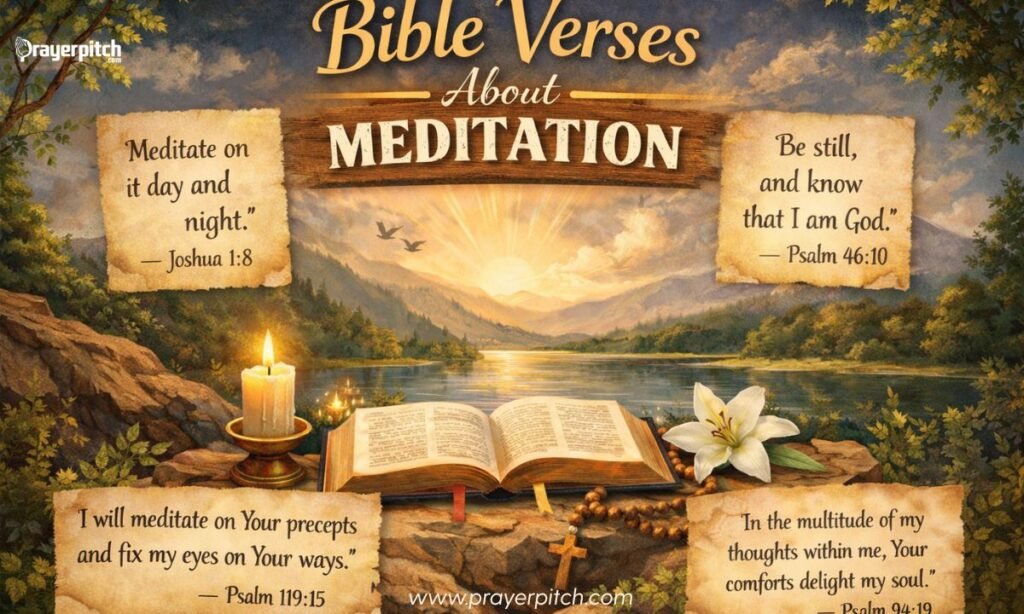
The practice of meditation is woven throughout the fabric of Scripture. God does not simply suggest that His people meditate — He commands it, models it through the lives of His servants, and promises blessing to those who commit to it. Here are some of the most powerful and foundational Bible verses about meditation:
• Joshua 1:8 — “Keep this Book of the Law always on your lips; meditate on it day and night, so that you may be careful to do everything written in it. Then you will be prosperous and successful.” — Here God gives Joshua, the new leader of Israel, one foundational instruction above all else: meditate on the Word. The connection between meditation and obedience is explicit. As we dwell on Scripture, we grow in our understanding of how to live it out.
• Psalm 1:1-2 — “Blessed is the one who does not walk in step with the wicked or stand in the way that sinners take or sit in the company of mockers, but whose delight is in the law of the Lord, and who meditates on his law day and night.” — The very first psalm of the entire Psalter opens with a picture of the blessed person — someone who delights in God’s Word so much that they return to it continually throughout their day.
• Psalm 19:14 — “May these words of my mouth and this meditation of my heart be pleasing in your sight, Lord, my Rock and my Redeemer.” — David offers his meditation itself as an act of worship. This verse reminds us that meditation is not just a mental discipline but a spiritual offering presented to God.
• Psalm 48:9 — “Within your temple, O God, we meditate on your unfailing love.” — The place of worship is also a place of meditation. This verse shows us that communal reflection on God’s character, particularly His steadfast love, is part of what it means to gather as His people.
• Psalm 77:12 — “I will consider all your works and meditate on all your mighty deeds.” — The Psalmist Asaph is in great distress in this passage, yet he deliberately turns his mind to what God has done. Meditation on God’s past faithfulness becomes the anchor for present-day trust.
• Psalm 119:15 — “I meditate on your precepts and consider your ways.” — This verse, from the longest chapter in the Bible, reveals the personal nature of meditation. It is not a distant or academic exercise — it is an intimate reflection on the ways and instructions of a God who is personally known.
• Psalm 119:97 — “Oh, how I love your law! I meditate on it all day long.” — Love and meditation are connected here. When we truly love someone, we think about them often. The Psalmist’s constant meditation on God’s Word flows naturally from a deep love for the One who wrote it.
• Psalm 143:5 — “I remember the days of long ago; I meditate on all your works and consider what your hands have done.” — David, in the middle of a desperate cry for help, grounds himself by deliberately remembering and meditating on God’s past works. Meditation on God’s faithfulness in history becomes fuel for faith in the present.
• Philippians 4:8 — “Finally, brothers and sisters, whatever is true, whatever is noble, whatever is right, whatever is pure, whatever is lovely, whatever is admirable — if anything is excellent or praiseworthy — think about such things.” — The New Testament’s clearest call to intentional mental focus, this verse from Paul gives us a filter for meditation. When we choose to direct our thoughts toward what is true and praiseworthy, we are practicing a form of Christian meditation.
• Colossians 3:2 — “Set your minds on things above, not on earthly things.” — Paul’s command to set the mind is not passive. It is a deliberate act of the will — choosing to direct thought and attention toward God and His Kingdom rather than being swept along by the anxieties and distractions of the world.
• 1 Timothy 4:15 — “Be diligent in these matters; give yourself wholly to them, so that everyone may see your progress.” — Writing to young Timothy, Paul uses a word for meditation that carries the idea of practicing or rehearsing. Just as a musician practices scales or an athlete rehearses movements, the believer is called to give themselves wholly to spiritual reflection and growth.
Bible Verses to Use in Meditation
Knowing that we should meditate on Scripture is one thing. Knowing where to begin is another. Many believers struggle to know which passages to sit with, especially in seasons of life when the heart is heavy or the mind is overwhelmed. The following sections offer specific Scripture passages organized around three common experiences: worry, pain, and the need for hope. These are not just verses to read — they are verses to sit with, to pray through, and to let soak into your spirit.
Scriptures for Meditation When You Are Worried
Worry is one of the most universal human experiences, and the Bible speaks to it with both compassion and clarity. These verses are not platitudes — they are anchors. When anxiety rises and the mind spins, these are passages worth memorizing, writing out, and returning to again and again in meditation:
• Matthew 6:25-26 — “Therefore I tell you, do not worry about your life, what you will eat or drink; or about your body, what you will wear. Is not life more than food, and the body more than clothes? Look at the birds of the air; they do not sow or reap or store away in barns, and yet your heavenly Father feeds them. Are you not much more valuable than they?” — Jesus Himself addresses worry directly, pointing to the natural world as evidence of God’s constant provision. Meditating on this passage means allowing your eyes to move from your problem to your Provider.
• Philippians 4:6-7 — “Do not be anxious about anything, but in every situation, by prayer and petition, with thanksgiving, present your requests to God. And the peace of God, which transcends all understanding, will guard your hearts and your minds in Christ Jesus.” — Paul offers one of the most practical instructions in all of Scripture for dealing with worry: bring everything to God in prayer, with gratitude, and receive His peace. This is a passage worth praying line by line.
• Isaiah 41:10 — “So do not fear, for I am with you; do not be dismayed, for I am your God. I will strengthen you and help you; I will uphold you with my righteous right hand.” — God’s personal presence is the antidote to fear. This verse is rich with first-person promises from God Himself. Meditating on each phrase slowly — I am with you. I am your God. I will strengthen you — allows the truth to penetrate at a deep level.
• 1 Peter 5:7 — “Cast all your anxiety on him because he cares for you.” — Short but profound, this verse is a complete theology of worry in one sentence. The word cast suggests an active, deliberate handing over. Meditating on this passage means asking: What am I carrying right now that I have not yet cast onto Him?
• Psalm 46:1-2 — “God is our refuge and strength, an ever-present help in trouble. Therefore we will not fear, though the earth give way and the mountains fall into the heart of the sea.” — This is a passage designed for crisis. Even in the most extreme imaginable circumstances — mountains crumbling, seas roaring — the Psalmist declares fearlessness because of God’s presence. Meditating on this passage in seasons of worry means letting the reality of God’s nearness become larger than the reality of your circumstances.
• John 14:27 — “Peace I leave with you; my peace I give you. I do not give to you as the world gives. Do not let your hearts be troubled and do not be afraid.” — Jesus offers peace as a gift, but He also calls His disciples to an act of the will: do not let your hearts be troubled. Meditating on this verse involves both receiving and choosing.
Bible Verses for Meditation When You Are Hurting
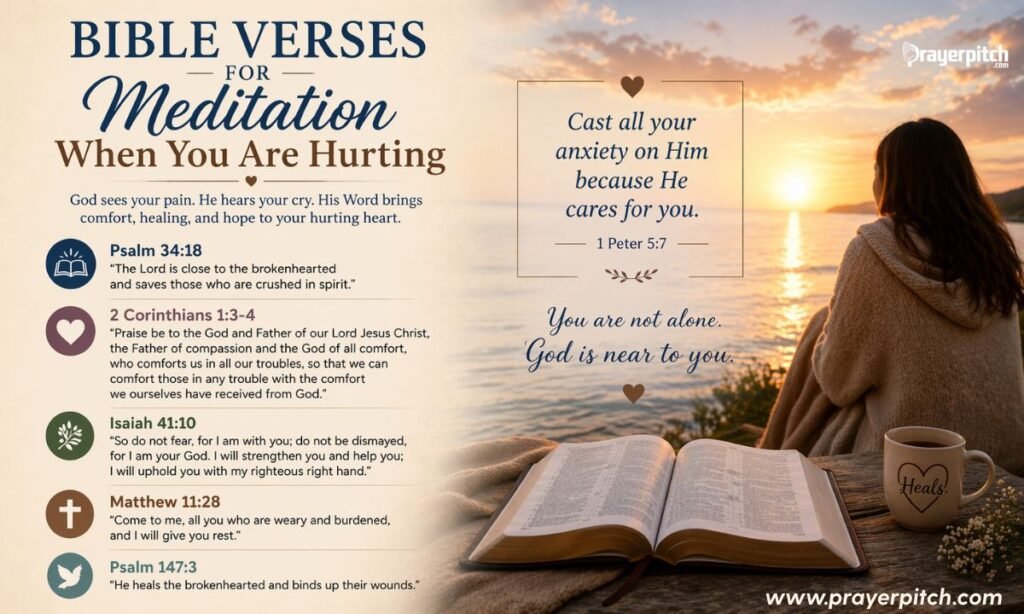
Pain — whether physical, emotional, relational, or spiritual — has a way of making God feel distant. Yet some of the most intimate moments in Scripture happen in places of deep suffering. These verses are for the seasons when life breaks your heart:
• Psalm 34:18 — “The Lord is close to the brokenhearted and saves those who are crushed in spirit.” — This verse is extraordinary in its specificity. God does not stand at a distance from our grief — He draws closer. The word crushed implies total devastation, yet even there, God is present and saving. For the person in deep pain, this is a verse worth sitting with for a long time.
• Romans 8:18 — “I consider that our present sufferings are not worth comparing with the glory that will be revealed in us.” — Paul’s perspective on suffering is not denial — he had suffered enormously. It is perspective. Meditating on this verse means lifting your eyes above the present moment to the larger story God is writing.
• 2 Corinthians 1:3-4 — “Praise be to the God and Father of our Lord Jesus Christ, the Father of compassion and the God of all comfort, who comforts us in all our troubles, so that we can comfort those in any trouble with the comfort we ourselves receive from God.” — God’s comfort is not wasted. It is received and then passed forward. This verse invites meditation not just on our own pain, but on how God redeems it for the sake of others.
• Psalm 23:4 — “Even though I walk through the darkest valley, I will fear no evil, for you are with me; your rod and your staff, they comfort me.” — The beloved 23rd Psalm does not promise that believers will avoid dark valleys — it promises they will not walk through them alone. Meditating on God as shepherd changes the landscape of suffering.
• Isaiah 53:4-5 — “Surely he took up our pain and bore our suffering, yet we considered him punished by God, stricken by him, and afflicted. But he was pierced for our transgressions, he was crushed for our iniquities; the punishment that brought us peace was on him, and by his wounds we are healed.” — This messianic passage reminds us that Jesus Himself entered into human suffering. He is not a distant God who watches our pain from afar — He bore it. Meditating here is meditating at the foot of the cross.
• Revelation 21:4 — “He will wipe every tear from their eyes. There will be no more death or mourning or crying or pain, for the old order of things has passed away.” — When pain feels endless, this future promise is a powerful anchor. God’s final word over every human tear is comfort and restoration. Meditating on eternity does not diminish present pain, but it places it within a story that ends with God’s overwhelming goodness.
• James 1:2-4 — “Consider it pure joy, my brothers and sisters, whenever you face trials of many kinds, because you know that the testing of your faith produces perseverance. Let perseverance finish its work so that you may be mature and complete, not lacking anything.” — James does not call us to pretend pain is not real. He calls us to see its purpose. Meditating on this passage requires honesty about the difficulty and faith in what God is producing through it.
Scripture for Meditation When You Need Hope
There are seasons in life when hope is the thing that is hardest to hold onto. Dreams that have not come true, prayers that seem unanswered, circumstances that refuse to change — all of these can quietly drain the soul of expectation and trust. But the Bible is saturated with hope. Not the thin, wishful kind, but the solid, sure, unshakeable hope that is grounded in the character and promises of God:
• Jeremiah 29:11 — “For I know the plans I have for you, declares the Lord, plans to prosper you and not to harm you, plans to give you hope and a future.” — Perhaps no verse in the Bible is more beloved as a source of hope than this one. God declares, not suggests, that His plans for His people are good. Meditating on this verse means allowing the certainty of God’s intentions to override the uncertainty of your present experience.
• Romans 15:13 — “May the God of hope fill you with all joy and peace as you trust in him, so that you may overflow with hope by the power of the Holy Spirit.” — Paul describes God Himself as the God of hope — not just a hopeful God, but the very source of hope. Meditating on this verse is an invitation to ask God to fill you where you feel empty.
• Lamentations 3:22-24 — “Because of the Lord’s great love we are not consumed, for his compassions never fail. They are new every morning; great is your faithfulness. I say to myself, ‘The Lord is my portion; therefore I will wait for him.'” — This passage comes from one of the darkest books of the Bible, written in the aftermath of Jerusalem’s destruction. Yet in the middle of ruin, the writer finds hope in the daily mercies of God. There is perhaps no greater proof that hope rooted in God can survive anything.
• Isaiah 40:31 — “But those who hope in the Lord will renew their strength. They will soar on wings like eagles; they will run and not grow weary, they will walk and not be faint.” — Hope and strength are connected here. The word hope in this context means to wait expectantly, like a watchman straining toward the horizon. Meditating on this verse means letting go of the frantic grasping for answers and resting in expectant waiting.
• Romans 5:3-5 — “Not only so, but we also glory in our sufferings, because we know that suffering produces perseverance; perseverance, character; and character, hope. And hope does not put us to shame, because God’s love has been poured out into our hearts through the Holy Spirit, who has been given to us.” — Paul draws a line from suffering all the way to hope. What appears to be a detour through difficulty is actually a direct path toward a deeper and more proven hope. Meditating on this passage invites us to trust the process even when we cannot see the destination.
• Psalm 42:11 — “Why, my soul, are you downcast? Why so disturbed within me? Put your hope in God, for I will yet praise him, my Savior and my God.” — This verse is a conversation with oneself — an act of deliberate self-counsel in a moment of despair. The Psalmist does not simply feel hopeful; he commands his own soul to hope. Meditating on this passage invites us to speak truth to ourselves when our emotions say otherwise.
• Hebrews 6:19 — “We have this hope as an anchor for the soul, firm and secure.” — In the ancient world, an anchor was the one thing that kept a ship from being driven onto the rocks in a storm. Biblical hope is not a feeling — it is a secure attachment to the unchanging character of God. Meditating on this image of the anchor is a deeply grounding exercise for any season of uncertainty.
How to Practice Biblical Meditation in Daily Life
Understanding the concept of biblical meditation is one thing. Building it into the rhythm of daily life is another. Many believers feel intimidated by the idea of meditation because they associate it with long hours of silence or a special spiritual gift they do not feel they have. The truth is that biblical meditation can be practiced by anyone, anywhere, in almost any circumstance. Here are some practical approaches to begin:
Start small. Choose one verse at a time rather than a long passage. Write the verse on a card or in a journal. Read it slowly. Ask several questions of the text: What does this tell me about God? What does it tell me about myself? What does it invite me to do or believe differently? Is there a promise here to claim, a command to obey, a warning to heed, an example to follow?
Use the practice of lectio divina — ancient Latin for sacred reading. Read the passage once slowly for understanding. Read it again and notice which word or phrase seems to stand out. Reflect on why that word matters to you today. Respond to God in prayer around what has surfaced. Then rest in His presence for a few moments of quiet. This simple rhythm can be done in as little as ten minutes and has been practiced by Christ-followers for centuries.
Another powerful method is memorization as meditation. When you commit a verse to memory, you carry it with you everywhere. While washing dishes, driving, exercising, or waiting in line, your mind can return to the verse and turn it over quietly. This is precisely the kind of day-and-night meditation that Joshua 1:8 describes — not a special retreat, but a continual returning throughout the ordinary hours of the day.
Journaling is also a natural companion to meditation. After sitting with a passage, writing out your thoughts, prayers, and reflections helps to solidify what God is saying and creates a record of His faithfulness over time. Many believers find that returning to old journal entries from times of meditation becomes its own form of encouragement — tangible evidence of how God met them in His Word.
Finally, it is important to approach biblical meditation in community. Share verses with friends. Discuss passages with your small group. Let the practice of dwelling on Scripture be something that spills over into conversation with others. The community of faith has always been a place where Scripture is pondered together, and that communal reflection deepens individual understanding.
Why Consistency in Meditation Matters
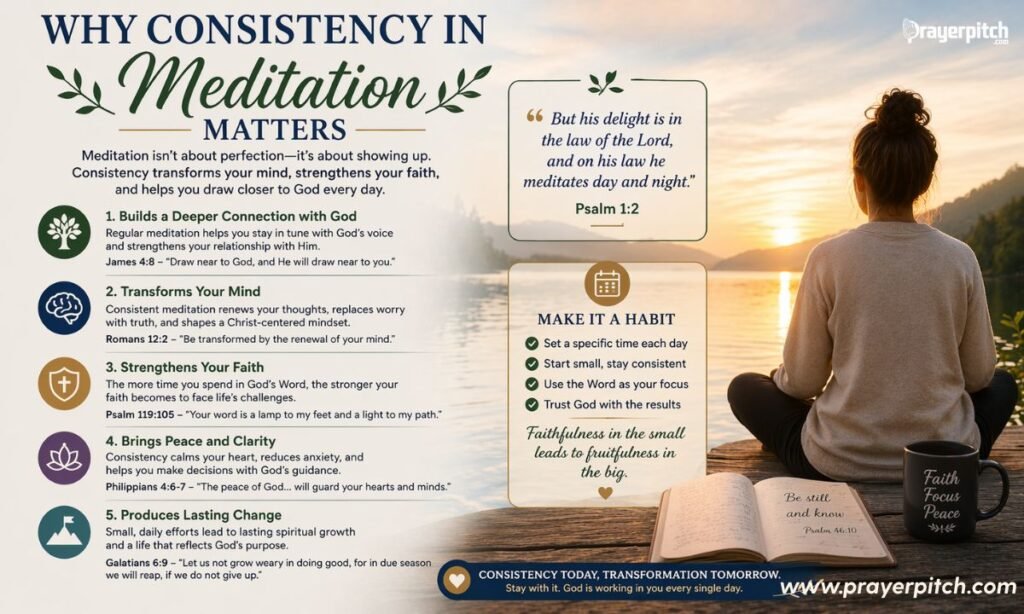
Like any spiritual discipline, biblical meditation yields its deepest fruit through consistency rather than intensity. An occasional retreat into God’s Word is a good thing, but it is the daily practice of returning to Scripture — even briefly, even imperfectly — that shapes the mind and heart over time. Just as the body is shaped by what we eat every day rather than what we eat once in a while, the soul is shaped by what we consistently feed it.
The Psalmist who declares that his delight is in the law of the Lord, meditating on it day and night, is not describing a person who has two free hours every morning. He is describing a person whose heart has so fallen in love with God’s Word that it naturally becomes the place he returns to throughout the day. That kind of love is built slowly, over time, through regular practice.
Neuroscience has actually confirmed what Scripture has always taught about the power of consistent thought. The brain is shaped by what we repeatedly think about — a phenomenon researchers call neuroplasticity. When we consistently return to thoughts of truth, beauty, goodness, and the promises of God, we are literally reshaping the patterns of our thinking. Paul’s instruction to be transformed by the renewing of your mind in Romans 12:2 turns out to have both spiritual and neurological dimensions.
This is why the stakes of biblical meditation are so high. We live in a world that works overtime to fill our minds with noise, fear, comparison, and distraction. Social media, news cycles, and the constant demands of modern life create a kind of mental static that makes it difficult to hear God or to think clearly about what is true. Biblical meditation is the discipline that cuts through the noise — not by ignoring the world, but by anchoring the mind to what is ultimate, true, and good.
Conclusion
Biblical meditation is not a mystical practice reserved for monks or spiritual experts — it is a call extended to every believer, in every season of life. God’s Word is living and active, and when we give it space to dwell in us through regular, intentional reflection, it does exactly what God promises it will do: it renews the mind, steadies the heart, and transforms the life from the inside out. The verses explored in this article are not just words on a page — they are invitations into deeper fellowship with the God who wrote them.
Begin where you are. Choose one verse, sit with it today, and let it speak. Come back to it tomorrow. Write it down. Pray through it. Let it meet you in your worry, your pain, or your need for hope. The discipline of meditating on God’s Word is one of the most transformative commitments a believer can make, and its rewards — peace, clarity, faith, and a deepened intimacy with God — are well worth the effort of a lifetime.
Frequently Asked Questions
1. What does the Bible say meditation is?
The Bible describes meditation as the practice of deeply pondering and continually reflecting on God’s Word, His works, and His character. It is an active, intentional dwelling on Scripture rather than a passive emptying of the mind.
2. Is Christian meditation different from Eastern meditation?
Yes, fundamentally. Eastern meditation typically seeks to empty the mind or detach from thought, while Christian meditation fills the mind with Scripture and directs thought toward God. The goal is not inner nothingness but deep engagement with divine truth.
3. Which Psalm talks most about meditation?
Psalm 119 contains the most references to meditation in the Bible, with the psalmist repeatedly declaring his love for God’s law and his practice of meditating on it throughout the day. Psalm 1 is also foundational in connecting meditation to a blessed and fruitful life.
4. How long should biblical meditation take?
There is no required length — even five to ten minutes of focused reflection on a single verse is valuable. Consistency matters more than duration, and even brief daily meditation builds a rich, transformative relationship with Scripture over time.
5. Can I meditate on Scripture throughout the day?
Absolutely — in fact, this is exactly what Joshua 1:8 and Psalm 1:2 describe. Memorizing a verse and returning to it throughout daily activities is one of the most natural and powerful forms of biblical meditation available to every believer.
6. What is the best Bible verse for meditation beginners?
Philippians 4:8 is an excellent starting point, as it provides a clear and practical filter for directing thoughts. Isaiah 41:10 is also highly recommended for its personal, promise-rich language that invites slow, reflective reading.
7. Does meditating on the Bible actually change you?
Yes — Scripture itself promises this in Romans 12:2, calling believers to be transformed by the renewing of the mind. Consistent meditation on God’s Word reshapes thinking patterns, deepens faith, and gradually aligns the heart more fully with the character and purposes of God.