

Irish wedding blessings have been making guests laugh, cry, and reach for a second glass of Guinness for centuries. They carry the unmistakable fingerprint of a culture that takes its storytelling seriously — and its humour even more so.
Whether you are a best man who cannot quite nail the serious toast, a couple looking for something memorable on the ceremony program, or a wedding guest who wants to share something with a genuine Irish soul, this collection is your pot of gold. No rainbow required.
What Makes an Irish Wedding Blessing…Irish?
Not every blessing with a shamrock emoji counts as authentically Irish. The real thing has a particular flavour — a blend of warmth, wordplay, and just enough cheek to make you snort-laugh at a formal occasion. True Irish blessings do not just wish you well; they wink at you while doing it.
The magic lives in a few key ingredients. There is always a thread of genuine affection underneath the comedy, a nod to life’s unpredictability, and an understanding that laughter is not the enemy of love — it is love’s best companion. Here is what gives an Irish blessing its DNA:
Blessings (points):
• Warm but cheeky: The blessing genuinely wants good things for you — it just delivers that wish with a grin and possibly a punchline.
• Rooted in real life: Irish blessings acknowledge rain, arguments, bad days, and odd relatives. They are honest about the whole picture of marriage.
• Rhythmic and memorable: Good Irish blessings have a natural lilt — they sound like they were meant to be spoken aloud, preferably with a slight accent.
• Layered meaning: On the surface, it is funny. Look closer, and there is often something genuinely wise tucked inside the joke.
• Community-minded: They pull the whole room in. Everyone feels included — from the flower girl to the grandmother in the back row.
• Whiskey-adjacent: Not mandatory, but any blessing that pairs well with a toast is doing its job correctly.
If your blessing hits at least four of those six marks, you are working with solid Irish material. Now let us get into the good stuff.
Ready-to-Use Funny Irish Wedding Blessings
The blessings below are organized by moment, mood, and audience so you can find exactly the right one without scrolling through a list that feels like the entire Book of Kells. Each one is ready to use as-is, or tweak a name and a detail to make it your own.
Short & Sweet (Perfect for Programs or Signage)
These compact blessings pack all the charm into just a line or two. They work beautifully printed on ceremony programs, framed as table décor, or spoken as a quick opener before the longer toasts begin.
Blessings (points):
• May your love be modern enough to survive the times and old-fashioned enough to last forever — and may you always agree on the thermostat.
• May the roof above you never fall in, and the two of you beneath it never fall out. (Unless it is about whose turn it is to do the dishes — in that case, good luck.)
• Here is to a long life and a merry one, a quick death and an easy one, a pretty girl and an honest one, a cold beer — and another one.
• May your wedding day be the worst day of your marriage. Everything after should only be better.
• May you always find a light in the dark, a laugh in the storm, and your car keys before the school run.
• May the Lord keep you in His hand and never close His fist too tight — and may your in-laws visit just often enough.
• May you be poor in misfortune, rich in blessings, slow to make enemies, and quick to make up after you do.
Short blessings are underrated. Sometimes the most powerful thing you can do is land the joke, land the warmth, and sit back down.
For Ceremony Moments
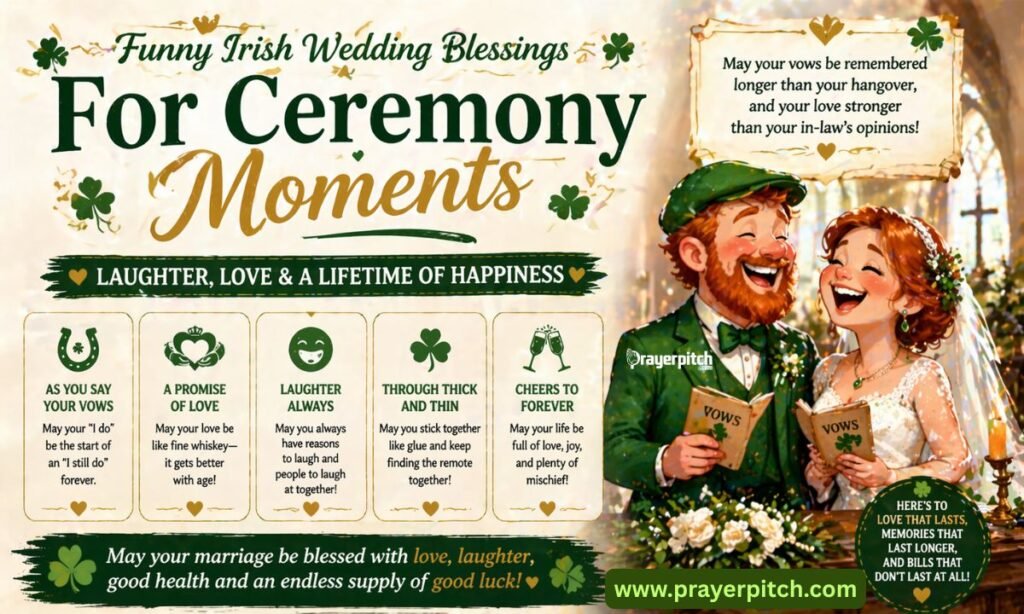
The ceremony is sacred — but sacred does not mean stiff. These blessings are written for officiants, readers, or family members who want to bring a smile to faces without upstaging the vows. They set a tone of joyful seriousness: this matters, and we are enjoying every second of it.
Blessings (points):
• May God be with you and bless you. May you see your children’s children. May you be poor in misfortune and rich in blessings. And may you know nothing but happiness from this day forward — and may you also find good parking whenever you need it most.
• As you stand here today, two becoming one, may you always remember: one of you will always be right. And the other one will be the husband.
• May your home be a place where laughter lives in every room, and where silence — the comfortable kind — is always welcome too.
• May the road ahead be smooth, the hills gentle, and should you ever find a pothole, may you find it together and have a good enough story to tell about it afterward.
• May the bond you form today be stronger than the Wi-Fi at this venue, and may your love last longer than the playlist.
• May every year of marriage feel like the best year of your life — except next year, which should be even better than that.
The trick with ceremony blessings is to let them breathe. Deliver the funny line, let the room laugh, then follow with the warmth. Do not rush through it.
For Toasts (Cue the Chuckles)
The toast is where Irish blessing culture truly shines. You have a glass in hand, an audience that has had just the right amount to drink, and a moment to say something that will be repeated at every anniversary dinner for the next thirty years. No pressure.
Blessings (points):
• May your glasses always be full, your troubles always small, and may the best day of your past be the worst day of your future. Slainte!
• Here is to the happy couple — may they have a lifetime of arguments that end in laughter, and laughter that begins before the argument has even finished.
• May you live as long as you want, and want as long as you live. And may you never want for anything — except maybe a better excuse when you forget the anniversary.
• To the bride and groom: may your love be as endless as the Irish coast, as deep as the Cliffs of Moher, and as warm as a pub on a Friday evening in November.
• They say marriage is finding that one special person you want to annoy for the rest of your life. By the look of things today, you have both found that person. Congratulations.
• May the hinges of your friendship never grow rusty, and may you always find, in each other, the thing you were looking for when you walked into the room.
• May your home always smell of something cooking, your bed always be warm, and your arguments always end before the kettle boils.
A great toast blessing lands with a laugh and exits with a lump in the throat. That is the Irish way. Master that sequence and the room is yours.
For Family or Best Friends to Read
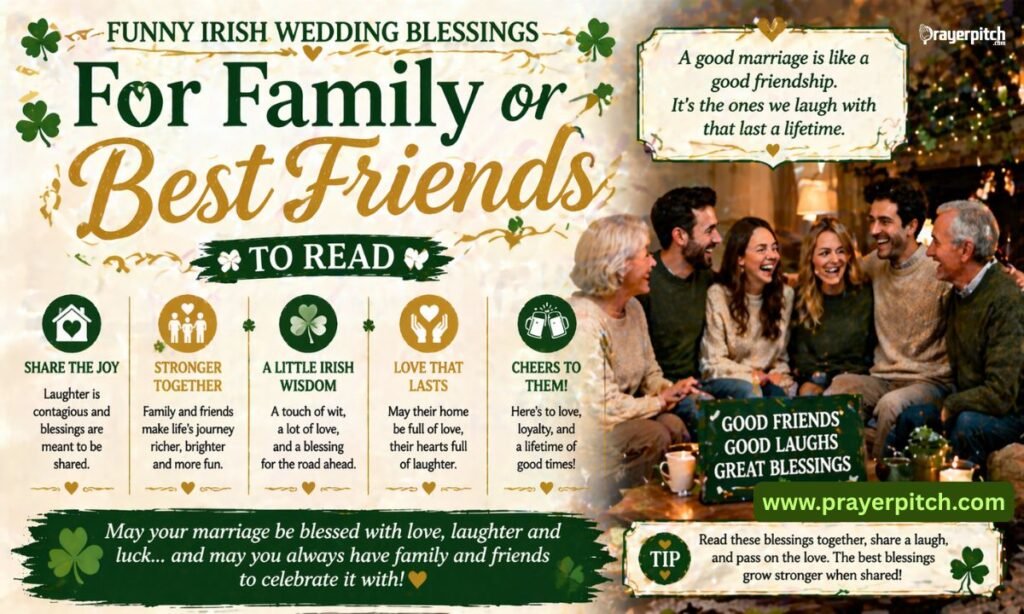
Some of the most memorable wedding moments happen when the people who know the couple best step up to speak. These blessings are written for the parent who is funny but emotional, the best friend who has known the couple since they were disasters, and the sibling who has fifteen years of material to draw from.
Blessings (points):
• I have known this person for most of their life, and I can tell you with full confidence: they have never made a better decision than this one. The bar was sometimes low, but today they cleared it magnificently.
• May you both be blessed with the wisdom to know when to speak and the grace to know when to listen — and may one of you learn the difference sooner than the other one.
• From one family to another: we are delighted to welcome you in. We are loud, we are late to everything, and we argue at Christmas. You will fit right in.
• May every fight you have be short, every holiday you take be long, and may you always be as happy as you look today — even at 7 am on a Tuesday in January.
• To my dearest friend: I always knew you would find someone extraordinary. I just did not expect them to also have such excellent taste in friends. Well done to both of you.
• May the love you have built today be like good soda bread — warm from the oven, made with simple things, and something people travel across counties to get a taste of.
• May your children have your best qualities, your worst qualities skip a generation, and may you always be each other’s favourite story to tell.
These blessings give speakers a ready-made framework. The personal detail they add on top is what transforms a good blessing into an unforgettable moment.
How to Write Your Own Funny Irish Blessing (Step-by-Step)
You do not need to be Irish to write one. You need to know the couple, appreciate a good pun, and understand that the funniest things are often just honest things said with a smile. Here is a simple framework that works every time.
Blessings (points):
• Start with a traditional structure: Begin with “May you…” or “Here is to…” — this immediately gives your blessing its Irish signature and signals to listeners what kind of moment this is.
• Pick one real, specific thing about the couple: The inside joke, the quirk, the habit. Specificity is what transforms a generic blessing into a roast — the affectionate kind.
• Build to the funny with the sincere: Lead with two lines of genuine warmth, then let the third line be the punchline. Reverse-engineer it — write the joke first, then build the setup around it.
• Use contrast for comic effect: “May your love be ancient and your arguments be brief” works because the two halves pull in opposite directions. Contrast is the engine of Irish humour.
• Read it aloud before you use it: If it does not have a natural rhythm when spoken, it will not land in the room. Rewrite until it flows like you are telling a story at the bar.
• End on warmth, not the joke: The laugh should come in the middle. The last thing your audience hears should be something they want to carry with them. End on love.
• Test it on someone who knows the couple: If they laugh and then say, “Oh, that is so them,” you have nailed it. If they just laugh, you have a good joke. If they just say, “oh that is so them,” you have a good blessing. You want both.
Writing your own means something more to the couple than anything you could have found online — including this article. Use these blessings as a launchpad, not a final destination.
Matching the Blessing to the Moment
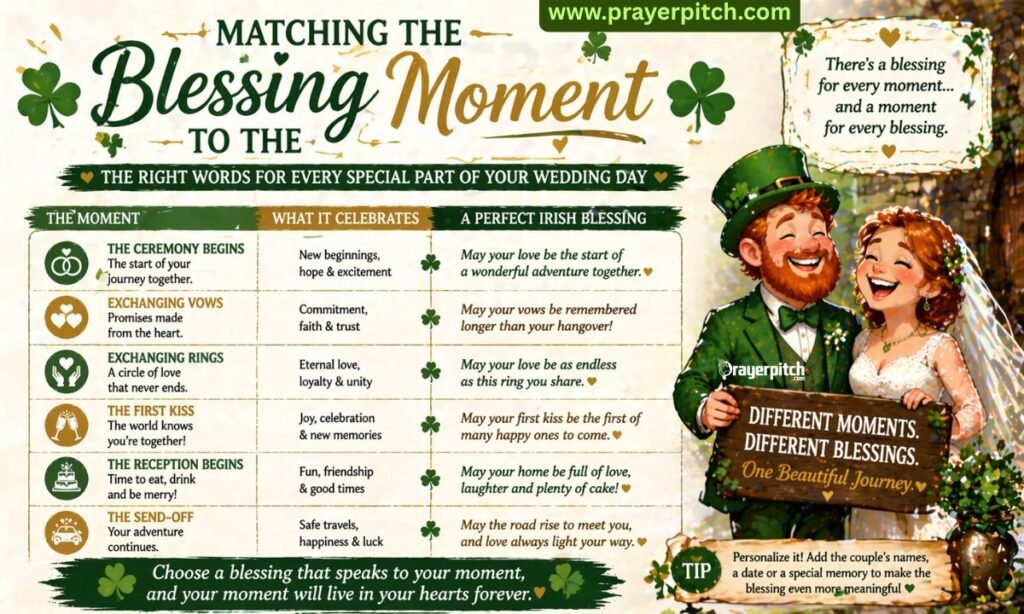
Not every blessing works in every spot. A toast blessing during the ceremony feels jarring. A solemn traditional blessing at the pub crawl feels like a buzzkill. Matching tone to moment is the difference between a memory and an awkward silence.
Blessings (points):
• Ceremony reading slot: Choose something that opens with laughter and closes with sincerity. The room is emotionally primed — meet them where they are and then gently elevate.
• Wedding program or signage: Go for the one-liners. People are reading while standing, talking, or wrestling with a buttonhole. Short, punchy, and printable wins every time.
• Best man speech opener: Use a funny blessing to break the ice in the first thirty seconds. It relaxes the room, relaxes you, and gives you momentum for the stories that follow.
• Maid of honour toast: Irish blessings work beautifully here because they combine the emotional and the comic — exactly what a great maid of honour speech needs to do.
• Dinner table card or favour tag: Keep it to one line, make it quotable, and make it feel like a gift rather than a decoration.
• End-of-night send-off: As the couple leaves, a short blessing called out by a family member or the MC is a lovely way to close. Choose something that feels like a proper farewell rather than a joke.
• Wedding website or invitation insert: A funny blessing sets the tone before guests even arrive. Choose something that previews the spirit of the celebration and makes people excited to come.
Context is everything. A blessing that kills at the toast can fall completely flat on a card. Think about who will be receiving it, where they will be standing, and what they will need to feel in that moment.
Pairing Funny with Traditional (Two Balanced Options)
Sometimes you want both — the laugh and the reverence. These two complete pairings show you how to balance a funny blessing alongside a traditional one so neither upstages the other. Use them together in a ceremony reading, a speech structure, or a printed keepsake.
Blessings (points):
• Traditional: “May love and laughter light your days, and warm your heart and home. May good and faithful friends be yours wherever you may roam.” | Funny follow-up: “And may your home have good enough Wi-Fi that your faithful friends actually want to visit it.”
• Traditional: “May the road rise up to meet you. May the wind be always at your back. May the sun shine warm upon your face.” | Funny follow-up: “And may the rain — which will absolutely come, because this is a wedding — at least wait until after the photos.”
• Traditional: “Deep peace of the running wave to you, deep peace of the flowing air to you, deep peace of the quiet earth to you.” | Funny follow-up: “And deep peace of a house with a good lock on the door, so your mother-in-law has to ring the bell first.”
• Traditional: “May you have warm words on a cold evening, a full moon on a night, and a smooth road all the way to your door.” | Funny follow-up: “And may your satnav actually know where your door is, unlike at the rehearsal dinner.”
• Pairing tip: Always lead with the traditional blessing. Let it land fully before pivoting to the funny. The comedy gets its power from the contrast — it only works if you have first established sincerity.
• Pairing tip: When using two speakers, have one person deliver the traditional, and another deliver the funny. The handoff itself becomes part of the joke — and it gives both speakers a clear, comfortable role.
Pairing blessings is also a wonderful way to involve two family members who both want to contribute but are working with very different personalities. Let the poet and the comedian both have their moment.
Conclusion
Funny Irish wedding blessings are not a replacement for sentiment — they are the delivery system for it. The Irish understood long before anyone else that a truth wrapped in laughter travels further, lands softer, and stays longer than a truth spoken with a straight face.
Whether you pick one blessing from this collection and read it word-for-word, mix and match a few lines for a toast, or use the step-by-step guide to write something entirely your own, you are participating in a tradition that stretches back centuries. Use it well, speak it with warmth, and when in doubt — add a line about the in-laws. It never fails. Slainte.
Frequently Asked Questions
1. Are funny Irish wedding blessings appropriate for religious ceremonies?
Yes, as long as the humour is warm and respectful rather than irreverent. Many traditional Irish blessings already blend faith and wit naturally, making them a comfortable fit for church ceremonies when chosen thoughtfully.
2. How long should a funny Irish blessing be for a wedding toast?
Aim for four to eight lines when spoken aloud — enough to build rhythm, land the joke, and close with warmth. Anything longer risks losing the room; anything shorter can feel incomplete without a real setup.
3. Can I write my own Irish-style blessing even if I have no Irish heritage?
Absolutely. Irish wedding blessings are a cultural form, not a bloodline requirement. The key elements — warmth, wit, rhythm, and sincerity — are universally available to anyone willing to put in the thought.
4. Where is the best place in a wedding ceremony to include a funny blessing?
The reading slot just before the vows works beautifully — it lightens the mood so guests feel emotionally open rather than stiff. A funny blessing during a toast or as the couple exits also lands extremely well.
5. What is the difference between an Irish blessing and an Irish toast?
A blessing is a wish directed toward the couple, often poetic and ceremonial. A toast is a social ritual where a wish is sealed with a raised glass and a drink. Many Irish toasts are also blessings — the line between them is wonderfully blurry.
6. How do I deliver a funny Irish blessing without it falling flat?
Slow down, make eye contact, and give the funny line room to breathe. The biggest mistake is rushing through it nervously. Pause after the punchline. Let the room catch up to you. Confidence is more fun than speed.
7. Can children or younger family members deliver an Irish wedding blessing?
Yes, and it is often one of the most charming moments of the reception. Choose something short, rhythmic, and free of any jokes that require adult context. Simple blessings about love, laughter, and home work beautifully from a young voice.