

If you have ever stood in front of a small circle of chairs, Bible in hand, wondering how to begin, you already understand why a good prayer meeting guide matters. Leading people in prayer is one of the most meaningful things you will ever do, and it does not require a seminary degree or a naturally bold personality. It requires a willing heart, a little preparation, and a genuine desire to meet with God alongside others.
This prayer meeting guide was written for the pastor preparing his first midweek gathering, the mom hosting a family prayer night, the youth leader nervous before her first session, and the small group host who just wants the evening to feel warm and unhurried. Whatever your setting, you will walk away from this guide knowing exactly how to lead a prayer meeting with confidence, structure, and biblical depth.
Prayer meetings have shaped the church since the very beginning, and they still shape it today. Revivals have started in rooms no bigger than a living room. Marriages have been restored, prodigal children brought home, and entire congregations renewed because a handful of believers decided to gather and pray. That is the quiet power sitting inside every prayer meeting, including the one you are about to lead.
Let’s walk through everything you need, step by step.
What Is a Prayer Meeting?
A prayer meeting is simply a gathering where believers come together with one shared purpose: to seek God together. It is not a Bible study with a prayer tacked on at the end, and it is not a social hour that happens to open with a prayer. The center of gravity is prayer itself.
Biblical meaning. The Greek word often translated “gathered together” in the book of Acts describes believers meeting with a shared mind and purpose. In Acts 1:14, the disciples “joined together constantly in prayer” while they waited for the promise of the Holy Spirit. That single verse is really the birth certificate of every prayer meeting that has happened since.
Purpose. A prayer meeting exists to bring God’s people into agreement before Him. It is where burdens are shared, needs are lifted up, praise is offered, and faith is strengthened through the presence of others.
Importance. Scripture never presents prayer as a solitary activity only. Jesus prayed alone, but He also prayed with His disciples. The early church devoted itself to prayer as a community practice (Acts 2:42). A healthy church or home cannot skip this rhythm and expect to stay spiritually strong.
Early church example. Acts 4 describes believers raising their voices together in prayer after Peter and John were released from custody, and the place where they were gathered was shaken as they were filled with the Holy Spirit. That is corporate prayer at its most vivid: ordinary believers, one voice, and a visible response from God.
Personal prayer vs. corporate prayer. Personal prayer is you and God, one on one, in the quiet of your own heart. Corporate prayer, sometimes called group prayer or church prayer meeting, adds agreement, encouragement, and shared faith to the mix. Jesus pointed to the unique power of this when He said that where two or three gather in His name, He is there among them (Matthew 18:20). Both forms of prayer matter, but a prayer gathering adds something personal prayer alone cannot: the strength of shared faith.
Bible Truth “Again, truly I tell you, if two of you on earth agree about anything they ask for, it will be done for them by my Father in heaven.” — Matthew 18:19
Why Prayer Meetings Matter?
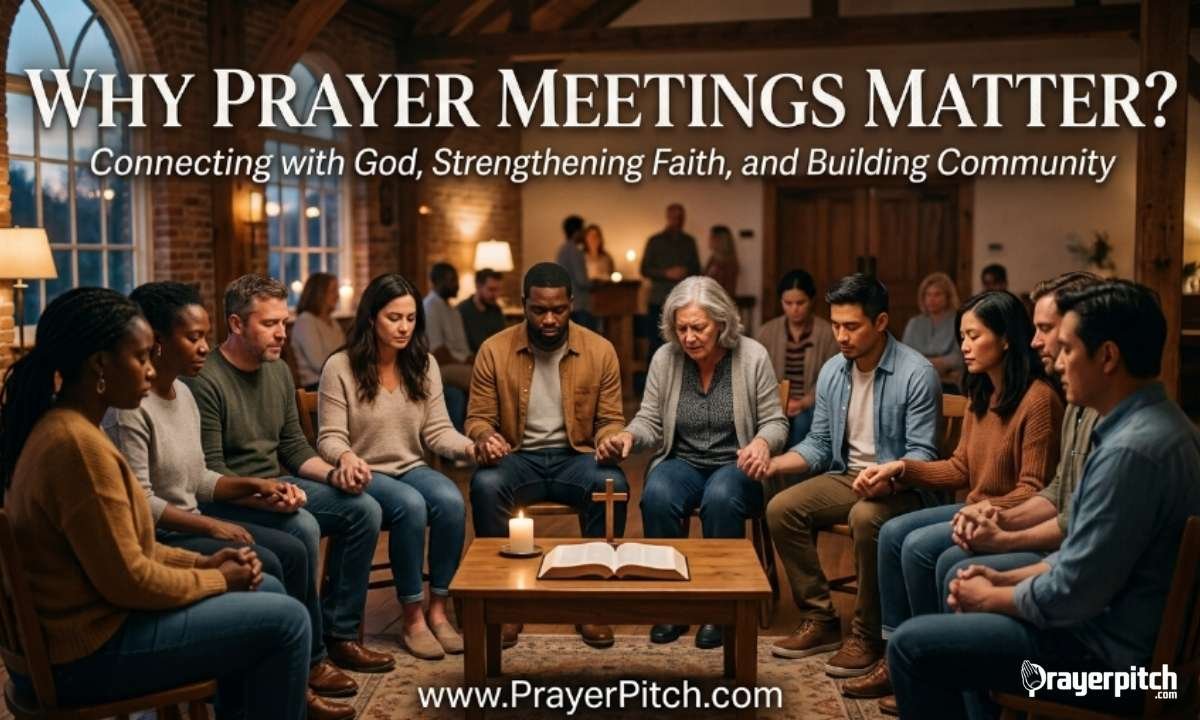
Some church leaders quietly wonder if prayer meetings still matter in a world of livestreamed services and packed calendars. They matter more than ever, and here is why.
Church unity. Nothing knits a congregation together like praying for one another by name. When you hear someone pray for your marriage, your health, or your children, walls come down. A consistent church prayer meeting becomes the glue that holds a congregation together through hard seasons.
Spiritual growth. Prayer stretches faith. Sitting under other people’s prayers teaches you how to pray with more depth, more Scripture, and more boldness. Many believers say they learned to pray simply by listening to mature believers pray out loud.
Faith. Watching prayers answered in real time, even small ones, builds faith like almost nothing else. A prayer meeting becomes a living classroom in trusting God.
Encouragement. Life is heavy. A prayer gathering gives people permission to say the hard thing out loud and be carried by others who care.
Revival. Historically, nearly every recorded revival traces back to a small prayer gathering. The Welsh Revival of 1904, the Azusa Street outpouring, and countless local renewals all began with ordinary people meeting to pray, often in small, unremarkable rooms.
Biblical examples. Consider Acts 12, where the church gathered at Mary’s house to pray earnestly for Peter while he sat in prison. Their prayer meeting led directly to his miraculous release by an angel. Or look at 2 Chronicles 7:14, where God promises that if His people will humble themselves and pray, He will hear from heaven and heal their land. Prayer meetings are where that promise gets activated corporately.
It also helps to remember that prayer meetings are not a modern invention layered on top of “real” church life. They are, in many ways, the oldest form of church life there is. Long before buildings, budgets, or programs existed, believers were simply gathering to pray. That should take some of the pressure off. You are not inventing something new when you start a prayer meeting; you are stepping into one of the oldest and most tested rhythms the church has ever practiced.
Key Takeaways
- Corporate prayer builds unity, faith, and spiritual maturity in ways personal prayer alone cannot.
- Historic revivals almost always began in small, humble prayer gatherings.
- Acts 12 shows a real, documented answer to group prayer: Peter’s release from prison.
How to Lead a Powerful Prayer Meeting Step by Step?
This is the heart of any prayer meeting guide: the actual how-to. Whether you are leading a church prayer meeting, a home group, or a youth gathering, the same core steps apply. Here is a complete prayer meeting outline you can adapt to any setting.
Notice that none of these steps require special training. What they require is intentionality. Leading prayer confidently is less about having the right personality and more about having a clear next step in mind at every point in the gathering. When you know what comes next, your own nerves settle, and that calm naturally spreads to the room.
1. Planning
Good prayer meetings rarely happen by accident. Decide on the day, time, and length well in advance. Thirty to sixty minutes works well for most groups. Choose a space that feels welcoming, whether that is a church fellowship hall, a living room, or a video call. If you are leading a small group prayer meeting, send a reminder a day or two ahead so people actually show up.
2. Choosing a Theme
A focused prayer meeting theme keeps the time from feeling scattered. You might pray around a season (a new year, a school year, a crisis), a topic (healing, unity, missions), or a passage of Scripture. Themes are not required every week, but they add depth and help people prepare their hearts beforehand.
3. Preparing Bible Verses
Choose two or three verses that fit your theme. You do not need dozens of references; a few well-chosen prayer meeting scriptures, read slowly and thoughtfully, will carry more weight than a long list rushed through.
4. Welcoming Attendees
The first two minutes set the tone for everything else. Greet people warmly by name. A simple “I’m glad you’re here” does more than you realize, especially for someone nervous about their first prayer gathering. If you are hosting a family prayer meeting or youth prayer meeting, a moment of light conversation before diving in helps people relax.
5. Leading Worship
Worship does not require a full band. One song on a phone speaker, a hymn sung a cappella, or even a few minutes of quiet reflection on a worship song’s lyrics can shift a room from distracted to focused. The goal is simply to turn hearts toward God before words are spoken.
6. Sharing Exhortation
A short exhortation, five to eight minutes, gives the meeting spiritual direction. This is not a full sermon. It is a brief, encouraging word from Scripture that points people toward why they are praying and what they are praying for. Looking for biblical encouragement before prayer? Explore these Exhortation Topics for Prayer Meeting to find inspiring Scripture-based messages that prepare hearts to seek God together. They are perfect for church, family, youth, and small group prayer gatherings.
7. Prayer Time
This is the main event. Invite people to share prayer requests briefly, then move into group prayer. You can pray in small clusters of two or three, go around in a circle, or have one or two people pray aloud while others agree silently. Give the Holy Spirit room to work; do not rush this section.
8. Closing
End with a clear closing prayer that summarizes what was shared and thanks God for His presence. A short benediction or blessing sends people out with encouragement rather than an abrupt goodbye.
Quick Answer How do you lead a prayer meeting? Welcome your group, lead a short time of worship, share a brief Scripture-based exhortation, collect prayer requests, guide the group through focused prayer, and close with a clear, encouraging prayer.
Leadership Advice Do not aim for a perfect meeting. Aim for an honest one. People remember how safe and cared for they felt far more than they remember the exact order of the agenda.
Prayer Meeting Agenda Example
A written prayer meeting agenda keeps things moving without feeling rigid. Here is a simple, adaptable prayer meeting format you can use as-is or adjust to fit your group.
| Time | Segment | Purpose |
| 0:00–0:05 | Welcome | Greet attendees, settle the room, brief announcements |
| 0:05–0:15 | Worship | One or two songs, or quiet reflective music |
| 0:15–0:20 | Scripture | Read the chosen prayer meeting Bible verses |
| 0:20–0:28 | Exhortation | Short encouraging word tied to the theme |
| 0:28–0:35 | Prayer Requests | Attendees share needs, joys, and burdens |
| 0:35–0:55 | Group Prayer | Pray in pairs, small clusters, or as one body |
| 0:55–1:00 | Closing Prayer | Summarize, thank God, dismiss with blessing |
Quick Answer What is the format of a prayer meeting? Most prayer meetings follow this order: welcome, worship, Scripture reading, a short exhortation, sharing of prayer requests, group prayer, and a closing prayer. The whole gathering typically lasts thirty to sixty minutes.
Quick Answer How long should a prayer meeting be? Most healthy prayer meetings last between thirty and sixty minutes. Shorter meetings work well for busy weeknights or youth groups, while longer gatherings suit dedicated prayer nights or retreats.
Best Bible Verses for Prayer Meetings

Scripture gives every prayer meeting its backbone. Below are some of the most helpful prayer meeting Bible verses, along with how to apply each one.
- Matthew 18:20 — Jesus promises His presence wherever two or three gather in His name. Use this to remind a nervous or small group that size does not limit God’s presence.
- James 5:16 — Encourages believers to confess to one another and pray for one another so that they may be healed, noting that the prayer of a righteous person is powerful and effective. Use this before opening up prayer requests.
- 1 Thessalonians 5:17 — A short instruction to pray continually. Great for closing a meeting with a challenge to keep praying through the week.
- Philippians 4:6-7 — Addresses anxiety directly, urging believers to bring every situation to God with thanksgiving so that His peace can guard their hearts and minds. Ideal for meetings focused on comfort or stress.
- 2 Chronicles 7:14 — God’s conditional promise to heal a land when His people humble themselves, pray, and turn from wrong. Powerful for revival-focused or national-concern prayer meetings.
- Acts 2:42 — Describes the early believers devoting themselves to teaching, fellowship, breaking of bread, and prayer. A good anchor verse for explaining why prayer meetings exist at all.
- Mark 11:24 — Jesus teaches that whatever is asked for in prayer with belief will be received. Useful when encouraging bold, faith-filled requests.
- Ephesians 6:18 — Calls believers to pray in the Spirit on all occasions, staying alert and persevering for all the saints. Good for intercessory prayer meeting focus nights.
- Romans 8:26 — Reminds believers that the Spirit helps in weakness, even interceding when words fail. Comforting for those who feel unsure how to pray aloud.
Bible Truth Prayer is not about finding the right words. It is about bringing a real heart to a real God who already knows what you need before you ask (Matthew 6:8).
Prayer Meeting Ideas for Different Groups
No two prayer gatherings look exactly alike, and that is a good thing. Here are practical prayer meeting ideas tailored to different settings.
Church. Rotate leaders monthly so ownership spreads across the congregation. Focus one week a month on missions, one on the local community, and so on.
Family. Keep it short and warm. Ten minutes before dinner, praying for each family member by name, builds a lifelong rhythm in children.
Youth. Use interactive elements: prayer stations, worship playlists teens actually enjoy, and space for testimonies. Teenagers respond well to prayer that feels personal rather than formal.
Women’s prayer meeting. Create a safe, confidential space. Many women’s groups thrive around a specific need, such as marriages, children, or healing.
Men’s prayer meeting. Men often open up more during an activity, so consider pairing prayer with breakfast, a work project, or an early morning gathering before the day starts.
Children. Use simple, concrete prayers (“Thank you, God, for my family”) and keep the whole gathering under fifteen minutes.
Small groups. Fold prayer naturally into the end of a Bible study so it feels like a continuation of the discussion, not a separate obligation.
Online prayer meetings. Mute participants during open prayer to avoid audio overlap, use a shared document for prayer requests, and consider breakout rooms for smaller, more personal prayer time.
| Group | Ideal Length | Best Focus |
| Church-wide | 45–60 min | Corporate needs, missions, revival |
| Family | 10–15 min | Daily gratitude, individual needs |
| Youth | 30–40 min | Testimonies, worship, peer support |
| Women’s group | 45–60 min | Relationships, healing, encouragement |
| Men’s group | 30–45 min | Accountability, strength, purpose |
| Children | 10–15 min | Simple, concrete prayers |
| Small group | 15–20 min | Continuation of Bible study themes |
| Online | 30–45 min | Structured, muted, request-driven |
Many people attend prayer meetings carrying stress and uncertainty. Our Prayers for Anxiety offer comforting, Scripture-based prayers that remind believers to trust God’s peace in every situation.
When someone in your church needs comfort or physical restoration, these heartfelt Prayers for Healing provide biblical encouragement and faith-filled words to lift them before God.
If your congregation is believing God for miracles, restoration, or new opportunities, these powerful Prayers for Breakthrough will encourage persistent faith and confident prayer.
For focused group intercession, these practical Breakthrough Prayer Points provide Scripture-centered prayer topics that can easily be incorporated into any church or small-group prayer meeting.
Common Mistakes to Avoid
Even seasoned leaders fall into these traps. A good prayer meeting checklist should help you sidestep them.
- Talking more than praying. If the leader dominates the time with teaching, the meeting stops being a prayer gathering and becomes a lecture.
- No structure at all. Total spontaneity sounds spiritual but often leaves people unsure what to do next. A light framework actually frees people to relax into prayer.
- Ignoring the clock. Meetings that run long without warning wear people out and shrink attendance over time.
- Skipping preparation. Walking in with no verse, no theme, and no plan usually produces a flat, wandering meeting.
- Only inviting “prayer warriors” to pray aloud. This quietly teaches newer believers that their prayers are less valuable.
- Neglecting follow-up. When prayer requests are shared but never revisited, people stop trusting the group with real needs.
- Making it feel like a performance. Elaborate wording or a “show” tone pushes people toward comparison instead of honesty.
Most of these mistakes come from good intentions taken too far. A leader who prepares carefully can accidentally over-plan and leave no room for the Holy Spirit to interrupt the agenda. A leader who wants everyone to feel included can accidentally let the meeting run long trying to hear from every single person. The goal is not a flawless system. The goal is a room where people leave feeling closer to God and more connected to one another than when they walked in.
| Do | Don’t |
| Keep the tone warm and unhurried | Rush through prayer requests |
| Invite everyone to participate | Let only a few voices dominate |
| Prepare a simple theme and verse | Wing it with no direction at all |
| Follow up on prayer requests later | Let shared burdens disappear unmentioned |
| Start and end on time | Let the meeting drag on indefinitely |
| Keep language simple and honest | Use overly formal or performative wording |
Tips for First-Time Prayer Leaders
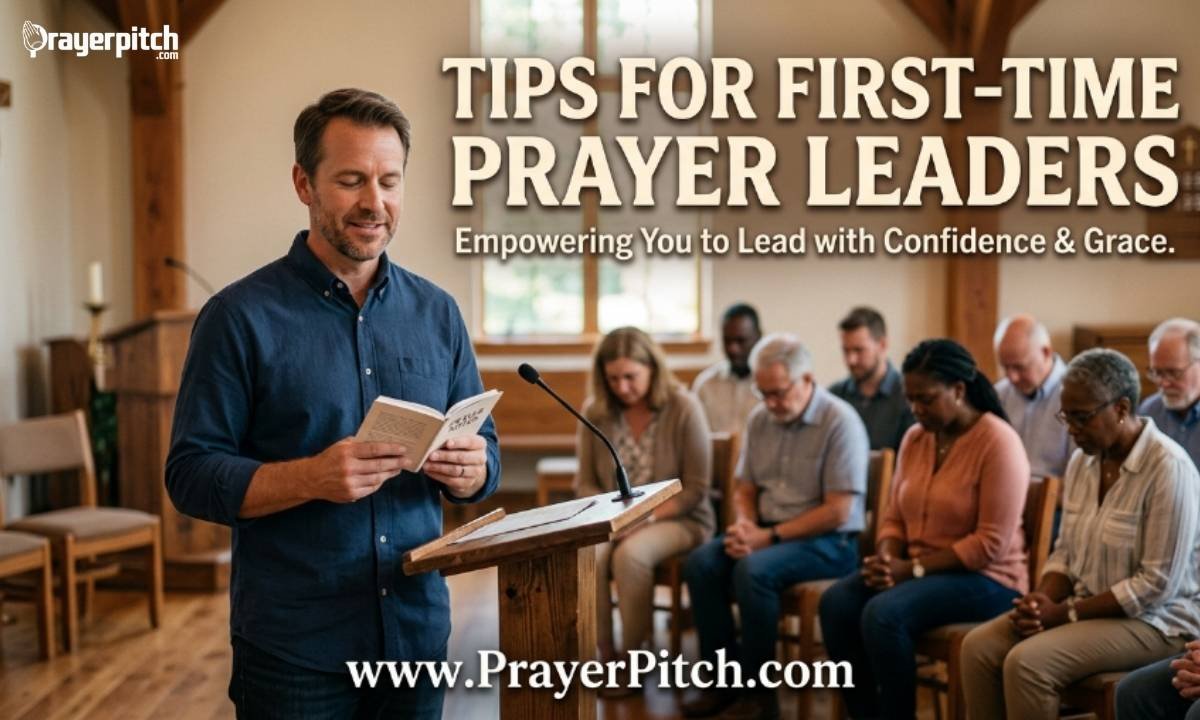
If this is your first time leading a prayer meeting, take a breath. Every experienced prayer leader started exactly where you are now.
- Write out your opening line. Knowing your first sentence removes most of the nervous energy.
- Keep your first meeting short. Twenty to thirty minutes is plenty for a first attempt.
- Use a printed or written agenda. Glancing at notes is completely normal and expected.
- Invite a co-leader. Sharing the load with a trusted friend takes pressure off you and models teamwork.
- Pray out loud on your own first. Practicing alone in your car or living room builds comfort before you do it in front of others.
- Expect silence, and let it be okay. Quiet moments are not failures; they often mean people are genuinely reflecting.
- Remember it is not about you. God honors a sincere, imperfect prayer far more than a polished one.
- Debrief after your first few meetings. Jot down what felt awkward and what felt natural. Small adjustments over a few weeks will do more for your confidence than any single piece of advice.
- Give yourself permission to grow into it. The leader you are in your twentieth prayer meeting will look nothing like the leader you are in your first, and that is exactly how it should be.
Quick Tips Start small, stay consistent, and let your prayer meeting grow naturally rather than trying to make the first one perfect.
Prayer Challenge This week, commit to leading or attending one prayer meeting, even if it is just you and one other person. Ask God to use that small gathering the way He used the disciples in the upper room.
Frequently Asked Questions
1. What is a prayer meeting?
A prayer meeting is a gathering of believers who come together specifically to pray, worship, and encourage one another, often including a short teaching or exhortation.
2. How often should a church hold a prayer meeting?
Weekly works well for most churches, though some hold biweekly or monthly gatherings depending on the size and season of the congregation.
3. What should we pray about in a prayer meeting?
Common focuses include church needs, personal requests, healing, guidance, missions, national and world concerns, and simple thanksgiving.
4. How do you keep a prayer meeting from feeling awkward?
A light structure, a warm welcome, and a clear invitation to participate (without pressure) go a long way toward easing tension.
5. Can a prayer meeting happen online?
Yes. Many churches and small groups now hold effective prayer meetings over video call, using shared documents for requests and breakout rooms for smaller prayer time.
6. What is the difference between a prayer meeting and a Bible study?
A Bible study centers on teaching and discussion of Scripture, while a prayer meeting centers on the act of praying together, though many groups blend both elements.
7. How long should someone pray out loud in a group setting?
Short prayers, generally under a minute or two, keep the meeting flowing and give more people the chance to participate.
8. What if no one wants to pray out loud?
That is normal, especially in new groups. The leader can model it first, or invite silent group prayer where people pray quietly at the same time.
9. What Bible verse is best for prayer meetings?
Matthew 18:20 is one of the most commonly used verses, since it directly addresses the power of gathering together in Jesus’ name to pray.
10. How do I choose a theme for a prayer meeting?
Look at what your group is currently facing: a season of transition, a community need, or a passage you have been studying. Let real life shape the theme.
Final Encouragement
You do not need perfect words to lead a powerful prayer meeting. You need a willing heart and a room full of people who are hungry to meet with God. Every great movement of prayer in church history started with someone deciding to simply begin, uncertain but obedient.
Whether you are leading a church prayer meeting, a family prayer time around the dinner table, or a quiet online gathering with a handful of friends, God honors the step you are about to take. Use this prayer meeting guide as your foundation, but let your own voice, your own church, and your own community shape the rest.
Start small if you need to. Invite one person. Open your Bible, say a simple prayer, and trust God with the outcome. That is how nearly every powerful prayer movement in Scripture began, and it is how yours can begin too.
Before you go, take a moment to explore a few more resources that pair naturally with your prayer meeting planning: exhortation topics to open your next gathering, daily prayers to strengthen your own walk with God, and focused prayers for healing, anxiety, and breakthrough for anyone in your circle carrying a heavy burden.
Build a stronger relationship with God through our Daily Prayers for morning, afternoon, and evening. These prayers help you stay spiritually connected every day, not just during church gatherings.