

Open a prayer app in Karachi and one in Chicago on the same day, and you’ll get five completely different sets of numbers. That’s not a bug. Islamic prayer times aren’t fixed clock times at all — they’re tied to where the sun actually is in the sky, which means Fajr, Dhuhr, Asr, Maghrib, and Isha shift every single day depending on your date and your location.
This guide walks through what each of the five daily prayers means, when each one genuinely starts and ends, how the calculations behind them work, and — just as important — why two prayer apps sitting on the same phone can disagree by several minutes. If you’ve ever wondered why your local masjid’s printed timetable doesn’t quite match what your app says, you’re in the right place.
Salah itself simply means “prayer” or “connection” — a structured act of worship involving specific movements and recitations, performed while facing the Kaaba in Mecca. Muslims are obligated to pray five times within each 24-hour cycle: Fajr before sunrise, Dhuhr after the sun passes its highest point, Asr in the mid-to-late afternoon, Maghrib just after sunset, and Isha once night has properly fallen.
The sun-based structure is worth sitting with for a second, because it explains almost everything people find confusing about prayer schedules. A prayer timetable isn’t really a list of times — it’s a translation of solar positions into local clock time for a particular date and place. Move the date, move the location, and the translation changes. That’s why Ramadan calendars, prayer apps, and mosque boards all need to be reissued constantly rather than printed once and reused.
What Are the Five Daily Islamic Prayer Times?
The five obligatory prayers, in order, are Fajr, Dhuhr, Asr, Maghrib, and Isha. Each has a start time triggered by a solar event and an end time that usually runs until the next prayer begins.
| Prayer | Common Name | General Time |
| Fajr | Dawn prayer | From true dawn until sunrise |
| Dhuhr | Noon prayer | After the sun passes its zenith |
| Asr | Afternoon prayer | Afternoon until its prescribed endpoint |
| Maghrib | Sunset prayer | After sunset |
| Isha | Night prayer | After evening twilight disappears |
That table is a starting point, not the full picture. Where a prayer’s window actually ends is one of the areas where recognized schools of Islamic jurisprudence, and the calculation conventions built on top of them, genuinely differ — Asr’s endpoint and Isha’s precise beginning are the two most debated. We’ll cover each prayer’s boundaries in detail below, along with where scholars and calculation methods diverge and why.
Fajr Prayer Time
Fajr is the dawn prayer, and it’s arguably the one people get wrong most often — mostly because they confuse it with sunrise.
Fajr begins at “true dawn” (Subh al-Sadiq), the point when a faint band of light starts spreading horizontally across the eastern horizon, well before the sun itself becomes visible. Astronomically, this corresponds to the sun reaching a specific angle below the horizon — most commonly somewhere between 15° and 20°, depending on which calculation authority a region follows. Fajr ends at sunrise, when the upper edge of the sun crosses the horizon. Once the sun is up, the Fajr window has closed and Dhuhr hasn’t opened yet — this gap is why the period right after sunrise has no assigned obligatory prayer.
What time does Fajr start? There’s no single universal clock time — it depends entirely on your location and the date, since it’s fixed to a solar angle rather than a number. Your local mosque schedule or a prayer calculator set to your coordinates will give you the specific time for that day.
What time does Fajr end? Fajr ends at sunrise. From that moment, the window for Fajr closes.
The reason Fajr shifts so much across the year, especially at higher latitudes, comes down to how twilight behaves. Near the equator, Fajr stays fairly stable year-round because day length barely changes; farther from it, summer Fajr can creep uncomfortably early. We’ll get into why that happens, and how it’s handled, in the location section further down.
Dhuhr Prayer Time
Dhuhr (also written Zuhr) is the early afternoon prayer, and its start is tied to the most astronomically precise moment of the day: solar noon, when the sun reaches its highest point in the sky for that location.
Technically, Dhuhr doesn’t begin exactly at solar noon — it begins a moment after, once the sun has visibly begun its decline from zenith. Most calculation methods build in a small buffer of a minute or two to account for this. Because solar noon itself shifts slightly through the year (a phenomenon tied to the elliptical shape of Earth’s orbit, sometimes called the “equation of time”), Dhuhr’s clock time creeps a little earlier or later across the seasons even at a fixed location, separate from the much larger seasonal swings you see in Fajr and Isha.
Dhuhr’s window runs until Asr begins, and where exactly that handoff happens depends on which Asr calculation a schedule follows — Dhuhr effectively ends when the shadow-length threshold for Asr is reached, which is discussed in detail below. On Fridays, congregational Jumu’ah prayer takes the place of the individual Dhuhr prayer for many Muslims, held at the mosque around the same solar-noon window. If Friday congregational worship is something you’re exploring further, PrayerPitch has a piece on Friday prayers and the significance of Jumu’ah that goes into the day’s rhythm in more depth.
Asr Prayer Time

Asr is the mid-to-late afternoon prayer, and it’s the one place where two entirely legitimate calculation approaches produce visibly different results — which is exactly why your prayer app probably has an “Asr method” setting buried in it somewhere.
Asr’s start is determined by the length of the shadow cast by an object relative to its own height, adjusted for the shadow that already existed at solar noon. As the afternoon progresses and the sun drops lower, shadows lengthen; once a shadow reaches a defined multiple of the object’s height, Asr begins.
The standard (Shafi’i, Maliki, and Hanbali) approach sets Asr’s start when an object’s shadow equals its own height, plus the noon shadow length. The Hanafi approach uses a longer threshold — when the shadow reaches twice the object’s height plus the noon shadow — which pushes Asr’s start later, sometimes by 45 minutes to over an hour depending on latitude and season. Neither approach is “more correct” than the other; they reflect a genuine, long-recognized difference in juristic reasoning about how the relevant hadith on shadow length should be applied. This is precisely why apps and prayer calendars almost always let you toggle between “Standard” and “Hanafi” Asr settings, and why two schedules for the same city can legitimately disagree.
Asr’s window continues until Maghrib, though many scholars distinguish a “preferred” earlier portion of Asr from a “permissible but discouraged” later portion as sunset approaches.
If your app and your local mosque schedule show different Asr times, check which method each one is using before assuming either is wrong — it’s very likely both are correct under their respective conventions.
Maghrib Prayer Time
Maghrib is the most straightforward of the five in terms of timing: it begins at sunset, the moment the sun’s disc fully disappears below the horizon, and its window is comparatively short.
There’s a subtle but meaningful distinction between “sunset” as most people casually understand it and Maghrib’s precise starting point. Maghrib begins once the entire solar disc has set — not when the sun first touches the horizon. Most calculation methods build in this same reference point, so Maghrib times tend to be more consistent across different apps and services than Fajr or Isha, where the underlying twilight angles vary by convention.
Maghrib’s window generally lasts until the red afterglow of sunset fades from the western sky and true evening twilight sets in, marking the start of Isha. During Ramadan, Maghrib takes on extra significance because it also marks Iftar, the breaking of the daily fast — a detail covered in more depth further down.
Isha Prayer Time
Isha is the night prayer, and — alongside Fajr — it’s the prayer most affected by seasonal and geographic extremes, because both are anchored to twilight rather than a simple sunrise/sunset event.
Isha begins once the red twilight glow from sunset has fully disappeared from the western horizon and the sky reaches genuine astronomical darkness. Like Fajr, this is measured as a solar angle below the horizon, typically somewhere between 15° and 18° depending on the calculation convention used, though some regional authorities apply a fixed time gap after Maghrib instead of an angle-based calculation.
When does Isha end? Isha’s window technically extends until Fajr begins the following day, though the strongly preferred and traditionally practiced time is before midnight (calculated as the halfway point between Maghrib and Fajr, not literal 12:00 a.m.).
Isha is the prayer most likely to disappear entirely, calculation-wise, during summer at high latitudes, where twilight can fail to fully fade before dawn twilight begins again. Along with Fajr, it’s the prayer most exposed to the seasonal and geographic effects covered in the location section below.
How Are Islamic Prayer Times Calculated?
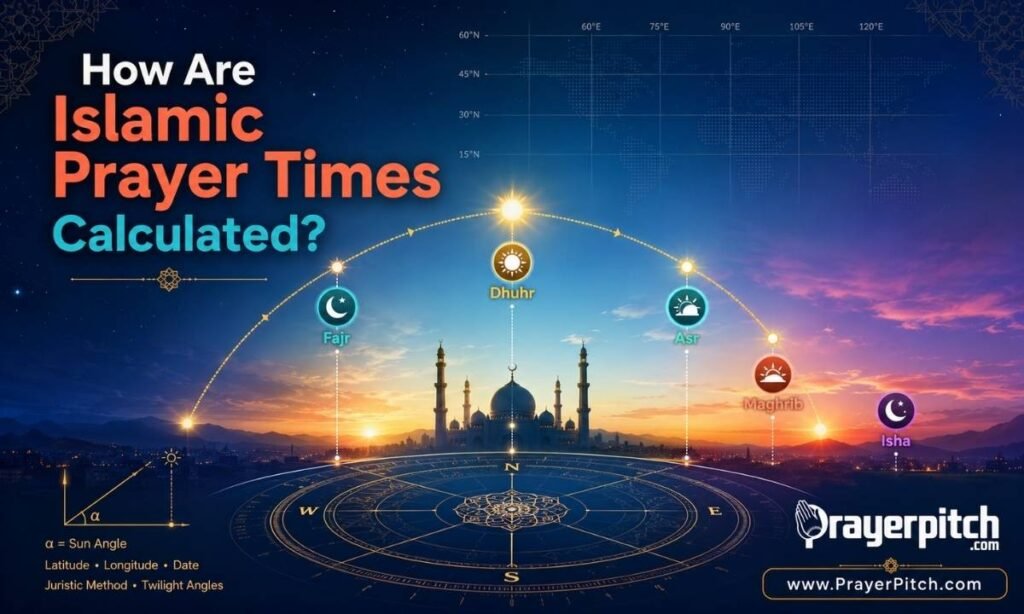
Underneath every prayer app and printed timetable is the same basic astronomy: where the sun sits relative to the horizon at a given location and moment.
Start with the Earth itself. It rotates on its axis roughly once every 24 hours and orbits the sun once a year on a tilted axis, which is why day length and the sun’s angle in the sky change through the seasons. For any point on Earth — defined by its latitude (how far north or south of the equator) and longitude (how far east or west) — you can calculate exactly where the sun will appear in the sky at any given moment, using well-established solar-position formulas that astronomers have refined over centuries.
From there, prayer-time calculation breaks the day down into specific solar events:
- Solar noon — the sun’s highest point for that day and location, which anchors Dhuhr.
- Sunset and sunrise — when the sun’s disc fully crosses the horizon, anchoring Maghrib and the end of Fajr.
- Dawn twilight — when the sun reaches a defined angle below the horizon before sunrise, anchoring the start of Fajr.
- Evening twilight — when the sun reaches a defined angle below the horizon after sunset, anchoring the start of Isha.
- Shadow length — how far an object’s shadow extends relative to its height as the afternoon progresses, anchoring Asr.
The twilight angles for Fajr and Isha are the two numbers where legitimate variation enters the picture, because “true dawn” and “true darkness” aren’t hard physical boundaries — they’re gradual transitions that different astronomical and religious authorities have measured and defined slightly differently, usually somewhere in the 15°–19.5° range below the horizon. Once you plug in a location’s coordinates, a date, and the specific angle values a calculation method uses, you get that day’s five prayer times.
Here’s a simple way to picture why two calculators can output different numbers for the exact same city and date: think of the sun’s descent below the horizon as a dimmer switch on a light, not an on/off switch. One organization might define “true dawn” as the point where the sky is 18% as bright as full daylight; another might set that threshold slightly earlier or later. Multiply that small difference across the whole calculation, and you get prayer times that are close — usually within a few minutes — but rarely identical between sources.
Why Do Islamic Prayer Times Differ Between Apps and Websites?
If you’ve ever compared two prayer apps side by side and found Fajr off by ten minutes and Isha off by twenty, you’re not imagining it, and neither app is necessarily broken. A handful of factors commonly cause the discrepancy:
- Different calculation methods. Muslim World League, ISNA, Umm al-Qura, and others each use their own Fajr and Isha angles (more on this below).
- Different Fajr and Isha angle settings, even within the same general method, since some apps let users manually adjust these.
- Different Asr methods — Standard versus Hanafi, as covered above.
- Slightly different geographic coordinates, especially in large cities, where one app might use city-center coordinates and another uses your exact GPS location.
- Elevation assumptions. Prayer times can shift by a minute or two at significant elevation, since a higher horizon line changes exactly when the sun becomes visible or disappears.
- Rounding conventions — some services round to the nearest minute differently, or round up versus down.
- Time zone and daylight-saving settings, particularly right around the days a region’s clocks change.
- Local mosque adjustments, where a masjid intentionally adds a few “precautionary” minutes to Fajr or subtracts a few from Isha for congregational convenience.
- High-latitude handling. Regions where true Fajr or Isha can’t occur astronomically in summer require special methods, and different authorities have adopted different fixes (more below).
None of this means one source is right and another is wrong. It usually means they’re built on different, equally legitimate conventions. If two schedules disagree, the most useful thing to do is check which calculation method and Asr setting each one is using, and — where it matters most, like Fajr for fasting — default to whichever convention your local mosque or regional Islamic authority follows.
What Is the Difference Between Fajr, Sunrise, and Imsak?
This trips up a lot of people, especially during Ramadan, so it’s worth being precise.
Fajr is true dawn — the astronomical moment that begins the Fajr prayer window and, in Ramadan, marks the start of the daily fast. Sunrise is a separate, later event: the moment the sun’s disc physically becomes visible above the horizon, roughly 60–90 minutes after Fajr depending on latitude and season. Fajr is not sunrise — there’s a genuine prayer window between the two, and treating them as the same thing is a common but mistaken assumption.
Imsak is a separate, practical concept layered on top of Fajr, mainly used during Ramadan. It refers to a short buffer period — typically 10 minutes — set before the calculated Fajr time, intended as a precaution so that a person finishing Suhoor (the pre-dawn meal) stops eating and drinking with some margin before the fast actually begins. Imsak is not a separate Islamic prayer time and it isn’t universally required; it’s a cultural and practical convention that many regional calendars include, rooted in caution rather than a distinct ruling that eating must stop earlier than true Fajr. Some Ramadan timetables print Imsak and Fajr as two separate lines; others print only Fajr. Either is fine — Imsak is simply a margin of safety, not a redefinition of when the fast technically begins.
So to put the sequence in order for a Ramadan morning: Imsak (a caution buffer, where used) comes first, then Fajr (true dawn, when the fast begins and the Fajr prayer window opens), then sunrise (when the Fajr window closes).
Why Do Prayer Times Change Every Day?
Prayer times shift daily because the Earth’s position relative to the sun is constantly changing, even from one day to the next.
As the Earth moves along its tilted orbit, the sun’s path across the sky at any given location gradually shifts — rising and setting a little earlier or later, and reaching a slightly different maximum height at solar noon. This is the same mechanism behind seasons: in summer, days are longer and the sun sits higher in the sky; in winter, the reverse is true. Because Fajr, Dhuhr, Asr, Maghrib, and Isha are all anchored to solar position rather than clock time, every one of them drifts gradually across the year.
A simple way to see it: in a city at mid-latitude, Fajr in the height of summer might fall well before 4:00 a.m., while the same city’s Fajr in midwinter might not arrive until closer to 6:00 a.m. — a swing of two hours or more, purely from the sun’s changing position. (These are illustrative examples only, not real times for any specific city.) Day to day, the shift is small — often a minute or less — but it accumulates steadily across weeks and months, which is exactly why a prayer timetable needs a new set of numbers for every single day rather than one fixed schedule.
Why Do Prayer Times Differ by Location?

Two people praying on the same date in different cities will see different prayer times, sometimes by hours, because location changes the sun’s position in three separate ways.
Longitude determines your time zone and roughly when solar noon falls in local clock time — move far enough east or west and the whole schedule shifts accordingly. Latitude determines how extreme your seasonal swings are: locations near the equator see relatively stable prayer times year-round, because day length barely changes, while locations farther from the equator see much larger seasonal swings in Fajr, Isha, and even Maghrib and Dhuhr.
At very high latitudes — northern Scandinavia, parts of Alaska, southern Chile in winter — the sun’s behavior becomes extreme enough that standard Fajr or Isha calculations can produce times that don’t reflect reality, or in some cases can’t be calculated using twilight angles at all during certain months, because the sun never dips far enough below the horizon. Regional Islamic authorities in these areas typically apply one of a few recognized “high-latitude” adjustment methods, such as dividing the night into fixed proportions or referencing the nearest latitude where normal twilight calculation still works, rather than leaving the prayer undefined.
For most of the world’s population, though, the practical takeaway is simpler: always use prayer times calculated for your specific city, not a nearby one, and if you’re in a region known for these seasonal extremes, follow your local mosque’s published adjustment rather than a generic app default.
Which Islamic Prayer Time Calculation Method Should You Use?
Several organizations have published their own sets of Fajr and Isha angles, developed for their region and generally adopted well beyond it as prayer apps became global. None of them is universally “the” correct method — they’re conventions, each with a reasonable astronomical and regional basis.
Commonly used methods include:
- Muslim World League (MWL) — widely used across Europe, parts of Asia, and elsewhere, using an 18° angle for both Fajr and Isha.
- Egyptian General Authority of Survey — one of the older established methods, commonly used across parts of Africa and the Middle East.
- Umm al-Qura, Makkah — used in Saudi Arabia, based on a fixed interval after Maghrib for Isha rather than a twilight angle.
- University of Islamic Sciences, Karachi — widely used across Pakistan, India, Bangladesh, and Afghanistan.
- Islamic Society of North America (ISNA) — commonly used across the United States and Canada.
Other regional and national authorities maintain their own conventions as well, often closely aligned with one of the methods above but adjusted slightly for local practice. If you’re not sure which to choose, the most practical approach is to match whichever method your local mosque or national Islamic council uses, since that keeps your personal schedule aligned with your community’s congregational prayer times. Most prayer apps let you select a method by name in settings, so this is usually a quick one-time adjustment rather than something you need to reconsider daily.
Why Is Asr Time Different in Hanafi and Standard Methods?
This deserves its own explanation because it’s one of the most common sources of confusion — and one of the easiest to resolve once you understand what’s actually being measured.
Both approaches to Asr rely on the same underlying idea: as the afternoon progresses, the sun drops lower and shadows grow longer. The disagreement is about exactly how long a shadow needs to be, relative to the object casting it, before Asr’s window opens.
The standard method (followed by the Shafi’i, Maliki, and Hanbali schools) sets the threshold at one shadow-length: when an object’s shadow becomes as long as the object itself (plus the shadow that already existed at solar noon), Asr begins. The Hanafi method sets the threshold at two shadow-lengths, meaning Asr doesn’t begin until the shadow is twice the object’s height. Because it takes longer in the afternoon for a shadow to double in length than to simply match the object’s height, Hanafi Asr consistently starts later than standard Asr — the gap can range from well under an hour near the equator to well over an hour at higher latitudes in certain seasons.
Both readings trace back to different scholarly interpretations of the same hadith describing the shadow at the time of Asr, and both are longstanding, respected positions within Islamic jurisprudence. There’s no need to view one as more authentic than the other. In practice, the simplest approach is to check which school you follow, or which convention your local mosque uses for its Asr congregational prayer, and set that as your default in whichever app or calendar you rely on.
Islamic Prayer Times During Ramadan
Ramadan doesn’t change how the five daily prayers are calculated, but two of them — Fajr and Maghrib — take on extra weight because they mark the start and end of the daily fast.
Fajr and Suhoor. Suhoor, the pre-dawn meal, must end by the start of Fajr, since fasting begins the moment true dawn arrives. This is why Ramadan calendars are printed so precisely and updated daily — a few minutes’ error at Fajr genuinely matters when it determines the exact moment eating and drinking must stop. As covered above, some calendars build in an Imsak buffer a few minutes before Fajr as an extra precaution, though it isn’t a separate religious requirement.
Maghrib and Iftar. The fast ends at Maghrib, the same moment the sunset prayer’s window opens, which is why Iftar — the breaking of the fast — is timed to Maghrib rather than to any other point in the evening. Many communities share dates or water at the exact calculated Maghrib time before eating a full meal.
Taraweeh is the special extended night prayer offered after Isha throughout Ramadan, and while it isn’t one of the five obligatory prayers, its timing follows directly from Isha’s calculated start time.
Because prayer times shift daily throughout the month — sometimes by a noticeable margin over the full 29 or 30 days of Ramadan — relying on a printed calendar from a previous year, or a screenshot passed around a family group chat, is a common and easily avoidable mistake. Ramadan timetables need to reflect the current year’s dates and your specific location, not a general estimate.
How to Find Accurate Islamic Prayer Times
A few practical habits go a long way toward avoiding the confusion covered throughout this guide:
- Use your exact location, not the nearest major city, especially if you live in a suburb or smaller town some distance from an urban center.
- Check which calculation method your app or website is using — MWL, ISNA, Umm al-Qura, Karachi, or another — and set it to match your local mosque where possible.
- Set the correct Asr method for your school of thought or community — Standard or Hanafi.
- Compare your app’s schedule with your local mosque’s printed or posted timetable periodically, particularly around Ramadan or seasonal transitions when times shift quickly.
- Double-check time zone and daylight-saving settings, especially in the days immediately before and after clocks change in your region.
- Remember that prayer times change every day — never rely on yesterday’s numbers, even if the difference feels negligible.
- Avoid outdated screenshots or old printed calendars. A Ramadan or general prayer timetable from a previous year will not match this year’s dates.
None of these steps require technical expertise — they’re mostly about making sure your settings actually reflect your location, your community’s convention, and the current date.
Conclusion
Islamic prayer times aren’t arbitrary numbers on a screen — they’re a daily translation of where the sun sits relative to your exact location, recalculated fresh every single day. Once you understand that Fajr tracks true dawn rather than sunrise, that Asr has two respected but different starting points, and that Isha and Fajr are the two prayers most sensitive to season and latitude, the small differences between apps, mosques, and calendars stop being confusing and start making sense. Set your location, pick the calculation method your community follows, and check in with your local mosque when something looks off — that’s really all accurate Islamic prayer times come down to.
Frequently Asked Questions
What are the five Islamic prayer times?
The five daily obligatory prayers are Fajr (dawn), Dhuhr (midday), Asr (afternoon), Maghrib (sunset), and Isha (night). Each begins at a specific solar event and its timing shifts daily based on date and location.
What time does Fajr begin and end?
Fajr begins at true dawn, when the sun reaches a defined angle below the eastern horizon, and ends at sunrise. The exact clock time depends entirely on your location and the date.
Is Fajr the same as sunrise?
No. Fajr is true dawn, which occurs roughly 60 to 90 minutes before sunrise depending on location and season. The period between Fajr and sunrise is itself the Fajr prayer window.
Is Imsak the same as Fajr?
Not quite. Imsak is a short precautionary buffer, commonly around 10 minutes, set before the calculated Fajr time on many Ramadan calendars. It’s a practical margin of safety rather than a distinct religious ruling that eating must stop earlier than Fajr itself.
Why do Islamic prayer times change every day?
Because they’re anchored to the sun’s position, and the Earth’s orbit constantly shifts that position — causing sunrise, sunset, solar noon, and twilight to fall at slightly different clock times each day.
Why are prayer times different between apps?
Common causes include different calculation methods (MWL, ISNA, Umm al-Qura, Karachi, and others), different Fajr and Isha angle settings, different Asr methods, slightly different coordinates, and local mosque adjustments. Most of these differences are a few minutes and reflect legitimate variation, not an error.
Which prayer time calculation method should I use?
There’s no single universally “correct” method. The most practical choice is whichever convention your local mosque or national Islamic authority follows, since that keeps your schedule aligned with your community.
Why is Asr time different between Hanafi and other methods?
The standard method starts Asr when a shadow equals the object’s height; the Hanafi method waits until the shadow reaches twice the object’s height. This reflects a longstanding difference in scholarly interpretation, not an error in either method.
Why do prayer times differ between cities?
Longitude affects your time zone and roughly when solar noon occurs locally, while latitude affects how much your prayer times swing across the seasons. Cities near the equator see smaller seasonal changes than cities farther north or south.
Are prayer times the same during Ramadan?
The calculation method doesn’t change during Ramadan, but Fajr and Maghrib take on added significance since they mark the start and end of the daily fast. Times still shift day to day throughout the month, so calendars need to reflect the current date.
How can I find accurate prayer times for my location?
Use your exact coordinates rather than a nearby city, select a calculation method and Asr setting that match your community, verify your time zone settings, and compare periodically against your local mosque’s schedule.
What determines Maghrib and Isha time?
Maghrib begins at sunset, when the sun’s disc fully disappears below the horizon. Isha begins once evening twilight has faded and the sky reaches a defined level of darkness, typically measured as a solar angle below the horizon.
Also Read More Islamic Contents:Reply of MashaAllah