

Someone just looked at your new car, your exam result, or your baby’s photo and said, “Mashallah!” Now you’re standing there wondering what the right response is. Should you say thank you? Is there a proper Islamic reply? You’re not alone in asking this. The reply of Mashallah is one of the most searched Islamic etiquette questions, and the answer is simpler than you might think, though there are a few beautiful options depending on the situation.
In this guide, we’ll walk through exactly what to say when someone says Mashallah to you, whether you’re chatting on WhatsApp, replying to an Instagram comment, or sitting across from your aunt at a family dinner. We’ll cover the Arabic phrases, their meanings, what scholars say, and plenty of real-life examples so you always know how to respond with grace.
What is the Correct Reply of Mashallah?
Here’s the short answer for anyone in a hurry: there is no single obligatory reply of Mashallah in Islam. Mashallah (ma sha Allah) is not a greeting like Assalamu Alaikum, which requires a specific response. It’s an expression of appreciation and a way of acknowledging that whatever good the speaker sees comes from Allah.
That said, Muslims around the world commonly respond in one of these warm, meaningful ways:
• Jazakallah Khair (May Allah reward you with goodness) — thanking the person for their kind words.
• Barakallahu Feek (May Allah bless you) — returning the blessing to them.
• Alhamdulillah (All praise is due to Allah) — redirecting the praise to Allah, the source of the blessing.
• Ameen — a simple, heartfelt “may it be so,” treating their Mashallah as a small prayer for you.
Any of these responses is correct. The best choice depends on tone, relationship, and context, which is exactly what we’ll unpack in the rest of this guide.
A quick word on what Mashallah actually means, because it shapes the reply. Ma sha Allah translates to “what Allah has willed.” When someone says it about your success, your health, or your family, they are really saying: this good thing exists because Allah willed it. In many Muslim cultures, it’s also said with the hope of protection from the evil eye. So when you reply, you’re responding to a compliment, a prayer, and a moment of shared faith all at once. That’s why the most loved replies either thank the person or return a blessing to them.
Jazakallah or Barakallah — Which is the Best Reply to Mashallah?
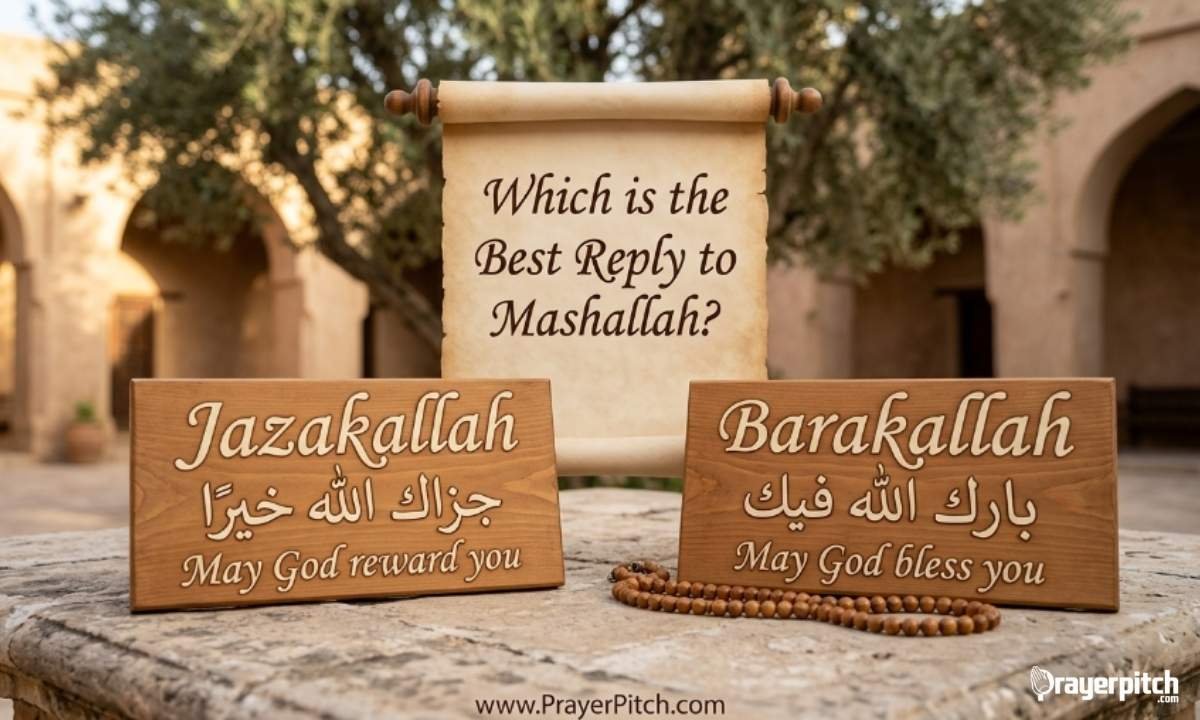
Both are beautiful, and honestly, you can’t go wrong with either. But they do carry slightly different flavors, and knowing the difference helps you pick the one that fits the moment.
Jazakallah Khair means “may Allah reward you with goodness.” It works like a spiritually elevated thank you. Use it when you want to express gratitude for the person’s kind words. If a colleague says “Mashallah, you handled that presentation so well,” replying with Jazakallah Khair thanks them while asking Allah to reward their kindness.
Barakallahu Feek means “may Allah bless you.” Rather than thanking, it mirrors the blessing back. They prayed for you by saying Mashallah; you pray for them in return. It creates a lovely exchange of duas. If your friend says “Mashallah, your garden looks amazing,” replying Barakallahu Feek sends the goodness right back to them.
So which is best? Many people feel Barakallahu Feek is the most fitting reply of Mashallah because it completes the circle: blessing for blessing. Jazakallah Khair is slightly more about gratitude, and it shines when someone has gone out of their way to compliment or help you. In everyday practice, Muslims mix both freely, and both are excellent.
One small note on gender and number in Arabic. Barakallahu Feek is said to one male. To one female, it becomes Barakallahu Feeki. To a group, Barakallahu Feekum. If you can’t remember the endings, don’t stress — the intention matters far more than perfect grammar, and everyone will understand you.
And if someone says Barakallahu Feek to you, the traditional response is Wa Feeka Barakallah (and may Allah bless you too) — Wa Feeki Barakallah when speaking to a woman. It’s the gracious full-circle ending to the exchange.
Reply of Mashallah in Arabic with Meaning
If you want to respond in Arabic the way it’s traditionally spoken, here are the most common replies with their transliteration and meaning. Keep this table handy — it covers nearly every situation you’ll face.
| Arabic Reply | Transliteration | Meaning | Best Used When |
| جزاك الله خيرا | Jazakallah Khair | May Allah reward you with goodness | Thanking someone for their kind words |
| بارك الله فيك | Barakallahu Feek | May Allah bless you | Returning the blessing warmly |
| وفيك بارك الله | Wa Feeka Barakallah | And may Allah bless you too | Replying when someone says Barakallahu Feek |
| الحمد لله | Alhamdulillah | All praise is due to Allah | Redirecting praise to Allah humbly |
| آمين | Ameen | May it be so | Accepting their words as a dua |
| اللهم بارك | Allahumma Barik | O Allah, bless (it/them) | Joining them in seeking blessing |
Notice how each reply carries its own spirit. Alhamdulillah is humble: you’re saying the credit belongs to Allah, not me. Ameen is receptive: you’re accepting their Mashallah as a prayer. Barakallahu Feek is generous: you’re giving a prayer back. Choose the one that matches your heart in the moment, and you’ll never be wrong.
Reply of Mashallah in English
Not everyone is comfortable with Arabic phrases, and that’s completely fine. Islam values intention over vocabulary. If you’d rather respond in English, or you’re speaking with someone who might not understand Arabic replies, here are natural English responses that carry the same warmth:
• “May Allah bless you too.” — the English twin of Barakallahu Feek.
• “All praise belongs to Allah.” — the meaning of Alhamdulillah, spoken plainly.
• “Thank you, that’s so kind. May Allah reward you.” — gratitude with a dua attached.
• “Ameen, thank you for your kind words.” — simple and heartfelt.
• “That means a lot — may Allah keep you and your family blessed.” — warm and personal.
Mixing English and Arabic is also perfectly natural. Millions of Muslims reply with something like “Aww, Jazakallah Khair! That’s so sweet of you.” Faith and everyday language blend all the time, and there’s nothing wrong with that. What matters is acknowledging their kindness and remembering Allah in your response.
Reply of Mashallah from a Girl or Boy
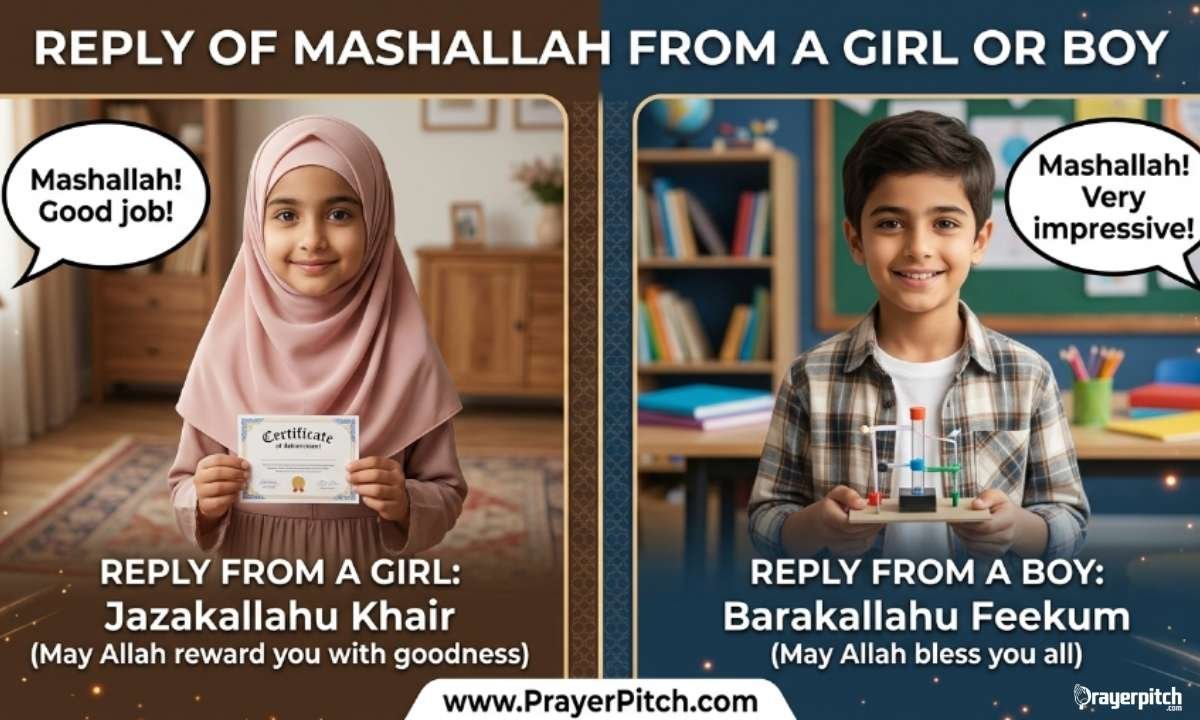
A very common question: does the reply of Mashallah change depending on whether a girl or a boy is responding? The core answer is no — the replies themselves (Jazakallah Khair, Barakallahu Feek, Alhamdulillah, Ameen) are the same for everyone. What changes slightly is the Arabic grammar when you’re addressing someone, not when you’re the one replying about yourself.
Here’s the simple breakdown:
• Replying to a male: Barakallahu Feek / Jazakallah Khair.
• Replying to a female: Barakallahu Feeki / Jazakillah Khair.
• Replying to a group: Barakallahu Feekum / Jazakumullah Khair.
So if a girl receives a Mashallah and wants to reply to the woman who said it, she’d say Barakallahu Feeki. If a boy replies to his uncle, he’d say Barakallahu Feek. The person’s own gender doesn’t change anything; the listener’s does.
There’s also a social etiquette layer worth mentioning. In conversations between non-mahram men and women (people who could marry each other), Islamic etiquette encourages modest, respectful exchanges. A short, polite reply — Jazakallah Khair or a simple Ameen — is graceful and appropriate. There’s no need for lengthy back-and-forth to be courteous.
Can You Simply Say Thank You After Mashallah?
Yes, you absolutely can. Saying “thank you” or “thanks” after someone says Mashallah is not wrong, disrespectful, or sinful. It’s a normal human response to a kind word, and kindness deserves acknowledgment in whatever language comes naturally.
That said, many scholars and everyday Muslims would gently encourage adding something more, for one lovely reason: when someone says Mashallah, they’ve brought Allah into the conversation. They’ve acknowledged that your blessing came from Him. Responding with only “thanks” answers the compliment but leaves the dua part hanging. Adding Alhamdulillah, Ameen, or a return blessing completes the spiritual exchange.
Think of it like this: “Thank you” answers the person. “Alhamdulillah, thank you!” answers the person and remembers Allah. Neither is wrong — one is simply fuller.
The Prophet Muhammad (peace be upon him) taught that whoever does you a kindness should be repaid, and if you cannot repay them, then pray for them (Sunan Abi Dawud 1672). A compliment wrapped in Mashallah is a kindness. Returning a small dua — even just “may Allah bless you” — beautifully fulfills that teaching.
Difference Between Mashallah, Subhanallah and Alhamdulillah
These three phrases are close cousins, and people often mix them up. Each one praises Allah, but from a different angle and in a different moment. Understanding when each is used will also sharpen your instinct for how to reply when you hear them.
| Phrase | Literal Meaning | When It’s Said | Example Moment |
| Mashallah | What Allah has willed | Admiring a blessing someone has, often with protection from envy in mind | “Mashallah, your son recited the whole surah!” |
| Subhanallah | Glory be to Allah | Amazement or wonder at something in creation | “Subhanallah, look at that sunset over the mountains.” |
| Alhamdulillah | All praise is due to Allah | Gratitude for a blessing you have received | “I passed my exam, Alhamdulillah!” |
A simple way to remember the difference: Mashallah looks outward at someone else’s blessing. Subhanallah looks upward in awe. Alhamdulillah looks inward with gratitude. So when your friend gets good news, you say Mashallah about their news, and they say Alhamdulillah about their own. When you both see something breathtaking, you say Subhanallah together.
This also explains why Alhamdulillah is such a natural reply of Mashallah. The speaker points at your blessing and credits Allah (Mashallah); you receive it and credit Allah too (Alhamdulillah). Two people, one acknowledgment of the true Source.
Islamic Scholars’ Views on Replying to Mashallah
Scholars across the major schools agree on the essentials here, which makes this refreshingly uncomplicated.
• There is no obligatory reply. Unlike returning the salam greeting, which scholars classify as a duty, responding to Mashallah is voluntary. No sin is incurred by staying silent.
• Responding with dua is recommended and loved. Scholars encourage answering kindness with kindness, citing the general principle in the Quran: “When you are greeted with a greeting, respond with one better than it, or return it equally” (Surah An-Nisa 4:86). While this verse addresses greetings, scholars extend its spirit to kind words generally.
• Saying Mashallah itself is rooted in the Quran. In Surah Al-Kahf (18:39), a man is advised he should have said upon entering his garden: “Ma sha Allah, la quwwata illa billah” — what Allah has willed; there is no power except through Allah. This is why some people say the full phrase, and replying Ameen to it is perfectly fitting.
• Redirecting praise to Allah is praised. Scholars note that responding with Alhamdulillah guards the heart against pride. The compliment passes through you and lands where it belongs — with Allah.
In short, the scholarly consensus is generous: reply in any of the recommended ways, keep your intention sincere, and remember Allah in your answer. There is no single “correct password” — there is simply good etiquette, and several beautiful ways to practice it.
Examples of Replies to Mashallah in Daily Life
Theory is nice, but let’s make this practical. Here’s how the reply of Mashallah plays out in real conversations — the ones actually happening on your phone and in your living room.
On WhatsApp
• Aunt: “Mashallah! Your graduation photos are beautiful ❤️” — You: “Jazakallah Khair Khala! Your duas made this possible 🤲”
• Friend in the family group: “New job? Mashallah bro!” — You: “Alhamdulillah! Barakallahu feek 🙌”
• Cousin: “Mashallah the baby is getting so big!” — You: “Ameen! Alhamdulillah, she’s growing fast. May Allah bless your kids too!”
On Instagram
• Comment: “Mashallah, this cake is stunning 😍” — Reply: “Jazakillah khair sis! 🤍”
• Comment on a fitness post: “Mashallah, the discipline is real” — Reply: “Alhamdulillah 🙏 consistency is all His tawfeeq”
• Story reply: “Mashallah your view!” — Reply: “Alhamdulillah! Make dua you visit too 😄”
In Family Conversations
• Grandmother, holding your hand: “Mashallah, you’ve grown into such a fine young man.” — You: “Ameen, Dadi. It’s your prayers. May Allah give you a long, healthy life.”
• Father, after you fix something around the house: “Mashallah, you’re handy now.” — You, smiling: “Alhamdulillah — learned from watching you, Abbu.”
Receiving Compliments from Colleagues or Neighbors
• Colleague: “Mashallah, you stayed so calm in that meeting.” — You: “That’s kind of you, Jazakallah Khair. Honestly, Alhamdulillah for patience!”
• Neighbor: “Mashallah, your kids are so well-mannered.” — You: “May Allah bless you for saying that — and keep your family happy too.”
Notice a pattern? Every reply does two small things: it acknowledges the person, and it remembers Allah. That’s the whole art. If you enjoy weaving faith naturally into everyday moments like these, you may also love understanding divine blessings in everyday life — it explores how small daily exchanges carry spiritual weight.
Many families also make it a habit to open the day with gratitude and close it with dua. If that speaks to you, browse these uplifting good morning blessings or start your routine with powerful morning prayers that set a peaceful tone before the world gets loud.
And since blessings have their own rhythm through the week — from Tuesday morning prayers and blessings to Friday blessings on the most honored day of the week, and even Saturday blessings for slow weekend mornings — there’s always a fitting way to share goodness with the people you love.
Frequently Asked Questions About Reply of Mashallah
What is the best reply of Mashallah?
The most loved replies are Jazakallah Khair (may Allah reward you), Barakallahu Feek (may Allah bless you), Alhamdulillah (all praise is due to Allah), or a simple Ameen. None is obligatory; all are correct. Barakallahu Feek is especially popular because it returns the blessing to the speaker.
Is it compulsory to reply when someone says Mashallah?
No. Mashallah is not a greeting that requires a mandatory response like the salam. Replying is voluntary, but responding with a kind word or dua is recommended etiquette and reflects the Islamic principle of returning kindness with equal or better kindness.
Can I reply to Mashallah with just “thank you”?
Yes, saying thank you is perfectly acceptable and not sinful. However, adding an Islamic phrase such as Alhamdulillah or “may Allah bless you too” completes the spiritual side of the exchange, since Mashallah itself is a form of remembering Allah.
What does Wa Feeka Barakallah mean?
Wa Feeka Barakallah means “and may Allah bless you too.” It is the traditional response when someone says Barakallahu Feek to you. When speaking to a woman, it becomes Wa Feeki Barakallah.
What is the reply of Mashallah on WhatsApp or Instagram?
The same replies work online: Jazakallah Khair, Barakallahu Feek, Alhamdulillah, or Ameen — often paired with a friendly emoji. Keep it short, warm, and sincere, exactly as you would in person.
Should I say Mashallah or Alhamdulillah about my own achievement?
Say Alhamdulillah for your own blessings, since it expresses gratitude for what you received. Mashallah is typically said about someone else’s blessing. If someone says Mashallah about your achievement, replying Alhamdulillah is a natural and humble fit.
Does saying Mashallah protect from the evil eye?
Many Muslims say Mashallah when admiring something precisely with this intention, drawing on Surah Al-Kahf (18:39), where the phrase is linked to acknowledging that all power belongs to Allah. Scholars encourage it as a way of blessing rather than envying what you admire.
Conclusion: Answering Mashallah with Grace
The reply of Mashallah doesn’t need to be complicated. When someone honors your blessing by crediting Allah, the most beautiful thing you can do is respond in the same spirit — with gratitude, humility, and a small prayer of your own.
Key takeaways to remember:
• No reply is obligatory, but responding kindly is loved and recommended.
• Barakallahu Feek returns the blessing; Jazakallah Khair expresses thanks; both are excellent.
• Alhamdulillah humbly redirects the praise to Allah, and Ameen accepts their words as a dua.
• A plain “thank you” is fine — adding a dua makes it fuller.
• The grammar changes with the listener (Feek, Feeki, Feekum), but sincerity matters more than perfect Arabic.
Next time someone smiles and says “Mashallah,” you’ll know exactly what to say — and you’ll mean every word of it. May your days be full of moments worth a Mashallah, and may every reply you give carry blessing back to the one who spoke it. Ameen.