

Sunday mornings can feel like a battle. The alarm goes off, the kids are slow to move, the couch is comfortable, and the temptation to just stay home and catch a sermon online is very real. Most believers have been there — and many have started to wonder whether showing up in person each week actually matters.
But church attendance is not just a religious habit or a rule someone made up. It is one of the most intentional, life-shaping decisions a believer can make. When you walk through those doors week after week, something happens to your faith, your family, and your soul that simply cannot be replicated anywhere else.
What’s So Important About Church?
Before we get into the specific reasons, it helps to take a step back and ask a more fundamental question: what is the church, really? It is not a building. It is not a service you attend. It is a living, breathing community of people who share a common faith in Jesus Christ and who are called to do life together — to worship, to grow, to serve, and to carry one another through the hard seasons of life.
The church matters because people matter. We are not designed to walk the road of faith alone. Hebrews 10:24-25 is direct about this: “Let us consider how to stir up one another to love and good works, not neglecting to meet together, as is the habit of some, but encouraging one another, and all the more as you see the Day drawing near.” The writer of Hebrews understood something we still struggle with — that the impulse to drift away from community is real, and the antidote is showing up anyway.
Church is also important because it is where the Word of God is taught, where the sacraments are observed, and where the mission of God is organized and sent out. It is the primary structure God established for the flourishing of His people. When it is working the way it is meant to, it is one of the most powerful forces for good in any community.
Top 10 Reasons for Attending Church Every Sunday
1. Humans Are Built for Community
From the very beginning, God said it was not good for man to be alone. That truth extends beyond marriage — it speaks to a deep, wiring-level need for belonging that every human being carries. We were made for relationship, for knowing and being known, for walking side by side with people who are honest about their struggles and faithful in their love.
Church is one of the last places in modern life where people of different ages, backgrounds, and life stages gather around a single, shared identity. In a world that increasingly sorts us into echo chambers of people just like us, the local church offers something countercultural and deeply human — genuine community across the lines that would otherwise divide us. Showing up every Sunday is how you build that community. You cannot belong to something you are never present for.
2. Church Is Good for the Soul
The soul needs tending. It gets battered by the week — by disappointments, temptations, grief, and the slow grind of ordinary life. Church is where the soul gets to exhale. Worship, prayer, the preaching of the Word, the confession of sin, the assurance of forgiveness — all of these are soul-level nourishment that refuels what the world depletes.
There is something about corporate worship in particular that does something individual devotion cannot fully replicate. When you sing alongside a hundred other people who believe what you believe, when you hear the truth spoken out loud by a pastor who has wrestled with it himself, when you sit in the presence of the sacred together — your soul registers something it does not when you are alone. The gathered church is a spiritual ecosystem, and your soul thrives inside it.
3. Church Is Good for the Body
Research consistently shows that regular churchgoers live longer, report higher levels of well-being, and are more likely to have strong social support networks. This is not coincidental. The church provides community that catches you when you fall — people who bring meals when you are sick, who pray when you are anxious, who show up to help you move or sit with you in the hospital waiting room.
Beyond social support, the spiritual disciplines practiced in church — gratitude, service, forgiveness, and hope — have measurable effects on physical health. Chronic stress is one of the most damaging forces on the human body, and faith communities consistently offer the kind of peace, perspective, and purpose that buffer against it. Attending church is, in a very real sense, good medicine.
4. Church Is Good for Our Spirit
The spirit is the part of us that connects with God, that hungers for meaning, that longs for something beyond the visible world. Without regular feeding, it grows thin and restless. Church is where the spirit gets direct attention — where prayer, Scripture, the Holy Spirit’s presence in worship, and the witness of other believers all combine to strengthen and renew the inner life.
Regular church attendance keeps your spirit oriented toward eternity. In a culture that is almost entirely focused on the immediate — the urgent, the trending, the fleeting — the weekly rhythms of church ground you in something timeless. They remind you who you are, whose you are, and what actually matters. That kind of spiritual reorientation is something the spirit desperately needs every single week.
5. Church Is an Honor and a Privilege
It is worth pausing to remember that for millions of Christians throughout history — and for many believers in the world today — gathering with other believers is not just a choice but a risk. People have gone to church in secret, in underground rooms, in the face of imprisonment or death, because they understood that what happens when the church gathers is worth any cost.
For those of us who can walk freely through church doors every Sunday morning, attendance is not a burden — it is a gift. It is the exercise of a freedom that believers around the world have bled for. To treat that privilege casually, to skip it for mild inconvenience, is to miss the weight of what we have been given. Attending church is an act of gratitude for the freedom to do so.
6. Church Strengthens Families
Families that worship together grow together. There is a wealth of research and a mountain of anecdotal evidence that says families who regularly attend church together have stronger relationships, lower divorce rates, and children who are more likely to maintain their faith into adulthood. The rhythms of church give families a shared language, a shared set of values, and a shared community that reinforces what is being built at home.
Church also gives children something they cannot get from school or sports or extracurricular activities — a multigenerational community where they are known by adults who are not their parents. Grandparent figures who remember their names, mentors who invest in them, peers who share their faith. These relationships shape character in ways that last far beyond childhood. Bringing your family to church every Sunday is one of the most strategic investments you can make in their lives.
7. Church Gives Hope in Hard Times
Life will bring hard seasons. Grief, illness, job loss, broken relationships, seasons of doubt — no one is exempt. In those moments, the church becomes something extraordinary. It is the body of Christ, showing up in tangible, practical, embodied ways to carry people through what they cannot carry alone. It is the community that prays when you have no words left, that sings when you cannot, that holds you when you are falling.
Hope is not just a feeling — it is a choice, and it is much harder to sustain in isolation. When you are embedded in a church community, you have access to people who have walked through hard things and come out the other side still believing. Their stories become your anchor. Their faith shores up yours. The church is where hope is not just preached but lived — where you can look around the room and see evidence that God is faithful even when life is not easy.
8. Church Teaches God’s Truth
We live in an age of infinite information and very little wisdom. Opinions are everywhere. Truth is contested. The noise is relentless. The local church — when it is doing its job faithfully — is one of the places where the eternal, unchanging Word of God is opened, taught, and applied to real life week after week. That is irreplaceable.
Regular exposure to sound biblical teaching shapes the way you think, the way you make decisions, the way you interpret the world around you. It builds theological roots that keep you grounded when cultural winds try to push you in every direction. You will not accidentally become theologically deep — it takes consistent, intentional exposure to Scripture in community. Church is where that happens.
9. Church Inspires a Life of Service
The church is not meant to be a place you consume — it is a place you contribute. When you are regularly present in a local body of believers, you begin to see the needs around you, discover your gifts, and find natural places to serve. Serving in the church shapes your character in ways that sitting in a pew never will. It stretches you, humbles you, and connects you to the mission of God in tangible ways.
Service also gives your faith hands and feet. It is easy to believe in the abstract — to hold convictions without putting them into practice. But when you show up to serve in the nursery, lead a small group, welcome a first-time visitor, or sit with someone who is hurting, your faith becomes lived. It becomes real. And it has a way of deepening in the process. A life of service starts with showing up.
10. Church Prepares Us for the Week Ahead
Sunday is not just the end of the week — it is the beginning of the next one. What happens at church on Sunday morning has the power to reframe everything that follows. You leave with a clearer sense of who you are and who God is. You leave encouraged, challenged, prayed over, and spiritually nourished. You leave as part of a community that is holding you accountable and cheering you on.
Think of church attendance as a weekly recalibration. The world will pull you off center — it always does. The routines of work and busyness and distraction will slowly crowd out the things that matter most. Church is the weekly reset. It says: before you go back out into the noise, pause. Worship. Listen. Be reminded. Be renewed. Then go — and go differently because you came.
Bible Verses for Attending Church
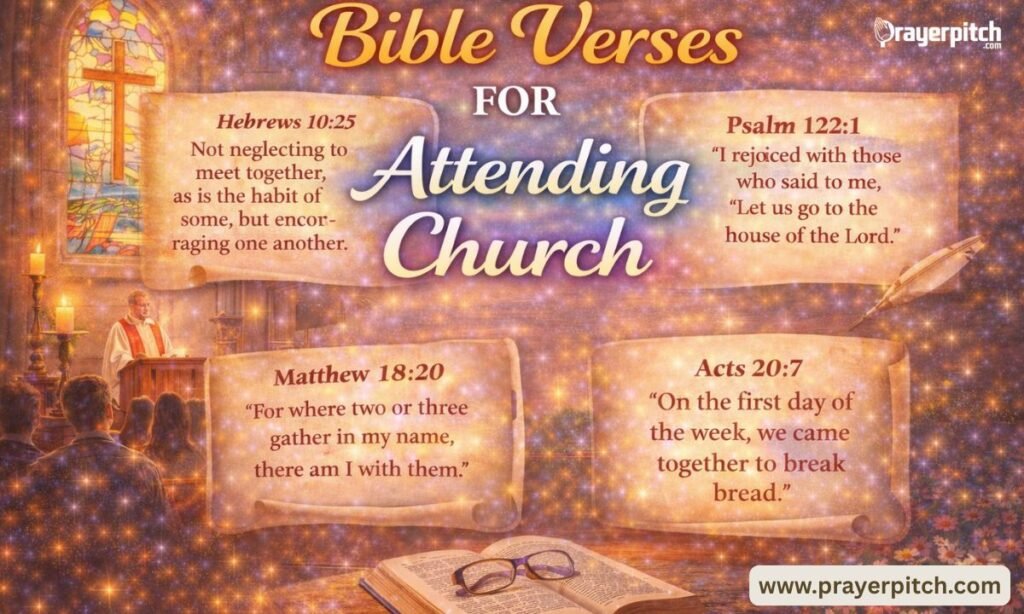
Scripture has a great deal to say about the importance of gathering together. These verses are not guilt-trips — they are invitations from a God who knows exactly what we need and has built the provision for it into the life of His church.
Hebrews 10:24-25
“And let us consider how to stir up one another to love and good works, not neglecting to meet together, as is the habit of some, but encouraging one another.” This verse directly addresses the tendency to drift from community and calls believers back to the discipline of gathering.
Psalm 122:1
“I was glad when they said to me, ‘Let us go to the house of the Lord!'” The psalmist did not approach worship reluctantly or dutifully — he was genuinely glad. This is the posture church attendance is meant to cultivate: joy in gathering with God’s people.
Matthew 18:20
“For where two or three are gathered in my name, there am I among them.” Jesus makes a direct promise about His presence in gathered community. There is something about the assembled church that carries a particular weight of His presence.
Acts 2:42
“And they devoted themselves to the apostles’ teaching and the fellowship, to the breaking of bread and the prayers.” The early church modeled what consistent, devoted community looks like. Devotion — not casual attendance — was their posture. It is worth asking whether ours reflects the same.
Colossians 3:16
“Let the word of Christ dwell in you richly, teaching and admonishing one another in all wisdom, singing psalms and hymns and spiritual songs.” This vision of the gathered church — teaching, encouraging, singing — is a picture of what Sunday morning is meant to be.
What to Do When We Don’t Feel Like Going to Church?

Here is the honest truth: there will be Sundays when you do not feel like going. You will be tired. You will be discouraged. You will be carrying something heavy that makes the thought of putting on a smile and making small talk feel exhausting. And on those days, the temptation to stay home will be loudest.
Those are often the days when you need to go the most. Feelings are real, but they are not always reliable guides. The discipline of showing up — especially when you do not feel like it — is what separates occasional attendance from genuine commitment, and it is where some of the most significant spiritual breakthroughs happen.
Start by being honest. You do not have to pretend everything is fine when it is not. In fact, the church is supposed to be one of the few places where you can show up in your actual state — tired, doubting, grieving, or just dry — and be received with grace. You do not have to perform wellness to walk through those doors.
Tell a friend. One of the most practical things you can do is build a relationship with someone at church who will check on you, sit with you, and occasionally ask the direct question: “Are you coming Sunday?” Accountability in community is not about pressure — it is about care. We all need people who notice when we are absent.
Lower the bar for a season if you need to. If you are in a particularly depleted stretch, give yourself permission to show up without expectation — no pressure to serve, no need to have deep conversations, no requirement to feel moved or inspired. Just be there. Let the music wash over you. Let the Word land without demanding that you process all of it. Sometimes presence is the whole assignment.
And when you genuinely cannot go — when illness or emergency or unavoidable circumstances keep you away — be honest about the difference between can’t and won’t. The occasional missed Sunday is not a spiritual crisis. A pattern of avoidance is. Know the difference, and be willing to ask someone you trust to speak into it if you are not sure.
Conclusion
Attending church every Sunday is not about following a rule or earning points with God. It is about showing up to the community He designed for your flourishing — the place where your soul is fed, your faith is sharpened, your family is strengthened, and your life is woven into something larger than itself.
Every Sunday, across the world, imperfect people gather in imperfect churches to worship a perfect God. They come tired and hopeful, doubting and believing, carrying burdens and ready to lay them down. And week after week, God meets them there. He will meet you there too. The doors are open. You are expected. Come.
Blessings for the Journey:
• May you find in the local church a community that knows your name and carries your burdens.
• May Sunday mornings become the highlight of your week rather than a hurdle to clear.
• May your family be shaped, generation by generation, by the faithful rhythms of gathering together.
• May you experience the tangible presence of God in the midst of His gathered people.
• May the Word of God, preached and sung and lived, sink deep into your soul and change you from the inside out.
• May you be both encouraged and an encourager — someone whose presence makes the room better.
• May the hard seasons drive you toward the church rather than away from it, and may you find there exactly what you need.
• May you never take lightly the gift of worshiping freely, and may gratitude be the posture you carry every time you walk through those doors.
Frequently Asked Questions
1. Is it really necessary to attend church every Sunday?
While grace covers missed Sundays, consistent attendance is what forms deep faith, strong community, and spiritual maturity. The rhythm of weekly gathering is not a legalistic rule — it is a proven pathway to a flourishing life with God and His people.
2. Can I just watch church online instead of attending in person?
Online church has real value in certain seasons or circumstances, but it cannot fully replace in-person community. You cannot be truly known, serve others, receive physical comfort, or share in the sacraments through a screen — and those things matter deeply.
3. What if I don’t feel connected at my church?
Connection rarely happens by accident — it is usually the result of intentional effort. Join a small group, volunteer somewhere, introduce yourself to the person sitting next to you. Belonging is built through consistent presence and small, repeated acts of showing up.
4. How do I get my kids to want to go to church?
Make church a non-negotiable family rhythm rather than a negotiated choice, and let your children see that you genuinely value it. When they see faith lived authentically at home and in community, it becomes something meaningful to them rather than something imposed on them.
5. Does God care if I miss church occasionally?
God’s love for you is not contingent on perfect attendance. However, He does care about your growth, your community, and your spiritual health — all of which are deeply served by the habit of gathering. Occasional absences are different from a pattern of avoidance.
6. What if I’ve been hurt by a church before?
Church hurt is real and it deserves to be taken seriously. Healing may require time, counseling, and finding a community that is safe and healthy. But one broken community does not disqualify all community — the answer to bad church is usually better church, not no church.
7. Are there benefits to church attendance beyond spiritual ones?
Yes, significantly. Regular churchgoers report better mental health, stronger social networks, longer life expectancy, and greater resilience in the face of hardship. The holistic benefits of church community touch every dimension of human flourishing.
8. What is the best way to build the habit of attending church every Sunday?
Treat it like any other non-negotiable in your week — put it in your calendar, prepare the night before, build it into your family routine, and find an accountability partner. Habits are formed through repetition, and the discipline gets easier the more consistently you practice it.