

There is something quietly powerful about a set of beads passing through your fingers while your heart rests on the life of Jesus. For centuries, Catholic rosary prayers have carried people through grief, gratitude, illness, celebration, and the ordinary rhythm of everyday life. Whether you grew up praying the Holy Rosary with your grandmother or you are picking up a rosary for the very first time, this guide will walk you through everything, one gentle step at a time.
In this complete rosary guide, you will learn what rosary prayers are, where they came from, how to pray the rosary step by step, and what each of the four mysteries means. You will also find practical tips for beginners, short rosary prayers for busy days, and answers to the questions people ask most. By the end, my hope is simple: that you feel confident and genuinely drawn to make daily rosary prayers part of your walk with God.
What Are Rosary Prayers?
Rosary prayers are a structured set of Catholic prayers, prayed on a string of beads, that combine vocal prayer with meditation on the life of Jesus Christ and the Blessed Virgin Mary. The core prayers of the rosary are the Apostles’ Creed, the Our Father (the Lord’s Prayer), the Hail Mary, and the Glory Be, prayed in a repeating pattern while reflecting on events called mysteries.
That definition is worth reading twice, because it clears up the most common misunderstanding about the rosary. The rosary is not simply repeating words. The words are the melody; the meditation is the song. While your lips pray the Hail Mary, your mind and heart walk through scenes from Scripture, from the Annunciation in Nazareth to the Resurrection on Easter morning.
A standard rosary has five decades, and each decade is a set of ten beads. One full loop of the beads covers:
- 1 Apostles’ Creed, prayed on the crucifix
- 6 Our Father prayers (one to open, one before each decade)
- 53 Hail Mary prayers (three at the start, then ten per decade)
- 6 Glory Be prayers, along with the Fatima Prayer if you choose to include it
- 1 Hail Holy Queen and a closing prayer at the end
If you are searching for a rosary for beginners, take heart. The structure looks complicated on paper, but the beads themselves do the remembering for you. Within a week or two of daily practice, your hands will know the way, and your heart will be free to pray.
The History and Meaning of the Rosary
The rosary did not appear overnight. It grew slowly, the way most beloved traditions do, out of the prayer life of ordinary Christians.
In the early centuries of the Church, monks prayed all 150 Psalms as part of their daily devotion. Lay people who could not read wanted to join that rhythm of prayer, so they began praying 150 Our Fathers instead, counting them on knotted cords or strings of beads. Over time, the Hail Mary prayer took shape from the words of the Angel Gabriel and Elizabeth in Luke’s Gospel, and it gradually joined the pattern. By the Middle Ages, the practice of praying 150 Hail Marys, grouped into decades and paired with meditations on the life of Christ, had become what we now call the Holy Rosary.
Catholic tradition holds that the Blessed Virgin Mary gave the rosary to Saint Dominic in the early 1200s as a weapon against error and a school of prayer. Whether you read that account as precise history or holy legend, the fruit is undeniable: the Dominican Order spread the rosary across Europe, and it became the most widely prayed Catholic devotion in the world.
A few milestones help explain why the rosary means so much to Catholics today:
- 1571, the Battle of Lepanto. Pope Pius V asked all of Europe to pray the rosary for protection, and the victory that followed gave us the feast of Our Lady of the Rosary on October 7.
- 1917, Fatima. During her appearances to three shepherd children in Portugal, Mary repeatedly asked the world to pray the rosary daily for peace.
- 2002, the Luminous Mysteries. Pope John Paul II added five new mysteries focused on the public ministry of Jesus, calling the rosary a compendium of the Gospel.
The word rosary itself comes from the Latin rosarium, meaning a garland or garden of roses. Every Hail Mary, the old saying goes, is a rose offered to Our Lady. But the deeper meaning is Christ-centered from beginning to end. As John Paul II put it, to pray the rosary is to contemplate the face of Christ with Mary. She is not the destination; she is the best of guides, always pointing to her Son, just as she did at Cana: “Do whatever he tells you” (John 2:5).
How to Pray the Rosary Step by Step?
Here is the complete order of prayers in the rosary. Keep this rosary guide beside you the first few times you pray, and do not worry about being perfect. God is not grading your technique.
- Begin with the Sign of the Cross. Hold the crucifix and pray: In the name of the Father, and of the Son, and of the Holy Spirit. Amen.
- Pray the Apostles’ Creed. Still holding the crucifix, profess the ancient summary of the Christian faith.
- Pray the Our Father. Move to the first large bead above the crucifix.
- Pray three Hail Marys. On the next three small beads, traditionally offered for an increase in faith, hope, and love.
- Pray the Glory Be. On the space or chain before the next large bead.
- Announce the first mystery. Name the mystery you are meditating on, for example, the Annunciation, and pray an Our Father on the large bead.
- Pray ten Hail Marys. Move through the ten beads of the decade while holding the scene of the mystery in your mind.
- Pray the Glory Be and the Fatima Prayer. Many Catholics add: O my Jesus, forgive us our sins, save us from the fires of hell, and lead all souls to heaven, especially those in most need of thy mercy.
- Repeat for the remaining four mysteries. Announce each mystery, pray one Our Father, ten Hail Marys, one Glory Be, and the Fatima Prayer.
- Pray the Hail Holy Queen. After the fifth decade, pray this beautiful hymn to Mary, followed by the closing prayer and the Sign of the Cross.
A full rosary takes most people about 15 to 20 minutes. If you pray in the morning, it pairs naturally with other daily Catholic prayers; many readers like to open the day with a decade of the rosary alongside seasonal devotions such as these morning prayers for June, then carry that peace into work, school, or family life.
One practical tip before we look at each prayer in detail: pray slowly. The rosary is not a race to the final bead. If a single Hail Mary opens into real conversation with God, stay there. The beads will wait.
The Apostles’ Creed in the Rosary
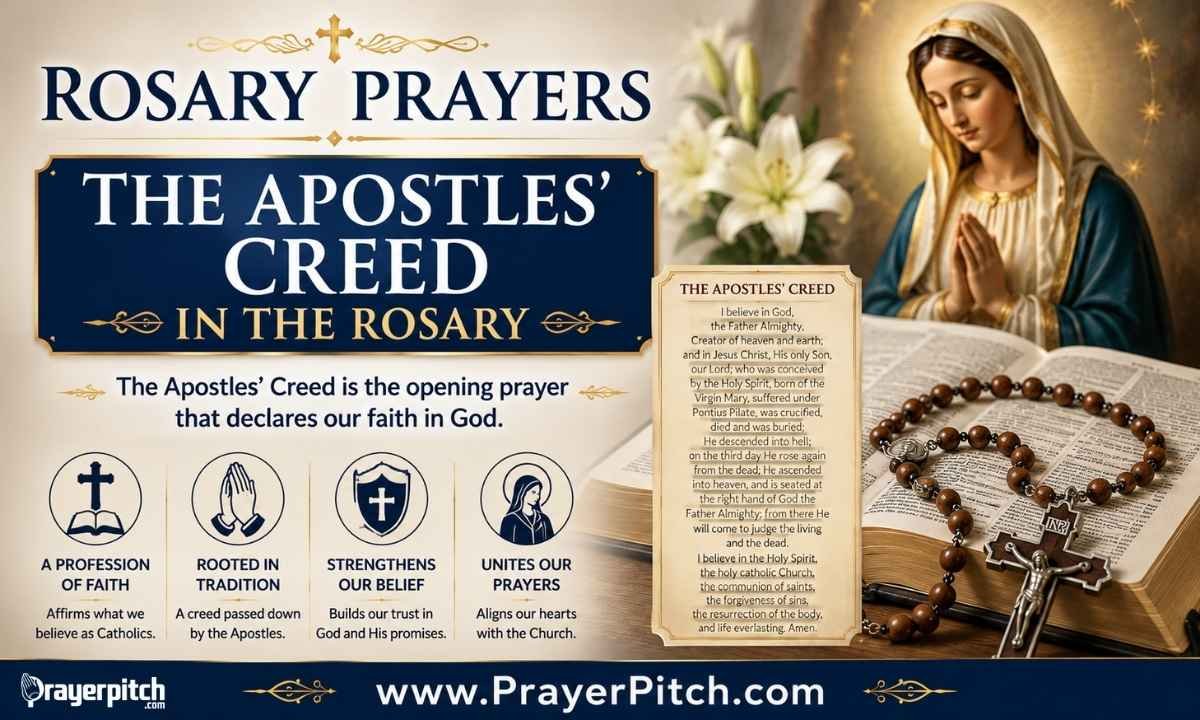
Every rosary begins at the crucifix with the Apostles’ Creed, and that placement is no accident. Before we meditate on the mysteries of Christ’s life, we first declare who He is and what we believe. The Creed is the doorway of the rosary.
The Apostles’ Creed is one of the oldest statements of Christian belief, rooted in the baptismal professions of the early Church. In a few short lines it covers the whole sweep of salvation: God the Father and creation, the life, death, and resurrection of Jesus, the Holy Spirit, the Church, the forgiveness of sins, and the promise of eternal life.
Here is the full text as prayed in the rosary:
I believe in God, the Father almighty, Creator of heaven and earth, and in Jesus Christ, his only Son, our Lord, who was conceived by the Holy Spirit, born of the Virgin Mary, suffered under Pontius Pilate, was crucified, died and was buried; he descended into hell; on the third day he rose again from the dead; he ascended into heaven, and is seated at the right hand of God the Father almighty; from there he will come to judge the living and the dead. I believe in the Holy Spirit, the holy catholic Church, the communion of saints, the forgiveness of sins, the resurrection of the body, and life everlasting. Amen.
When you pray the Creed at the start of the Holy Rosary, do not rush it. Think of it as planting a flag. Everything that follows, every Hail Mary, every mystery, rests on these truths. On days when your faith feels thin, praying the Creed out loud can be an act of quiet courage: I still believe. I am still here. Lord, I believe; help my unbelief (Mark 9:24).
The Our Father Prayer in the Rosary
The Our Father prayer, also called the Lord’s Prayer, opens every decade of the rosary. It is the only prayer in the entire devotion that Jesus taught with His own lips, which is why the Church has always called it the most perfect of prayers. When the disciples asked, Lord, teach us to pray, this was His answer (Matthew 6:9–13; Luke 11:2–4).
In the rhythm of catholic rosary prayers, the Our Father acts like a hinge. Each time you reach a large bead, you turn from one mystery to the next, and you begin again by addressing God as Father. That single word changes everything about how we pray. We do not approach a distant power; we come home to a Father who already knows what we need.
The prayer holds seven petitions, and each one deserves a lifetime of reflection:
- Hallowed be thy name – we begin with worship, not with our wish list.
- Thy kingdom come, thy will be done – we surrender our plans to His.
- Give us this day our daily bread – we ask for what we need today, not for a guaranteed tomorrow.
- Forgive us our trespasses as we forgive – mercy received becomes mercy given.
- Lead us not into temptation, but deliver us from evil – we admit our weakness and ask for protection.
Praying the Our Father six times in a single rosary is not vain repetition. Each repetition lands on a different mystery, so the same words take on new color. Thy will be done sounds one way beside the Annunciation and quite another way in the Garden of Gethsemane.
The Hail Mary Prayer Explained
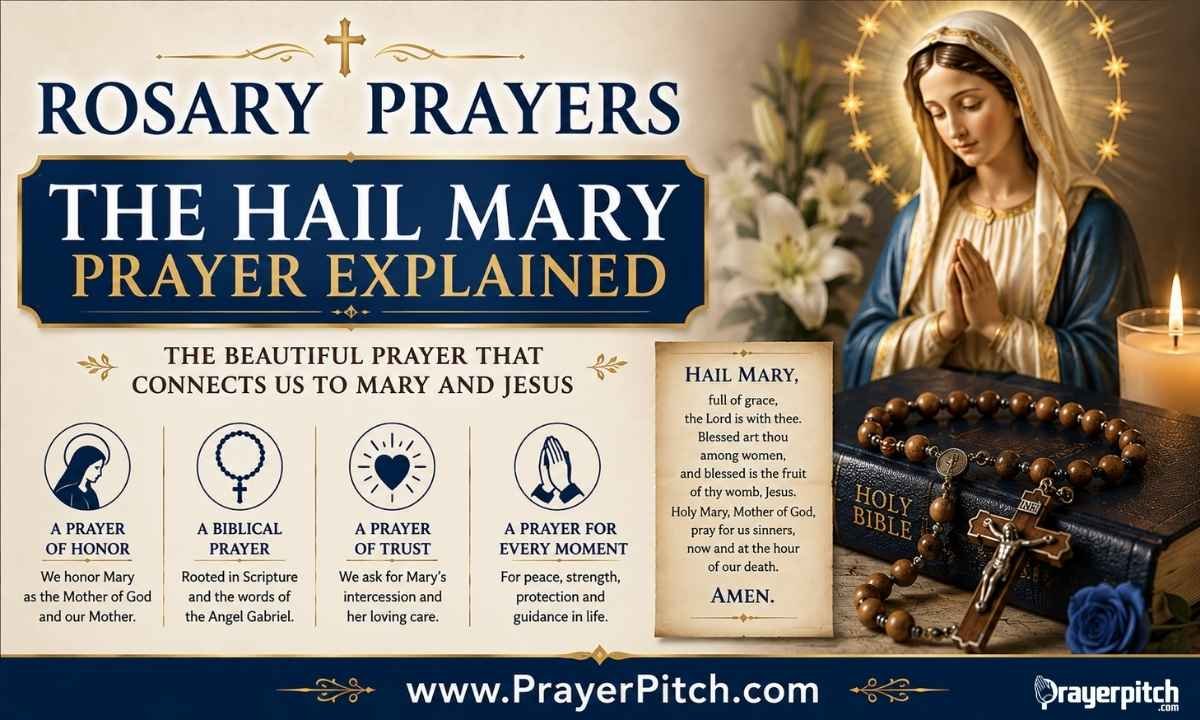
The Hail Mary prayer is the heartbeat of the rosary. You will pray it 53 times in a full rosary, and far from being empty repetition, it works the way a favorite hymn works: the familiar words free your heart to gaze at Christ.
What surprises many people is how thoroughly biblical the Hail Mary is. The first half is stitched together almost entirely from Scripture:
- Hail, full of grace, the Lord is with thee – the greeting of the Angel Gabriel at the Annunciation (Luke 1:28).
- Blessed art thou among women, and blessed is the fruit of thy womb – Elizabeth’s Spirit-filled greeting at the Visitation (Luke 1:42).
The second half is the Church’s response: Holy Mary, Mother of God, pray for us sinners, now and at the hour of our death. Amen. Notice what we are actually doing here. We are not worshiping Mary; worship belongs to God alone. We are asking her to pray for us, the same way you might ask a trusted friend to pray for you, except this friend is the mother of Jesus, and the Gospel tells us her intercession moved her Son to His first miracle (John 2:1–11).
The two moments named in the prayer, now and the hour of our death, quietly cover everything. Every anxiety you carry lives in one of those two words. The Hail Mary is a mary prayer for the whole of life: the present moment with all its noise, and the final moment we will each face. Praying it dozens of times a day slowly teaches the soul that neither moment is faced alone.
The Glory Be Prayer and Its Importance
The Glory Be prayer, known formally as the Doxology, is the shortest prayer in the rosary and one of the most important: Glory be to the Father, and to the Son, and to the Holy Spirit, as it was in the beginning, is now, and ever shall be, world without end. Amen.
Every decade ends with the Glory Be, and its placement teaches us something about the goal of all prayer. After meditating on a mystery, after ten Hail Marys, where do we land? In pure praise of the Holy Trinity. We ask for nothing in this prayer. We simply give glory, joining the unending worship of heaven that Isaiah glimpsed and the angels never stop singing (Isaiah 6:3).
The Glory Be also anchors the rosary firmly in Trinitarian faith. Some people worry that the rosary is too focused on Mary; the structure itself answers them. The devotion opens with the Sign of the Cross in the name of the Trinity, and every single decade resolves back into the Trinity. Mary’s role in the rosary is exactly her role in the Gospel, to magnify the Lord (Luke 1:46).
If you only have thirty seconds to pray today, the Glory Be is a complete prayer in itself. Pray it slowly at a red light, before a difficult meeting, or as your head hits the pillow, and you have joined the oldest song in creation.
The Four Mysteries of the Rosary
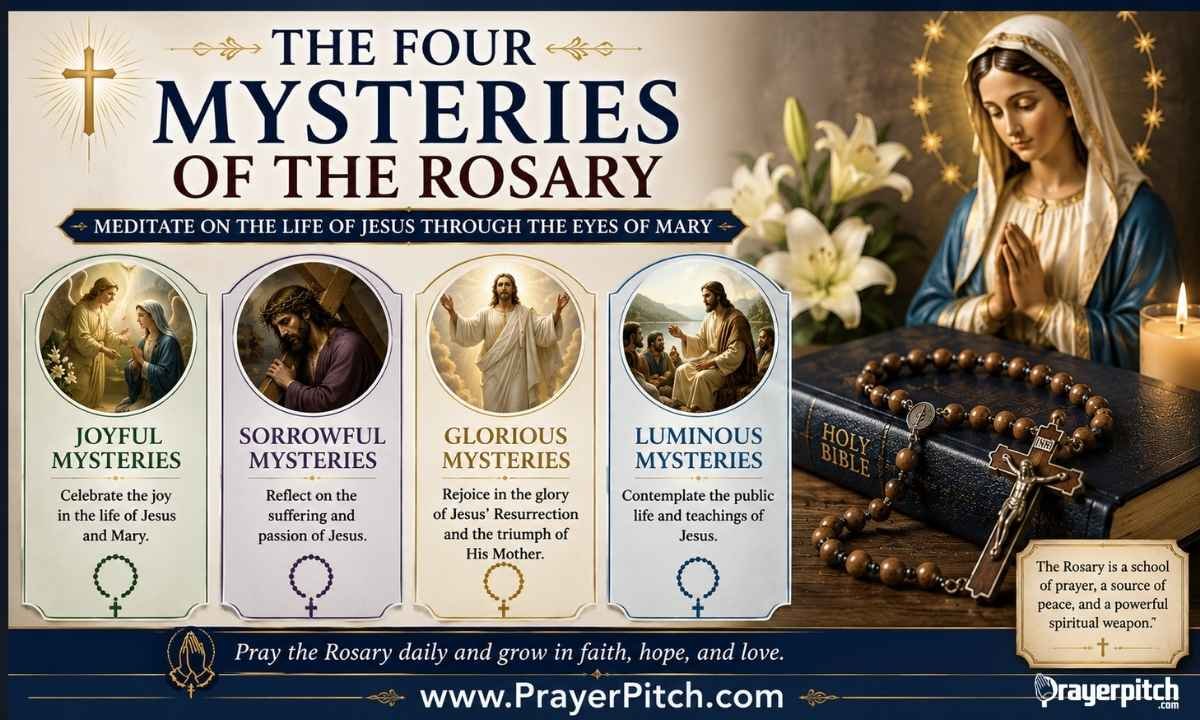
The rosary mysteries are the meditations at the heart of the devotion, twenty scenes from the life of Jesus and Mary, grouped into four sets of five. Think of them as a walking tour of the Gospel. Each day you pray one set, and over the course of a week you travel the entire arc of salvation, from the angel’s greeting in Nazareth to the crowning of Mary in heaven.
The Joyful Mysteries
The Joyful Mysteries follow the hidden years of Jesus, the seasons of waiting, wonder, and family life:
- The Annunciation – Gabriel announces the Incarnation, and Mary says yes (Luke 1:26–38).
- The Visitation – Mary hurries to serve her cousin Elizabeth (Luke 1:39–56).
- The Nativity – Jesus is born in Bethlehem (Luke 2:1–20).
- The Presentation – Mary and Joseph offer Jesus in the Temple (Luke 2:22–38).
- The Finding in the Temple – the boy Jesus is found among the teachers (Luke 2:41–52).
The Luminous Mysteries
Added by Pope John Paul II in 2002, the Luminous Mysteries, or Mysteries of Light, walk through the public ministry of Christ:
- The Baptism of Jesus in the Jordan (Matthew 3:13–17).
- The Wedding at Cana, where water becomes wine at Mary’s request (John 2:1–11).
- The Proclamation of the Kingdom and the call to conversion (Mark 1:14–15).
- The Transfiguration on the mountain (Luke 9:28–36).
- The Institution of the Eucharist at the Last Supper (Matthew 26:26–28).
The Sorrowful Mysteries
The Sorrowful Mysteries accompany Jesus through His Passion. Many Catholics pray these decades when carrying heavy burdens, and they pair naturally with prayers for protection from evil during seasons of spiritual struggle:
- The Agony in the Garden of Gethsemane (Luke 22:39–46).
- The Scourging at the Pillar (John 19:1).
- The Crowning with Thorns (Matthew 27:27–31).
- The Carrying of the Cross to Calvary (John 19:16–17).
- The Crucifixion and Death of Our Lord (Luke 23:33–46).
The Glorious Mysteries
The Glorious Mysteries celebrate the victory of Christ and the hope of heaven:
- The Resurrection of Jesus on Easter morning (Matthew 28:1–10).
- The Ascension into heaven (Acts 1:6–11).
- The Descent of the Holy Spirit at Pentecost (Acts 2:1–4).
- The Assumption of Mary, body and soul, into heaven.
- The Coronation of Mary as Queen of Heaven and Earth (Revelation 12:1).
A simple way to pray each mystery: before the decade begins, picture the scene for a few seconds. Where are you standing? What do you see and hear? Then let the ten Hail Marys carry you through it. You are not studying the Gospel from a distance; you are stepping inside it beside Mary, who treasured all these things in her heart (Luke 2:19).
Rosary Mysteries by Day of the Week
The Church suggests a weekly schedule so that, over seven days, you meditate on the whole life of Christ. Here is the traditional pattern most Catholics follow:
- Monday: Joyful Mysteries
- Tuesday: Sorrowful Mysteries
- Wednesday: Glorious Mysteries
- Thursday: Luminous Mysteries
- Friday: Sorrowful Mysteries
- Saturday: Joyful Mysteries
- Sunday: Glorious Mysteries
The logic behind the schedule is beautiful once you see it. Friday, the day of the Crucifixion, belongs to the Sorrowful Mysteries. Sunday, the weekly celebration of Easter, belongs to the Glorious. Saturday has long been dedicated to Our Lady, so it carries the Joyful Mysteries of her early life with Jesus.
Two gentle notes. First, this schedule is a guide, not a law; if your heart needs the Sorrowful Mysteries on a Wednesday, pray them. Second, the rosary also flexes with the liturgical seasons. During Advent and Christmas, the Joyful Mysteries take center stage; in Lent, the Sorrowful. Many families weave the rosary into seasonal devotions the same way they use June blessings and prayers to mark the month of the Sacred Heart. Letting the calendar shape your prayer keeps the devotion fresh all year long.
Benefits of Praying the Rosary Daily
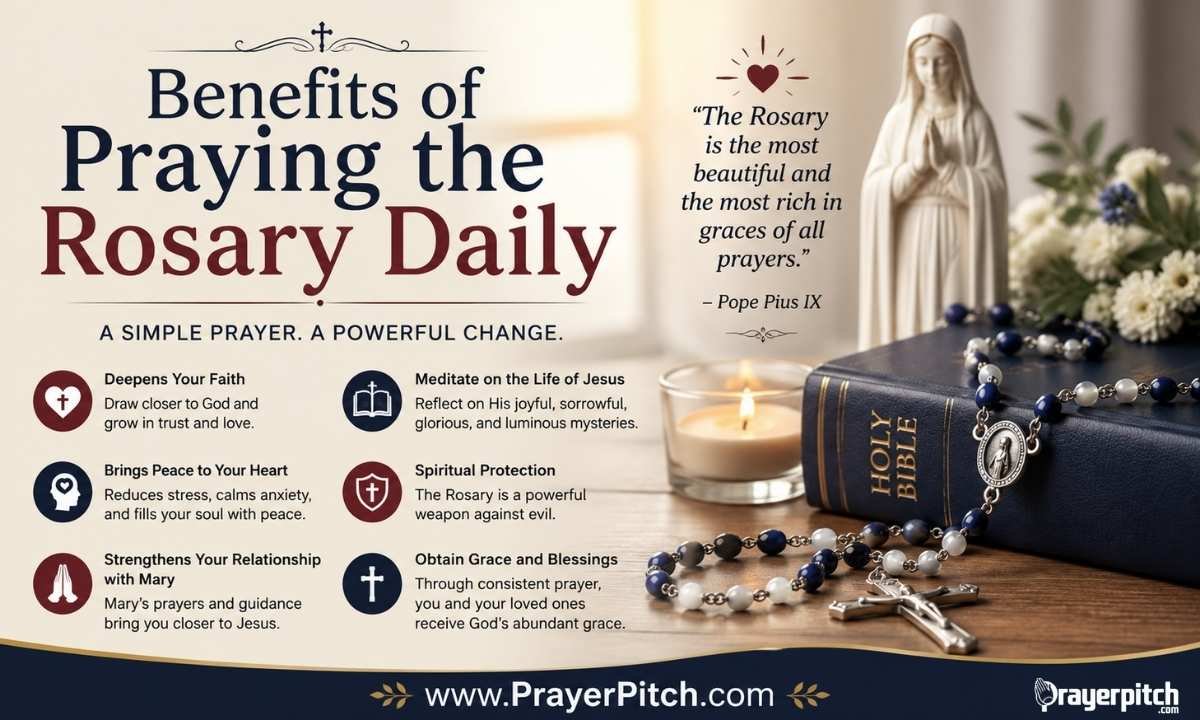
Ask anyone who has prayed daily rosary prayers for years and they will tell you: the rosary changes you slowly, the way water shapes stone. Here are the benefits of praying the rosary that people notice most, both spiritual and practical.
- It deepens your knowledge of Jesus. Twenty mysteries, prayed weekly, walk you through the entire Gospel again and again. Over a year, that is dozens of complete meditations on the life of Christ.
- It brings measurable calm. The rosary’s rhythm of slow, repeated prayer naturally steadies breathing and quiets a racing mind. Many people describe it as the most peaceful twenty minutes of their day.
- It builds a habit of daily prayer. Because the structure is fixed, you never face a blank page. On days when you have no words of your own, the rosary lends you its words.
- It strengthens families. The family that prays together stays together, Father Patrick Peyton famously preached. A family rosary, even one decade after dinner, gives a household a shared spiritual anchor.
- It is powerful intercession. From Lepanto to Fatima, the Church has turned to the rosary in times of crisis. Your intentions, for a sick parent, a struggling marriage, a wandering child, ride on every decade.
- It sanctifies ordinary time. A rosary fits into a commute, a walk, a hospital waiting room. It turns dead time into prayer time.
The rosary also has a way of consecrating the milestones of the year. Families pray it at baptisms and funerals, on feast days and national holidays alike; pairing a decade with happy 4th of July blessings or a birthday intention is a lovely way to hand the day back to God. Scripture promises that persistent, trusting prayer bears fruit: Pray without ceasing (1 Thessalonians 5:17). The rosary is simply one of the Church’s oldest and most tested ways of obeying that verse.
Short Rosary Prayers for Beginners
If a full five-decade rosary feels like too much right now, please hear this clearly: start small. A short rosary prayed with love is worth more than a long one prayed with resentment. Here are beginner-friendly ways to begin.
- Pray a single decade. One Our Father, ten Hail Marys, one Glory Be. It takes about three minutes and counts as real, substantial prayer.
- Use the three opening prayers. The Sign of the Cross, the Apostles’ Creed, and one Our Father form a complete mini-devotion for the busiest mornings.
- Try a morning offering with one Hail Mary. O Jesus, through the Immaculate Heart of Mary, I offer you my prayers, works, joys, and sufferings of this day. Then one slow Hail Mary.
- Pray one mystery deeply. Read the Scripture passage for a single mystery, sit with it for a minute, then pray the decade.
- Keep beads within reach. A rosary on your nightstand, in your car, or in your pocket is a standing invitation to pray.
Evening is an especially gentle time to learn the rosary, because the day’s noise has faded. Many beginners pray a decade in bed, then close with a night prayer for peaceful sleep and protection from evil. Falling asleep mid-decade is not failure, by the way. As one old saying goes, if you fall asleep praying the rosary, your guardian angel finishes it for you. God is a Father, not a taskmaster.
One last beginner’s tip: use a rosary app or printed guide for the first couple of weeks if it helps, but try to graduate to plain beads. The goal is prayer that lives in your hands and heart, available anywhere, no battery required.
Frequently Asked Questions About Rosary Prayers
How long does it take to pray the rosary?
A full five-decade rosary takes about 15 to 20 minutes at a prayerful pace. A single decade takes roughly three minutes, making it easy to fit into any daily routine.
What is the correct order of prayers in the rosary?
Begin with the Sign of the Cross, the Apostles’ Creed, one Our Father, three Hail Marys, and a Glory Be. Then pray five decades, each with one Our Father, ten Hail Marys, and a Glory Be, and close with the Hail Holy Queen.
Can non-Catholics pray the rosary?
Yes. Anyone is welcome to pray the rosary, and many Protestants and seekers use it as a Scripture-based meditation on the life of Jesus. Every mystery except two comes directly from the Bible.
Do I need blessed rosary beads to pray?
No. You can pray the rosary on any beads, on your fingers, or with no counter at all. Having a rosary blessed by a priest is a beautiful tradition, but it is not required for the prayer to be heard.
Which rosary mystery should I pray today?
Follow the weekly schedule: Joyful on Monday and Saturday, Sorrowful on Tuesday and Friday, Glorious on Wednesday and Sunday, and Luminous on Thursday. If a different set of mysteries speaks to your situation, you are free to pray it instead.
Is praying the rosary worshiping Mary?
No. Catholics worship God alone; in the rosary we ask Mary to pray for us, just as we ask friends to pray for us. Every decade is a meditation on Jesus and ends by glorifying the Holy Trinity.
What if I get distracted while praying the rosary?
Distractions happen to everyone, including the saints. Simply return your attention to the mystery without guilt; the gentle act of returning is itself a prayer.
Can I pray the rosary silently?
Absolutely. The rosary can be prayed aloud, whispered, or entirely in the heart. Silent prayer is ideal for commutes, waiting rooms, and late nights.
Conclusion: Make the Rosary Part of Your Daily Life
Everything in this guide comes down to one loving invitation: pick up the beads. Not next month, not once you feel holier, not after you have memorized every prayer. Today. Start with a single decade if that is what you have room for. Announce a mystery, pray slowly, and let Mary walk you through the Gospel one bead at a time.
The rosary has steadied saints and sinners, popes and grandmothers, for eight hundred years. It has been prayed in cathedrals and prison cells, at weddings and gravesides, in every language on earth. It will meet you exactly where you are, in whatever mess or blessing this season holds, and it will slowly, faithfully draw you closer to the heart of Jesus.
So find a quiet corner tonight. Hold the crucifix. Make the Sign of the Cross. And begin the most well-worn path of prayer the Church has ever known. Our Lady of the Rosary, pray for us.

2 thoughts on “Rosary Prayers: Complete Guide to Praying the Rosary in 2026”