

Hajj is not just a physical journey — it is a conversation with Allah that unfolds across five sacred days and multiple holy sites. Every step a pilgrim takes, from the moment they enter Ihram to the final farewell Tawaf, is accompanied by specific prayers, supplications, and remembrances passed down directly from the Prophet Muhammad ﷺ. Miss the rituals and you’ve visited Makkah. Perform them with the right prayers and you’ve performed Hajj.
What makes Hajj truly unique is that, unlike most acts of worship, it has no single fixed prayer script. The pilgrim is free to call upon Allah in their own words, in their own language, from the depths of their own heart. However, there are deeply powerful duas recommended at each specific stage — and knowing them transforms the entire experience from a checklist of rituals into a profound, living dialogue with the Divine.
What Are the Stages of Hajj and Why Do Prayers Matter?
Hajj consists of several sequential stages, each with its own spiritual significance, physical location, and recommended supplications. Understanding why you’re praying — not just what to say — is what separates a Hajj that changes your life from one that merely checks a religious box.
The Prophet ﷺ said: “Take your rituals from me.” — (Muslim)
This means the prayers and acts of Hajj are not invented traditions. They are a living inheritance, a direct transmission from the Prophet ﷺ himself. Every dua you make at the right time and place is, in a very real sense, a dua the Prophet ﷺ also made.
Stage 1: Entering Ihram — The Prayer of Intention (Niyyah)
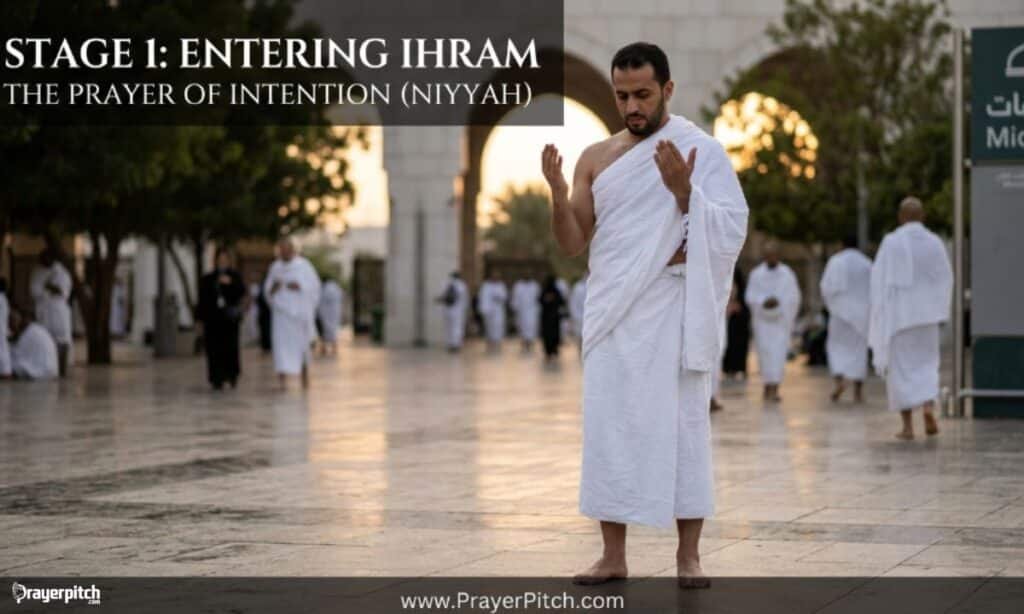
The journey begins before you even set foot in Makkah. At the Meeqat — the designated boundary point — every pilgrim enters the sacred state of Ihram by making their intention and reciting the Talbiyah.
The Niyyah (Intention):
“Allahumma inni ureedu al-Hajja fa yassirhu li wa taqabbalhu minni.” (O Allah, I intend to perform Hajj, so make it easy for me and accept it from me.)
Then, the Talbiyah begins — and it does not stop until the pilgrim reaches Makkah:
“Labbayk Allahumma labbayk. Labbayka la sharika laka labbayk. Innal hamda wan-ni’mata laka wal-mulk. La sharika lak.” (Here I am, O Allah, here I am. Here I am, You have no partner, here I am. Verily all praise and blessings are Yours, and all sovereignty. You have no partner.)
Prayers during Ihram:
- 🤲 Pray for sincerity and purity of intention before entering the state of Ihram
- 🤲 Ask Allah to make the journey easy and free of hardship
- 🤲 Seek forgiveness for all past sins before beginning this purification journey
- 🤲 Pray for the well-being of your family left behind
- 🤲 Ask Allah to accept your Hajj and return you transformed
The Talbiyah is not a one-time recitation. It is a continuous chant of arrival and surrender, repeated loudly by men and quietly by women, at every moment until the pilgrim reaches Makkah and begins Tawaf.
Stage 2: Tawaf al-Qudum — Prayers During the Circumambulation
Upon arriving at the Masjid al-Haram, the pilgrim performs Tawaf al-Qudum — the “arrival Tawaf” — circling the Ka’aba seven times counterclockwise. This is the moment millions of Muslims dream about their entire lives.
At the start of each circuit, the pilgrim faces the Black Stone (Hajar al-Aswad) and says:
“Bismillahi Allahu Akbar.” (In the name of Allah, Allah is the Greatest.)
At the Yemeni Corner (Rukn al-Yamani) before the Black Stone in each round:
“Rabbana atina fid-dunya hasanatan wa fil-akhirati hasanatan wa qina ‘adhab an-nar.” (Our Lord, give us good in this world and good in the Hereafter, and save us from the punishment of the Fire.) — (Quran 2:201)
Prayers during Tawaf:
- 🤲 Recite the dua of the Yemeni Corner in every circuit — the Prophet ﷺ never missed it
- 🤲 Ask Allah for forgiveness, health, guidance, and ease in this life and the next
- 🤲 Pray for your parents, your children, and anyone you carry in your heart
- 🤲 Make dua for the entire Muslim ummah — you are circling the same point as billions before you
- 🤲 Ask for Hajj Mabroor — an accepted, complete, and sin-erasing pilgrimage
Between Tawaf circuits, there are no fixed prayers required. This is deliberately open — Allah invites you to speak freely, to cry freely, to ask for whatever your heart holds.
Stage 3: Sa’i Between Safa and Marwa — The Walk of Faith
After Tawaf, the pilgrim performs Sa’i — walking seven times between the hills of Safa and Marwa, reenacting Hajar’s desperate search for water for her infant son Ismail (peace be upon him).
At Safa, the pilgrim faces the Ka’aba and begins with:
“Inna as-Safa wal-Marwata min sha’a’irillah.” (Indeed, Safa and Marwa are among the symbols of Allah.) — (Quran 2:158)
Then the pilgrim recites:
“Allahu Akbar, Allahu Akbar, Allahu Akbar. La ilaha illallah wahdahu la sharika lah, lahul mulku wa lahul hamdu wa huwa ‘ala kulli shay’in qadir.”
This is repeated three times at both Safa and Marwa at the beginning of each lap.
Prayers during Sa’i:
- 🤲 Pray with the same desperation Hajar felt — because Allah answered her, He will answer you
- 🤲 Ask for provision, sustenance, and relief from financial hardship
- 🤲 Make dua for any difficulty in your life that feels like a dead end — this is precisely where Allah opens doors
- 🤲 Pray for mothers and caregivers who sacrifice everything for their families
- 🤲 Ask Allah to make you among those whose striving is never wasted
Between Safa and Marwa, the pilgrim is free to make any dua in any language. Many scholars consider this one of the most powerful locations for answered prayer — because it is a site of proven, witnessed divine response.
Stage 4: The Day of Arafah — The Heart of Hajj
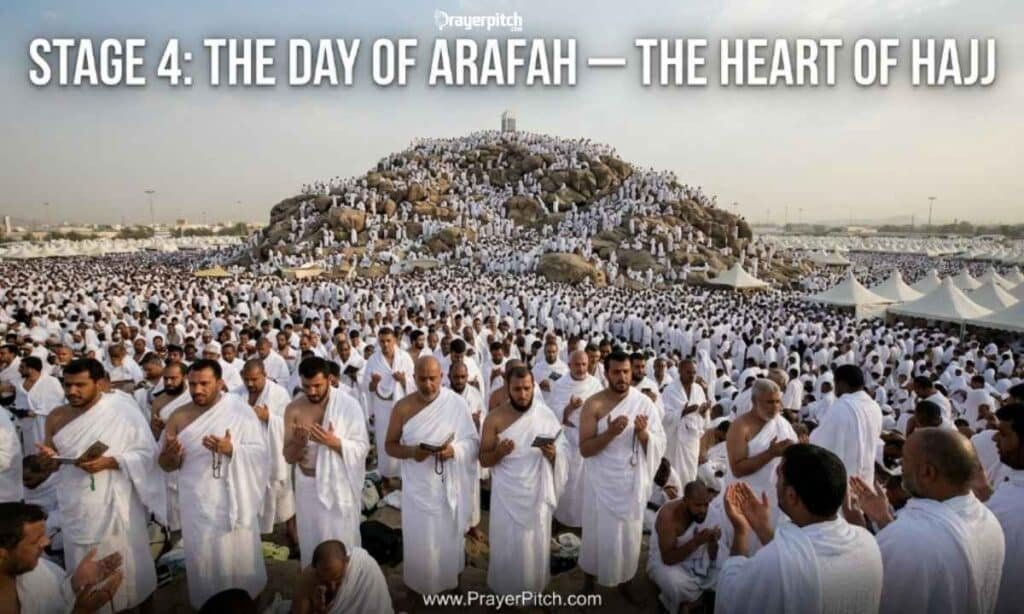
If Hajj has a soul, it lives on the plains of Arafah. The Prophet ﷺ said: “Hajj is Arafah.” — (Tirmidhi, Ibn Majah)
Everything leads to this. Pilgrims spend the afternoon of the 9th Dhul Hijjah standing, sitting, or prostrating on the plain of Arafah, in an ocean of white-clad humanity, calling upon Allah from Dhuhr until sunset.
The best dua on this day — according to the Prophet ﷺ himself — is:
“La ilaha illallah wahdahu la sharika lah, lahul mulku wa lahul hamdu wa huwa ‘ala kulli shay’in qadir.” (There is no god but Allah alone, with no partner. To Him belongs all dominion and all praise, and He has power over all things.)
Prayers on the Day of Arafah:
- 🤲 Ask for complete forgiveness — this is the day Allah frees the most souls from Hellfire
- 🤲 Pray for guidance and steadfastness after Hajj — the real test begins when you return home
- 🤲 Make dua for those who have passed away — they cannot make it themselves
- 🤲 Ask for health, clarity of purpose, and protection for your family
- 🤲 Pray for the entire Muslim ummah — standing among millions, you carry their hopes too
- 🤲 Weep if you can, and ask even if you cannot — Allah hears the silent dua of a sincere heart
| Time at Arafah | Recommended Act |
| After Dhuhr | Combined Dhuhr and Asr prayer, then begin dua |
| Early afternoon | Recite Talbiyah, Takbeer, and personal dua |
| Peak afternoon | Extended, tearful personal supplication |
| Before sunset | Final intense dua — this is the golden hour |
| After sunset | Move to Muzdalifah with Takbeer and Tahmeed |
Stage 5: Muzdalifah — The Night Under the Stars
After leaving Arafah, pilgrims travel to Muzdalifah, where they spend the night in open air, collecting pebbles for the Jamarat and praying Maghrib combined with Isha.
This is a night of quiet reflection. The rituals are done for the day. The sky is wide. The ground is shared with millions.
Prayers at Muzdalifah:
- 🤲 Perform the combined Maghrib-Isha prayer immediately upon arrival
- 🤲 Make dua in the stillness of the night — this is a sacred stop mentioned in the Quran (2:198)
- 🤲 Ask Allah to preserve the spiritual state you felt at Arafah
- 🤲 Pray for ease in the remaining days of Hajj
- 🤲 Recite morning Adhkar before departing for Mina after Fajr
Stage 6: Stoning the Jamarat — Prayers at the Pillars
At Mina, pilgrims stone three pillars (Jamarat) representing the locations where Shaytan tried to tempt Ibrahim (peace be upon him). With each pebble thrown, the pilgrim says:
“Allahu Akbar.”
After stoning the first and second Jamarat, the pilgrim steps aside, faces the Qibla, and makes a long, personal dua. After the third (largest) Jamarat, there is no standing for dua — you simply move on.
Prayers at the Jamarat:
- 🤲 Declare Allah’s greatness with each stone — this is the entire prescribed dhikr
- 🤲 After the first Jamarat, pray for protection from the whispers of Shaytan in your daily life
- 🤲 After the second Jamarat, ask Allah to strengthen your resolve against sins you repeatedly fall into
- 🤲 Pray for all Muslims struggling with spiritual weakness — you are symbolically defeating that enemy for all of them
- 🤲 Ask Allah to make you among those who live the lesson of Ibrahim — total submission, no compromise
Stage 7: Tawaf al-Ifadah and the Final Farewell Tawaf
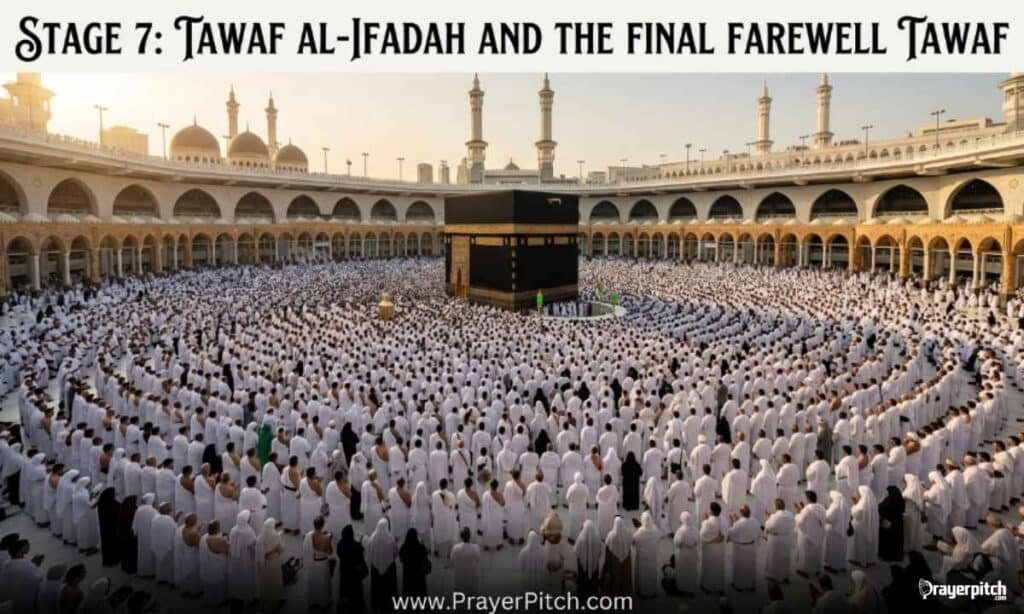
After Eid al-Adha and the symbolic shaving of the head (halq or taqsir), pilgrims return to the Masjid al-Haram to perform Tawaf al-Ifadah — the most essential Tawaf of Hajj.
The same duas from Tawaf al-Qudum apply here, with one critical addition: the awareness that your sins have been forgiven. You are circling the Ka’aba as a new person.
Before leaving Makkah, the final act is the Farewell Tawaf (Tawaf al-Wada). The Prophet ﷺ commanded that no one leave Makkah without it.
Prayers during the Farewell Tawaf:
- 🤲 Ask Allah to bring you back to this House — again and again — before you die
- 🤲 Pray that the transformation of Hajj stays with you long after you return home
- 🤲 Ask for the Hajj to be accepted — Hajj Mabroor — whose only reward is Jannah
- 🤲 Pray for everyone who has ever wanted to stand here but couldn’t
- 🤲 Leave with gratitude — “Alhamdulillah“ on your lips and tears, if Allah blesses you with them, in your eyes
Quick Reference: Prayers at Each Hajj Stage
| Hajj Stage | Location | Key Dua / Dhikr |
| Ihram & Meeqat | Meeqat boundary | Niyyah + Talbiyah |
| Tawaf al-Qudum | Masjid al-Haram | Bismillah + Yemeni Corner dua |
| Sa’i | Safa & Marwa | Takbeer + personal dua |
| Arafah | Plain of Arafah | Best dua + personal supplication |
| Muzdalifah | Open plain | Combined prayer + night dhikr |
| Jamarat | Mina | Allahu Akbar with each stone |
| Tawaf al-Ifadah | Masjid al-Haram | Yemeni Corner dua + gratitude |
| Farewell Tawaf | Masjid al-Haram | Dua to return + acceptance prayer |
5 Frequently Asked Questions
FAQ 1: Are there fixed prayers that must be recited at every stage of Hajj?
No — Hajj has no single mandatory prayer script at most stages. Certain duas are strongly recommended at specific points (like the Talbiyah and the Yemeni Corner dua), but the pilgrim is largely free to call upon Allah in any language, any words, with a sincere heart.
FAQ 2: What is the most powerful dua to make during Hajj?
The Prophet ﷺ identified the best dua on the Day of Arafah as: “La ilaha illallah wahdahu la sharika lah, lahul mulku wa lahul hamdu wa huwa ‘ala kulli shay’in qadir.” Repeating this sincerely and consistently throughout Arafah is the most spiritually potent act a pilgrim can perform.
FAQ 3: Can I make dua in English or my native language during Hajj?
Absolutely yes — scholars are unanimous that personal supplications (dua) during Hajj can be made in any language. Allah understands every tongue. The prescribed dhikr (like Talbiyah and Takbeer) should be in Arabic, but your personal duas can be in whatever language flows most naturally from your heart.
FAQ 4: When should the Talbiyah stop being recited?
For Hajj, the Talbiyah is recited continuously from Ihram until the pilgrim begins stoning the first Jamarat (the large pillar) on the 10th of Dhul Hijjah. At that point, the Talbiyah ends and Takbeer takes over as the primary remembrance.
FAQ 5: Is there a special prayer for Hajj acceptance?
Yes — asking for Hajj Mabroor (an accepted, complete Hajj) is itself a beloved dua. The Prophet ﷺ said: “An accepted Hajj has no reward except Paradise.” — (Bukhari, Muslim). Make this dua at every stage, especially during Tawaf and on the Day of Arafah, as it encapsulates the entire purpose of the journey.
Closing: Pray Like You Mean It
The prayers of Hajj are not ceremonial scripts to recite and forget. They are living words — charged with fourteen centuries of tears, hope, and answered prayers from millions of pilgrims who stood exactly where you stand.
Whether you are preparing for your first Hajj, making dua from home, or helping a loved one prepare, know this: Allah does not invite you to His House to ignore you. Every sincere word you utter, every tear you shed, every moment of genuine presence — it is all seen, all heard, all written.
Pray with your whole heart. That is what Hajj has always been about.
May Allah accept the Hajj of every pilgrim, grant those who long for it the opportunity to go, and make us all among the people of answered prayers. Ameen.