

There is a moment in almost every believer’s life when ordinary prayer no longer feels like enough. Maybe you are facing a decision too heavy to carry alone, waiting on God for something that hasn’t come, or simply longing to feel close to Him again. In those seasons, Christians throughout history have turned to one practice above almost any other: fasting and prayer.
Fasting and prayer is not a formula, a bargaining tool, or a spiritual shortcut. It is a way of setting everything else aside — food, comfort, distraction — so that seeking God becomes the main thing rather than one more item on a busy list. This guide walks through what fasting and prayer actually mean, what the Bible teaches about the practice, how to begin, what to pray during a fast, and how to finish well.
What Is Fasting and Prayer?
Fasting is the voluntary denial of food, or sometimes other comforts, for a set period of time, done for a spiritual purpose. Prayer is the ongoing conversation between a believer and God — praise, confession, requests, and listening. Fasting and prayer together simply means combining the two: using the physical discomfort and clarity of fasting to sharpen and deepen the time you spend with God.
The practice is not about punishing the body or proving spiritual strength. It is about removing something that normally satisfies you so that your hunger points you back to Him. Every time your stomach growls or you reach for your phone out of habit, that moment becomes a small reminder to pray instead.
Fasting and prayer can take many forms — a single meal skipped with intentional prayer, a full day without food, or an extended fast over several days. What matters is not the length or difficulty, but the heart behind it: humility, dependence on God, and a genuine desire to seek Him.
What Does the Bible Say About Fasting and Prayer?
Fasting appears throughout Scripture as a normal, expected part of a life devoted to God, though it is never presented as mandatory in the way prayer itself is. Jesus assumed His followers would fast. In His teaching on the subject, He said: “when you fast,” not “if you fast” (Matthew 6:16–18), instructing believers to fast quietly, without drawing attention to themselves, so that the practice remains between them and God rather than becoming a performance for others.
Jesus Himself modeled fasting before beginning His public ministry. Before facing temptation in the wilderness, He fasted for forty days, relying entirely on Scripture and the Father rather than physical strength to resist the enemy (Matthew 4:1–11). This example shows fasting as preparation — a way of entering a difficult season already anchored in God’s word rather than in personal strength.
The early church also paired fasting with prayer at pivotal moments of decision and calling. In Acts, the leaders in Antioch were worshiping and fasting when the Holy Spirit set apart Barnabas and Saul for a specific mission, and the church responded with further fasting and prayer before sending them out (Acts 13:2–3). Scripture consistently treats fasting not as a ritual with automatic results, but as a posture of humility that makes room for God to speak and act.
Why Do Christians Fast and Pray?
Christians fast and pray for many reasons, but they generally fall into a few overlapping categories.
To seek God’s presence and direction. Fasting clears away the noise of daily life so that a believer can focus more fully on hearing from God, especially before a major decision.
To express humility and repentance. Throughout Scripture, fasting is closely tied to sorrow over sin and a desire to turn back to God with a sincere heart.
To intercede for others. Many fasts in the Bible were undertaken on behalf of a nation, a family, or a specific crisis, showing fasting as an act of love and intercession, not only personal devotion.
To grow in spiritual discipline. Denying a basic physical need trains the will and builds the kind of self-control that carries over into other areas of faith and life.
To prepare for something significant. Whether it’s a calling, a season of ministry, or a difficult trial, fasting is often used as a way of entering that season already grounded in prayer.
None of these reasons treat fasting as a way to control outcomes. Christians fast because it draws them closer to God — not because it guarantees a particular result.
The Spiritual Importance of Fasting and Prayer
Fasting matters spiritually because it interrupts autopilot living. Most days, needs get met quickly, and comfort is never far away. Fasting removes that comfort on purpose, and in doing so, it exposes what a person is really leaning on — food, routine, distraction — and redirects that dependence back to God.
This is why fasting and prayer are so often paired together rather than practiced separately. Fasting without prayer is just going hungry. Prayer is what gives the fast its meaning; the emptiness created by fasting becomes space filled with seeking God rather than simply enduring discomfort.
The spiritual importance also lies in what fasting cultivates over time: humility instead of self-reliance, sensitivity to God’s voice instead of distraction, and a settled trust that He is enough even when something familiar has been set aside.
Benefits of Fasting and Prayer
While fasting is never a guarantee of a specific outcome, believers throughout history have described real, consistent benefits from the practice.
● Greater clarity in prayer. Many people find their prayers become more focused and honest during a fast, less rushed and more attentive.
● Increased sensitivity to God. Removing distractions often makes it easier to notice conviction, peace, or a sense of direction that might otherwise go unnoticed.
● Deepened humility. Fasting is a physical reminder that a person’s strength has limits, which naturally softens pride and self-sufficiency.
● Renewed spiritual hunger. The physical hunger of fasting frequently awakens a parallel hunger for God’s word and presence.
● Stronger self-discipline. Completing a fast builds confidence that, with God’s help, other areas of self-control are possible too.
● A deeper sense of dependence on God. Fasting reframes daily provision — food, comfort, routine — as something to be thankful for rather than taken for granted.
These benefits are real, but they are the natural fruit of drawing near to God, not a mechanism that forces His hand.
How to Fast and Pray Effectively
An effective fast is less about technique and more about the condition of the heart. A few practical principles help:
Start with a clear purpose. Know why you are fasting — repentance, guidance, intercession, spiritual renewal — so your prayer time has direction rather than drifting.
Pair the fast with actual prayer time. Fasting alone accomplishes little spiritually. Set aside specific times each day to pray, read Scripture, and be still, rather than simply skipping meals and going about the day unchanged.
Choose a fast that fits your life and health. A one-day fast, a partial fast, or fasting from a specific food or habit can all be effective. The goal is sincerity, not extremity.
Stay teachable. Approach the fast expecting to listen, not just to ask. Some of the most meaningful moments in a fast come from what God brings to mind rather than what is requested.
Keep it private. Following Jesus’ teaching in Matthew 6:16–18, avoid drawing attention to your fast. Let it remain a quiet matter between you and God.
How to Prepare for a Fast and Prayer
Preparation makes a fast more sustainable and more spiritually focused.
Decide on the type and length beforehand. Choose whether you are fasting from all food, certain meals, or specific items, and decide how many days in advance so you aren’t making decisions mid-fast out of hunger.
Pray about the fast before you begin. Ask God to prepare your heart, and be honest with Him about any nervousness or reluctance.
Plan your schedule. Set aside specific times for prayer and Bible reading during the fast so the hours aren’t simply spent being hungry.
Prepare physically if needed. For longer fasts, easing into it with smaller meals beforehand and staying hydrated throughout can make the experience safer and more sustainable. Anyone with a health condition, who is pregnant, or on medication should speak with a doctor before undertaking an extended fast.
Remove likely distractions. Consider limiting social media, entertainment, or other habits that might compete with your prayer time during the fast.
What Should You Pray for During a Fast?
A fast becomes meaningful through what fills the space it creates. Common areas to bring before God during a fast include:
● Confession and repentance for specific sin
● Seeking wisdom for a decision
● Interceding for a family member or friend in crisis
● Praying over a marriage, a home, or a relationship
● Seeking healing — physical, emotional, or relational
● Asking for direction about a job, move, or major life change
● Praying for protection over yourself or loved ones
● Interceding for your church, community, or nation
● Simply seeking a renewed closeness with God, without a specific request attached
There is no required list. The point of fasting is to bring whatever is genuinely on your heart before God with greater focus and humility than usual. Praying this way on someone else’s behalf is a form of intercessory prayer — standing in the gap for a person or need you carry to God.
Different Types of Fasting in the Bible
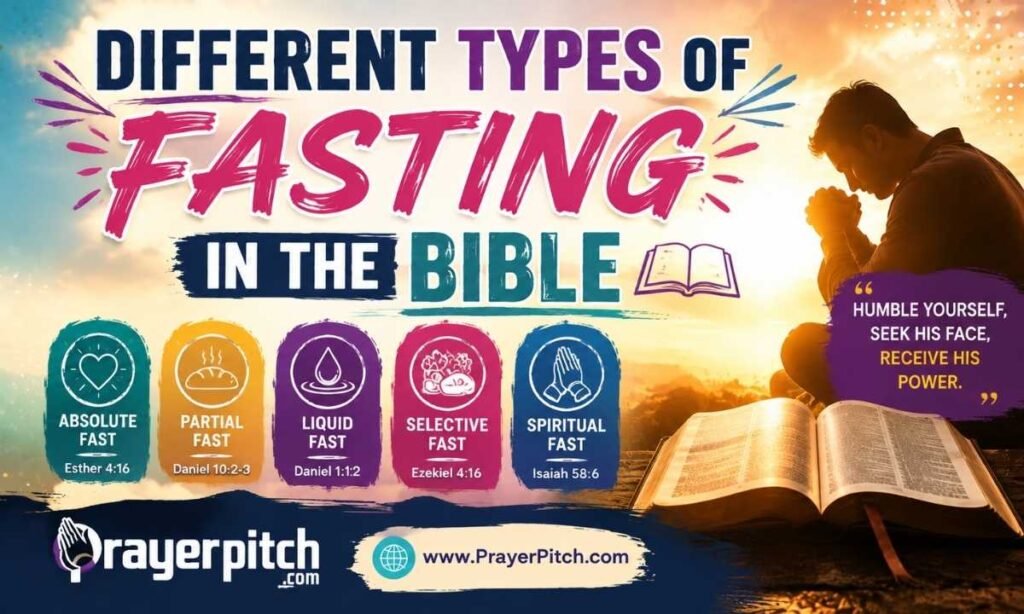
Scripture describes several distinct patterns of fasting.
The normal fast. Abstaining from all food, though usually still drinking water, for a set period — this is the most common form described in the Bible.
The absolute fast. Abstaining from both food and water, generally only for a very short period due to the physical risk involved. Esther’s three-day fast before approaching the king is an example of an urgent, intense fast undertaken by her and those with her (Esther 4:15–16).
The partial fast. Restricting certain foods rather than abstaining entirely. Daniel’s extended time of eating no pleasant food, meat, or wine while he sought understanding from God is the clearest biblical picture of this pattern (Daniel 10:2–3).
The corporate or national fast. A fast undertaken together by a group, city, or nation, often in response to a crisis or as an act of collective repentance, such as the fasting practiced by the people of Nineveh after Jonah’s warning.
The extended fast. A fast lasting many days, generally undertaken for a significant spiritual purpose, as when Jesus fasted for forty days before He was tempted in the wilderness (Matthew 4:1–2).
Each type served a different purpose depending on the need and the season, and Scripture never presents one form as more spiritual than another.
How Long Should You Fast and Pray?
There is no biblically required length for a fast. Scripture shows fasts of a single day, three days, a week, and forty days, each fitting the specific circumstance. What matters more than duration is sincerity and sustainability.
For most people beginning the practice, a single meal or a full day is a reasonable starting point. Longer fasts — three days or more — are usually approached only after some experience with shorter fasts, and always with attention to physical safety, especially regarding water intake. There is no spiritual advantage to fasting longer than is wise for your body; God is not more impressed by extremity than by sincerity.
Fasting and Prayer for Breakthrough
When facing a situation that feels stuck — a prolonged struggle, a closed door, or a long-awaited answer — fasting and prayer can be a way of renewing focus and surrender rather than a guarantee of a specific breakthrough. It is important to hold this kind of fast with open hands, seeking God’s will above a predetermined outcome.
A short prayer: “Lord, I bring this situation to You because I cannot move it myself. I set aside my own strength today and ask for Your help. Whatever You choose to do, help me trust You more through this fast. Amen.”
Fasting and Prayer for Spiritual Strength
Seasons of spiritual dryness or temptation often call for fasting as a way of re-anchoring in God rather than in personal willpower. Jesus’ own fast before facing temptation shows that spiritual strength is found in dependence on God and His word, not in self-effort alone (Matthew 4:1–11).
A short prayer: “Father, strengthen what is weak in me. Where I have relied on myself, teach me to rely on You. Fill the places fasting empties with Your presence and Your word. Amen.”
For more prayers centered on steadiness through a hard season, PrayerPitch also has a guide to the Serenity Prayer.
Fasting and Prayer for Guidance and Direction
Before major decisions, fasting has long been a way believers seek clarity beyond their own reasoning. Nehemiah fasted and prayed for days before approaching the king with a difficult request, seeking both wisdom and favor before acting (Nehemiah 1:4). Ezra called a fast to seek a safe journey and God’s protection before an important undertaking, specifically because he wanted to depend on God rather than a human escort (Ezra 8:21–23).
A short prayer: “Lord, show me the way I should go. Quiet the noise of my own preferences and help me hear Your direction clearly. I trust You to guide my steps. Amen.”
Fasting and Prayer for Healing
Fasting can accompany prayers for healing — physical, emotional, or relational — as an expression of humble dependence on God rather than a means of forcing a cure. Scripture never promises that fasting guarantees healing; it presents fasting as one way of drawing near to God with a specific need, while trusting His will and timing.
A short prayer: “God, You know every detail of this need for healing. I bring my body, my heart, and my hope to You today. Help me trust Your care regardless of how or when You choose to answer. Amen.”
Fasting and Prayer for Protection
Many believers fast when facing danger, uncertainty, or spiritual attack, asking God for covering and safety. Esther’s fast before facing the king, undertaken with the Jewish community around her, reflects this pattern of seeking God’s protection in a moment of real risk (Esther 4:15–16).
A short prayer: “Lord, be a shield around me and those I love. Guard our steps, our hearts, and our home. I set this day apart to seek Your protection above every other source of safety. Amen.”
For a fuller collection of protection-focused prayers you can use anytime, see Prayers for Protection.
Fasting and Prayer for Deliverance
Fasting is often connected to seeking freedom from a besetting sin, an unhealthy pattern, or a difficult circumstance that feels hard to escape. It reflects a recognition that some struggles are not overcome by willpower alone, but require God’s help to break their hold.
A short prayer: “Father, I want to be free from what has held me for so long. I lay it down before You today and ask for Your deliverance. Give me strength to walk differently from this day forward. Amen.”
For prayers written specifically to stand against harmful patterns and spiritual attack, see Prayers for Protection From Evil.
Fasting and Prayer for Family and Loved Ones
Intercessory fasting on behalf of others is a deeply biblical practice — setting aside personal comfort to stand in the gap for someone else’s need. This can be for a child’s faith, a spouse’s struggle, a parent’s health, or a family relationship in need of restoration.
A short prayer: “Lord, I bring my family before You today. Watch over [name], meet their needs, and draw them close to You. Let this fast be an act of love for the people You’ve placed in my life. Amen.”
For a fuller list of prayer points to pray over each family member by name, see Prayer Points for Family.
Fasting and Prayer for a Specific Need
Sometimes a fast centers on one clear, specific request — a job, a financial need, a court case, a relationship, or a decision with a deadline. There is nothing wrong with bringing a specific need to God during a fast, as long as it’s held with trust in His will rather than an expectation that fasting obligates a particular answer.
A short prayer: “God, You already know exactly what I’m facing. I bring this specific need to You today, not because fasting forces Your hand, but because I want to seek You more than I want the answer itself. Amen.”
Powerful Bible Verses About Fasting and Prayer
The Bible speaks to fasting and prayer in several key passages, each offering a different angle on the practice:
● Matthew 6:16–18 — Jesus teaches that fasting should be done privately, for God’s attention rather than others’.
● Matthew 4:1–11 — Jesus fasts forty days before facing temptation in the wilderness.
● Acts 13:2–3 — The church in Antioch fasts and prays before sending out Barnabas and Saul.
● Ezra 8:21–23 — Ezra proclaims a fast to seek a safe journey and God’s protection.
● Esther 4:15–16 — Esther calls for a three-day fast before approaching the king.
● Daniel 9:3 — Daniel turns to the Lord with prayer, fasting, and repentance on behalf of his people.
● Daniel 10:2–3 — Daniel fasts partially for three weeks while seeking understanding from God.
● Nehemiah 1:4 — Nehemiah fasts and prays for days after hearing troubling news about Jerusalem.
Reading these passages in context, rather than as isolated proof-texts, shows fasting consistently connected to humility, seeking God’s will, and dependence on Him rather than as a technique for guaranteed results. For a broader look at how prayer runs throughout Scripture, PrayerPitch also has a guide to powerful prayers in the Bible.
Fasting and Prayer Examples in the Bible
Several biblical figures modeled fasting and prayer in distinct circumstances, each worth studying for what it teaches about the practice.
Jesus in the wilderness. Before beginning His public ministry, Jesus fasted forty days and was tempted by the devil, responding each time with Scripture rather than His own strength (Matthew 4:1–11). His fast shows preparation for a difficult season through total reliance on God’s word.
Esther before the king. Facing the possible destruction of her people, Esther asked all the Jews in Susa to fast for three days before she approached the king uninvited, a request that could have cost her life (Esther 4:15–16). Her fast reflects urgent, corporate intercession in a moment of crisis.
Daniel’s mourning and seeking. Daniel turned to prayer, fasting, and repentance while studying the prophecies about his people’s exile, showing fasting connected to serious reflection on Scripture and heartfelt confession (Daniel 9:3). Later, he fasted partially for three weeks while seeking understanding, receiving insight only after that sustained season of seeking (Daniel 10:2–3).
Ezra’s fast for safe passage. Before leading a group back to Jerusalem, Ezra proclaimed a fast so the group could humble themselves before God and seek a safe journey, specifically because he was ashamed to ask the king for a military escort after affirming that God’s hand was on those who seek Him (Ezra 8:21–23).
Nehemiah’s mourning for Jerusalem. Upon hearing that Jerusalem’s walls lay in ruins, Nehemiah wept, fasted, and prayed for days before God, laying the groundwork for the courage and favor he would later need to act (Nehemiah 1:4).
The church at Antioch. As the believers in Antioch worshiped and fasted, the Holy Spirit set apart Barnabas and Saul for a specific mission, and the church responded with further fasting and prayer before sending them out (Acts 13:2–3).
Each of these examples shows fasting paired with genuine prayer and a specific, sincere purpose — never as a ritual performed for its own sake.
Common Mistakes to Avoid When Fasting and Praying
Fasting can lose its spiritual power when a few common mistakes creep in.
Treating fasting as a way to manipulate God. Fasting is not a bargaining chip that obligates God to answer a certain way. It is an act of humility and seeking, not a transaction.
Fasting without actually praying. Skipping meals without dedicating real time to prayer and Scripture turns a spiritual discipline into little more than dieting.
Making the fast about appearances. Announcing a fast for recognition, rather than keeping it between you and God, works against the heart of what Jesus taught in Matthew 6:16–18.
Ignoring physical safety. Fasting recklessly — especially with extended or absolute fasts — without regard for health, medication, or medical conditions can be genuinely dangerous rather than spiritually beneficial.
Expecting a specific outcome as guaranteed. Fasting does not obligate God to heal, provide, or answer a prayer in a particular way. It is an act of seeking Him, not a formula for controlling outcomes.
Giving up too easily, or pushing through when the body says stop. Both extremes miss the point. A fast should be sincere and sustainable, not abandoned at the first inconvenience or continued past a genuine health concern.
What to Do When You Feel Weak During a Fast
Feeling physically weak, irritable, or foggy during a fast is common, especially for those new to the practice. A few things help:
● Stay hydrated. Unless practicing a very short absolute fast, drink water consistently throughout the day.
● Rest more than usual. Lower your physical expectations for the day rather than pushing through a full normal schedule.
● Turn the weakness into prayer. Let the physical reminder of limitation become a prompt to depend on God rather than simply something to endure.
● Know when to stop. If you experience dizziness, confusion, fainting, or any signs of a medical emergency, break the fast and seek care. God does not ask anyone to risk serious harm to prove devotion.
● Adjust the fast if needed. Moving from a full fast to a partial fast is not failure — it’s wisdom.
Can You Fast and Pray Every Day?
Some believers practice a regular pattern of fasting — a weekly partial fast, for example — as an ongoing spiritual discipline rather than a one-time event tied to a crisis. This kind of rhythm can be healthy when approached with balance, adequate nutrition on non-fasting days, and attentiveness to the body’s needs.
However, fasting every single day, or fasting in a way that becomes extreme or compulsive, is not the biblical pattern and can be physically and psychologically harmful. Scripture presents fasting as a set-apart practice for specific seasons and purposes, not a permanent daily state. Anyone who notices fasting becoming tied to anxiety, control, or an unhealthy relationship with food should pause the practice and, where appropriate, talk with a doctor or counselor.
Short Prayers to Say While Fasting
● “Lord, today I set aside food to seek You. Let this hunger point me back to You again and again.”
● “Father, I don’t fully understand my situation, but I trust You. Speak to me during this time.”
● “God, humble my heart today. Show me anything I need to confess or release.”
● “Lord, be near to me in this fast. I want more of You, not just an answer to my prayer.”
● “Father, give me strength for this day, and let my weakness remind me of Your sufficiency.”
Morning Prayer During Fasting
“Lord, as I begin this day of fasting, I ask You to meet me here. Quiet my mind before the busyness of the day sets in, and help me hold onto this time with You even as hunger sets in later. Show me what You want to teach me today. Give me strength for my responsibilities and clarity in my prayers. Whatever this day brings, let it be marked by Your presence more than by what I’m giving up. Amen.”
For more morning prayers beyond a fast, PrayerPitch has a larger collection of good morning prayer messages.
Night Prayer During Fasting
“Father, thank You for walking with me through today. Whether it was easy or hard, You were present in every hour. Forgive me for the moments I was distracted or impatient, and thank You for the moments I felt close to You. As I end this fast for the day, help me carry what I’ve learned into tomorrow. Give me rest tonight, and let my heart still be turned toward You as I sleep. Amen.”
For more on ending the day in prayer, see Night Prayer for Peaceful Sleep.
Ending a Fast: How to Finish Your Fast Well
How a fast ends matters almost as much as how it begins.
Break the fast gently. After a longer fast, especially, reintroduce food slowly with something light rather than a large or heavy meal, both for physical comfort and safety.
Take time to reflect before returning to normal routine. Before diving back into regular activity, spend a few minutes in prayer thanking God for the time and noting anything He brought to mind during the fast.
Carry the discipline forward. Consider how something from the fast — a habit of prayer, a piece of guidance, a renewed sense of dependence on God — can continue in daily life rather than ending abruptly when the fast does.
Give thanks regardless of outcome. Whether or not you received the specific answer you were seeking, thank God for His presence during the fast itself; the time spent seeking Him is never wasted.
Frequently Asked Questions About Fasting and Prayer
Do I have to stop eating completely to fast?
No. While a full fast from food is the most common biblical pattern, a partial fast — abstaining from specific foods, meals, or even non-food comforts like social media — can also be a meaningful and sustainable way to fast and pray.
How long should a beginner fast?
Starting with a single meal or one full day is reasonable for most people. Longer fasts are usually approached gradually, with attention to health and hydration.
Can I drink water while fasting?
In most biblical fasting patterns, water is still consumed; the absolute fast without water is rare in Scripture and generally only for very short, urgent periods due to the physical risk involved.
Is it wrong to tell others I’m fasting?
Jesus’ teaching in Matthew 6:16–18 emphasizes keeping fasting private rather than announcing it for attention. There can be legitimate reasons to let a spouse or close friend know for safety or accountability, but the heart posture should remain focused on God rather than recognition.
Does fasting guarantee God will answer my prayer?
No. Fasting is an act of humility and seeking, not a transaction that obligates God to respond in a specific way. Scripture consistently ties fasting to drawing near to God rather than controlling outcomes.
What if I break my fast accidentally?
Simply resume the fast, or extend it if needed, without guilt. God is far more concerned with a sincere heart than a technically perfect fast.
Can children or those with medical conditions fast?
Fasting should always be approached with wisdom. Those with medical conditions, who are pregnant or nursing, or who are very young should consult a doctor and consider modified forms of fasting, such as giving up a specific food or activity rather than food entirely.
What’s the difference between fasting and just skipping a meal?
The difference is intention. Skipping a meal out of convenience isn’t fasting; fasting is a deliberate choice to forgo food for a spiritual purpose, paired with prayer.
Conclusion
Fasting and prayer are not about proving devotion or forcing God’s hand — it is about clearing space to seek Him more fully than daily life usually allows. Whether you’re beginning with a single meal set aside in prayer or entering a longer season of seeking direction, what matters most is the sincerity behind it. God is not distant from those who seek Him this way; He draws near to the humble, and fasting, at its best, is simply one more way of saying: I want more of You than I want anything else.

4 thoughts on “Fasting and Prayer: A Biblical Guide to Seeking God”