

Every year, millions of Muslims pack their white Ihram garments, book flights to Makkah, and prepare for the most spiritually transformative journey of their lives. But for every pilgrim who steps onto the sacred ground of the Haram, there are dozens — maybe hundreds — of others left behind, hearts full of longing, wondering if they are truly missing out. The good news? Islam, in its boundless mercy, did not leave them empty-handed.
Allah, in His infinite wisdom, has opened doors of worship, devotion, and divine reward that are accessible to every single Muslim during the blessed days of Dhul Hijjah — regardless of where they are in the world. Whether you’re in Muscat, Manchester, or Manila, you can earn blessings that rival the spiritual weight of Hajj itself. Let’s explore exactly how.
Why Can’t Everyone Go to Hajj?
Hajj is the fifth pillar of Islam, and it is obligatory only upon those who are physically and financially able. This is not a loophole — it’s a divine kindness.
Many sincere believers are held back by very real, very valid reasons:
| Reason | Details |
| Financial hardship | Hajj packages can cost thousands of dollars, making it inaccessible for many |
| Health conditions | Physical illness, disability, or age may make the journey impossible |
| Visa restrictions | Some countries face quota limits or political barriers |
| Family obligations | Primary caregivers often cannot leave dependents behind |
| Lack of a Mahram | For women without a male guardian, travel may not be permissible |
| Sudden life changes | Job loss, pregnancy, or emergencies can disrupt plans overnight |
The Prophet Muhammad ﷺ himself acknowledged those unable to attend. In multiple authentic hadith, he highlighted special acts of worship that carry enormous reward during Dhul Hijjah — a clear indication that the blessings of this season are not gated behind a plane ticket.
The Power of Dhul Hijjah: Why These 10 Days Are Different?
Before diving into specific practices, it’s important to understand why this period matters so much.
The Prophet ﷺ said:
“There are no days in which righteous deeds are more beloved to Allah than these ten days.” — (Bukhari)
The companions asked, “Not even Jihad in the path of Allah?” He replied, “Not even Jihad, except for the man who goes out with his life and wealth and does not return with either.”
This is staggering. These ten days of Dhul Hijjah — the same days pilgrims are performing Hajj — are the most virtuous days of the entire year for good deeds. And you don’t need to be in Makkah to benefit from them.
Blessings You Can Earn Without Going to Hajj
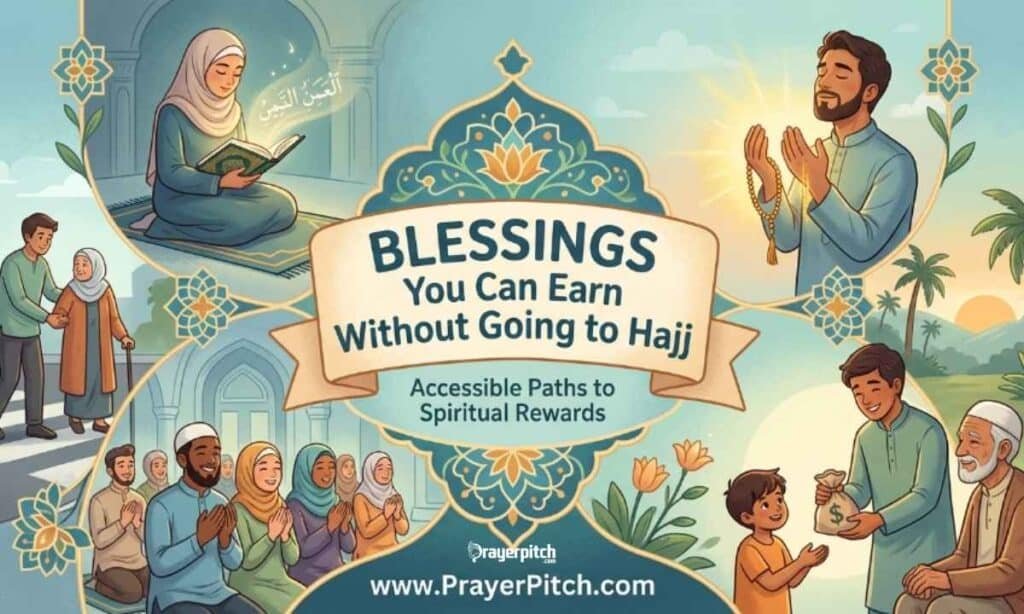
1. Fasting on the Day of Arafah (9th Dhul Hijjah)
Of all the acts of worship available to non-pilgrims, fasting on the Day of Arafah stands head and shoulders above the rest.
The Prophet ﷺ said:
“Fasting the Day of Arafah, I hope from Allah, expiates the sins of the year before it and the year after it.” — (Muslim)
One day of fasting. Two years of sins forgiven. That is not a small thing.
For pilgrims standing on the plains of Arafah, this is the peak of their entire Hajj. For you, sitting at home or at your desk, a single day of sincere fasting connects you to that same divine mercy. The spiritual door swings open equally for both.
Blessings of fasting on Arafah:
- 🌿 Expiation of sins from the previous year
- 🌿 Expiation of sins from the upcoming year
- 🌿 Deep spiritual renewal and closeness to Allah
- 🌿 A share in the blessings of the most sacred day of the Islamic year
- 🌿 An act beloved to Allah more than voluntary fasting on any other single day
2. Engaging in Dhikr, Takbeer, and Tahmeed
During the first ten days of Dhul Hijjah — and especially from Fajr on the Day of Arafah through Asr on the 13th (the days of Tashreeq) — Muslims are encouraged to raise their voices in the remembrance of Allah.
The specific words to repeat are:
- Allahu Akbar (Allah is the Greatest)
- La ilaha illallah (There is no god but Allah)
- Alhamdulillah (All praise is for Allah)
- Allahu Akbar, Allahu Akbar, la ilaha illallah, Allahu Akbar, Allahu Akbar, wa lillahil hamd
The Prophet ﷺ said: “Increase your remembrance of Allah during these days.” — (Ahmad)
Ibn Umar and Abu Hurairah (may Allah be pleased with them) used to go out to the marketplace during these ten days and make takbeer aloud, and the people would join them. Today, you can do the same — in your home, in your car, on your morning walk. The spirit is identical.
Blessings of Dhikr during Dhul Hijjah:
- 🌿 Direct fulfillment of the Sunnah of the Prophet ﷺ
- 🌿 Elevation of your rank with Allah
- 🌿 A light on your tongue that weighs heavily on the scales of good deeds
- 🌿 Connection to the global Muslim ummah engaged in the same remembrance
- 🌿 Peace of heart — “Verily, in the remembrance of Allah do hearts find rest” (Quran 13:28)
3. Performing Qurbani (Udhiyah — the Sacrifice)
When pilgrims in Makkah slaughter their animals as part of Hajj, Muslims around the world are simultaneously performing their own Qurbani on Eid al-Adha.
This is not a consolation prize. It is a direct act of worship tracing back to the sacrifice of Prophet Ibrahim (peace be upon him).
The Prophet ﷺ said:
“There is nothing dearer to Allah during the days of Qurbani than the sacrificing of animals. The sacrificed animal shall come on the Day of Resurrection with its horns, hair, and hooves. The sacrifice is accepted by Allah before the blood reaches the ground.” — (Ibn Majah, Tirmidhi)
Blessings of Qurbani:
- 🌿 An act of worship that earns divine pleasure before the blood even touches the ground
- 🌿 Every hair of the sacrificed animal equals a reward on your scale
- 🌿 Spiritual connection to Ibrahim ﷺ and the legacy of absolute submission to Allah
- 🌿 Feeding the poor and strengthening community bonds
- 🌿 A physical, tangible expression of gratitude for Allah’s blessings upon you
4. Performing Extra Prayers and Voluntary Worship
The nights of Dhul Hijjah are golden. While pilgrims spend their nights in Mina and Muzdalifah, you can spend yours in Qiyam al-Layl (night prayer), Tahajjud, and heartfelt dua.
The last third of every night — regardless of the month — is a time when Allah descends to the lowest heaven and asks: “Who is calling upon Me, that I may answer him?”
During these blessed ten nights, that invitation carries an extra weight.
Maximize your worship by:
- Praying all five daily prayers on time, with full focus
- Adding extra voluntary (nafl) prayers throughout the day
- Spending the last third of the night in Tahajjud and sincere supplication
- Performing Duha prayer (mid-morning) — a consistent Sunnah often overlooked
- Making lengthy, personalized dua in your own language
5. Reciting and Reflecting on the Quran
There is no better companion during these blessed days than the Book of Allah. Pilgrims in Makkah recite Quran between rituals, in the Haram, and in the precious quiet of Mina. You can do the same from wherever you are.
Consider completing a full recitation (khatm) during these ten days. But even more importantly, slow down. Read with reflection (tadabbur). Let a single ayah sit with you for an entire day.
Blessings of Quranic recitation:
- 🌿 Every letter carries ten rewards, multiplied further during blessed days
- 🌿 The Quran will intercede for its reciter on the Day of Judgment
- 🌿 A direct, living conversation with the words of Allah
- 🌿 Spiritual healing for anxiety, grief, and uncertainty
- 🌿 Elevation of rank in Jannah commensurate with how much you memorized and recited
6. Giving Charity (Sadaqah)
The connection between Hajj and generosity is deep. Pilgrims are stripped of their wealth indicators — no jewelry, no fine clothing — and stand equal before Allah. This spirit of giving should extend to those at home.
The Prophet ﷺ said: “Sadaqah extinguishes sin as water extinguishes fire.” — (Tirmidhi)
During the ten days of Dhul Hijjah, every act of charity is multiplied. Give to a local food bank. Sponsor an orphan. Fund a water well. Pay off someone’s debt quietly. The form matters less than the sincerity.
Blessings of Sadaqah during Dhul Hijjah:
- 🌿 Expiation of sins
- 🌿 Protection from calamity and hardship
- 🌿 A shade on the Day of Judgment when there is no shade but Allah’s
- 🌿 Increased barakah (blessing) in your own wealth
- 🌿 The feeling — and the reality — of being connected to something far greater than yourself
7. Making Sincere Tawbah (Repentance)
Hajj is described in the Quran and Sunnah as a complete purification — pilgrims return like newborns, free of sin. But sincere repentance (tawbah) is also one of the most powerful acts available to every Muslim, at any time, anywhere.
Allah says in the Quran: “Indeed, Allah loves those who are constantly repentant and loves those who purify themselves.” (2:222)
During Dhul Hijjah, make a genuine, private, heartfelt tawbah. Not a rushed “Astaghfirullah” between tasks, but a real moment of stillness — acknowledging your shortcomings, feeling genuine remorse, and committing to change.
Blessings of sincere tawbah:
- 🌿 Complete forgiveness of past sins — Allah’s promise, not a human one
- 🌿 Spiritual transformation and a fresh start
- 🌿 The love of Allah — He loves those who return to Him
- 🌿 Relief from spiritual heaviness and moral fatigue
- 🌿 A prerequisite for and multiplier of all other good deeds
A Special Note: The Reward of Intending Hajj
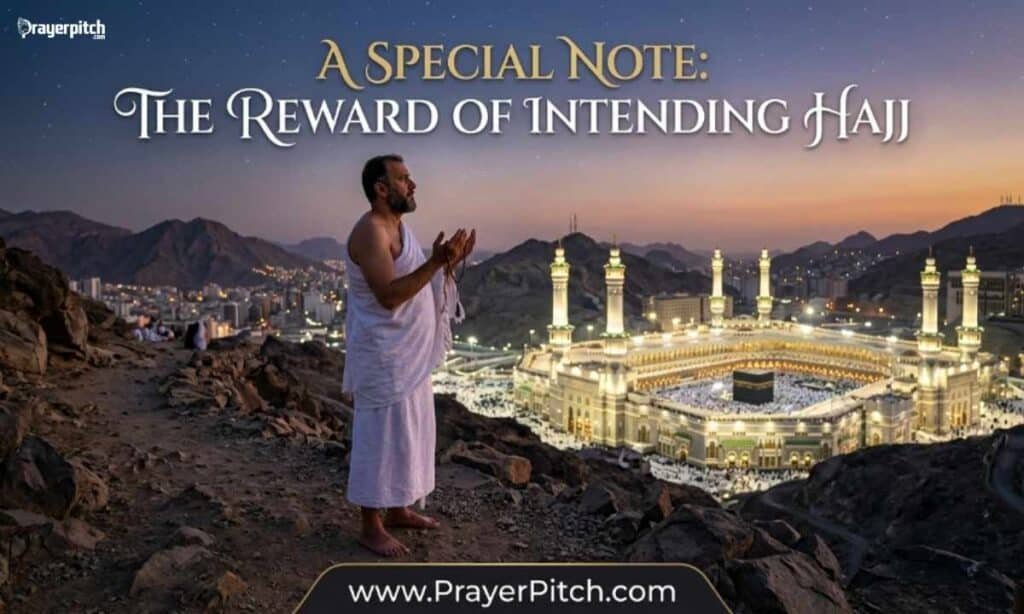
Here is something beautiful that many Muslims don’t know.
If a person sincerely intends to perform Hajj, has made genuine efforts toward it, but is prevented by circumstances beyond their control — they may still receive the reward of Hajj, by the mercy of Allah.
The Prophet ﷺ said: “Whoever leaves home for a good deed and then death overtakes him, Allah will write for him the reward of what he intended.” — (Musnad al-Bazzar)
Make the intention. Make the du’a. Take real steps — begin saving, research the process, register your name. Allah sees your heart and your effort, not just your physical location.
How to Structure Your Dhul Hijjah Worship at Home?
Here is a practical, day-by-day framework to maximize your blessings during the first ten days:
| Day | Focus |
| 1st – 7th Dhul Hijjah | Daily Quran reading, morning/evening Dhikr, extra Sadaqah, avoid cutting hair/nails |
| 8th (Day of Tarwiyah) | Increased ibadah, night prayers, intention renewal |
| 9th (Day of Arafah) | Full-day fasting, Takbeer, extended dua from Dhuhr to Maghrib |
| 10th (Eid al-Adha) | Eid prayer, Qurbani, family, gratitude |
| 11th – 13th (Tashreeq) | Continue Takbeer after every fard prayer, celebrate, maintain worship |
The Wisdom Behind Staying Home

Sometimes, people who cannot attend Hajj feel a kind of grief — a deep, aching longing for Makkah. That feeling itself is not nothing. Scholars have written that the yearning for the House of Allah is itself a form of worship, a sign of a living, connected heart.
Ibn al-Qayyim wrote that a heart attached to the Kaaba, even from thousands of miles away, is a heart alive with Iman. Your longing is not wasted. It is, in its own way, a form of tawaf.
There is also wisdom you gain at home that no Hajj package can provide: the test of patience, the discipline of worship without a crowd, the sincerity of devotion when no one can see you. The pilgrim worships surrounded by millions. You worship alone, or close to it — and Allah sees every quiet moment of it.
5 Frequently Asked Questions
Q 1: Can I get the reward of Hajj without going?
Yes — while nothing fully replaces the obligation of performing Hajj, Allah has blessed several acts of worship with rewards comparable to Hajj.
Q 2: Is fasting on the Day of Arafah obligatory?
No — it is a highly recommended Sunnah for non-pilgrims, not an obligation. However, given the extraordinary reward (two years of sins forgiven), missing it without reason would be a significant missed opportunity.
Q 3: Should I avoid cutting hair and nails during Dhul Hijjah?
Yes — if you intend to perform Qurbani, the Prophet ﷺ instructed that you should not cut your hair, nails, or remove skin from the time the new moon of Dhul Hijjah appears until after the sacrifice.
Q 4: What is the best dua to make on the Day of Arafah?
The Prophet ﷺ said: “The best dua is the dua on the Day of Arafah, and the best thing I and the Prophets before me have said is: La ilaha illallah, wahdahu la sharika lah, lahul mulku wa lahul hamdu wa huwa ‘ala kulli shay’in qadir.” (Tirmidhi).
Q 5: Can women earn Hajj blessings without a Mahram?
Absolutely — all the at-home practices described in this article are fully accessible to women without any need for a Mahram. Fasting on Arafah, Dhikr, Qurbani, Quran recitation, night prayers, sadaqah, and tawbah carry no travel-related conditions whatsoever. Every door mentioned here is open equally to every Muslim, regardless of gender.
Closing: Your Heart Is Never Far from Makkah
Not everyone can stand on the plains of Arafah. Not everyone can touch the Black Stone or drink from the well of Zamzam. But every sincere Muslim — wherever they are, whatever their circumstances — can turn their heart toward Makkah and find that the blessings of Allah travel without distance.
The mercy of Allah is not bound by geography. His reward is not limited by airline routes or visa quotas. These ten blessed days are a gift to the entire ummah — not just those with packed suitcases and boarding passes.
So make your intention. Fast your day. Give your charity. Remember your Lord. Sacrifice your animal. And trust, with certainty, that the One who accepts Hajj from those in Makkah is the same One who sees you, right where you are — and loves you for it.
May Allah accept our deeds, forgive our shortcomings, and grant us all the opportunity to visit His sacred House. Ameen.