

If you’ve ever flipped through a baby name book and paused at “Elijah” or “Miriam,” you already know there’s something magnetic about biblical names. They carry weight — history, faith, culture, and story all wrapped into a few syllables.
Whether you’re naming a child, diving into scripture study, or simply curious about why so many of the world’s most popular names come from an ancient text, this guide is your deep dive into the meaning, origin, and enduring power of biblical name meanings.
Wondering what Jirah means in the Bible? Discover its biblical meaning, spiritual significance, and scriptural context.
👉 https://prayerpitch.com/jirah-meaning-in-bible/
Why Biblical Names Still Dominate Baby Name Charts?
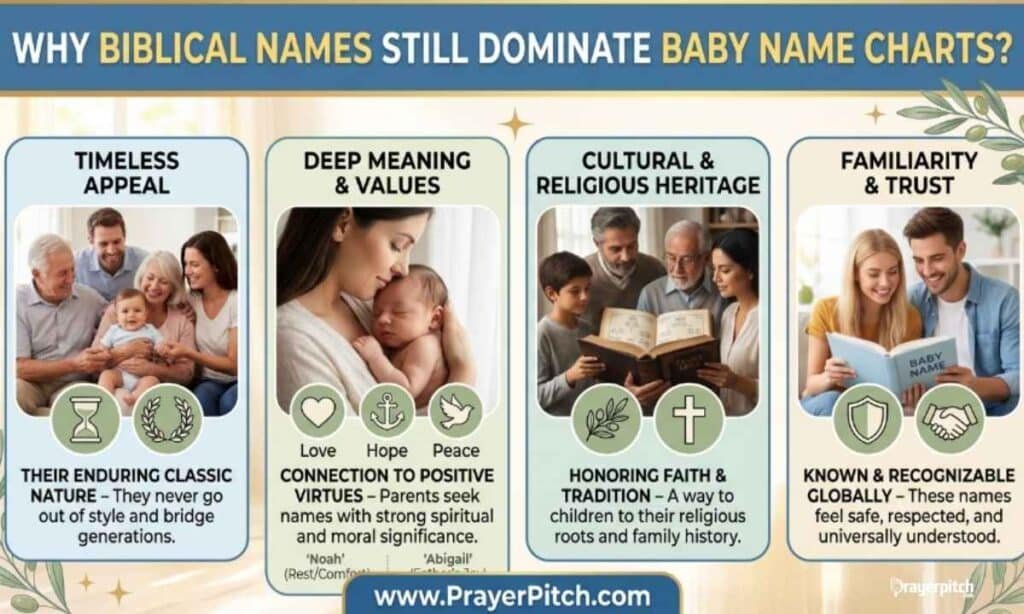
Walk into any classroom in America, the UK, or Australia and you’ll likely find a Noah, an Emma (from the Hebrew em, meaning “whole” or “universal”), or a Jacob. That’s not a coincidence — it’s centuries of cultural influence at work.
Biblical names have outlasted empires, language shifts, and naming trends. They root the bearer in something larger than themselves. A name like Nathaniel (“God has given”) or Hannah (“grace” or “favor”) isn’t just an identifier — it’s a declaration of values.
Moreover, many parents today are rediscovering the depth behind scripture-based names as a counter to fleeting modern trends. The meaning behind a name matters again, and the Bible offers thousands of years of naming wisdom.
Curious about the biblical meaning of the name Iris? Discover its spiritual symbolism, origin, and biblical connections.
👉 https://prayerpitch.com/iris-name-meaning-in-the-bible/
The Origins of Biblical Names: Hebrew, Greek, and Aramaic Roots
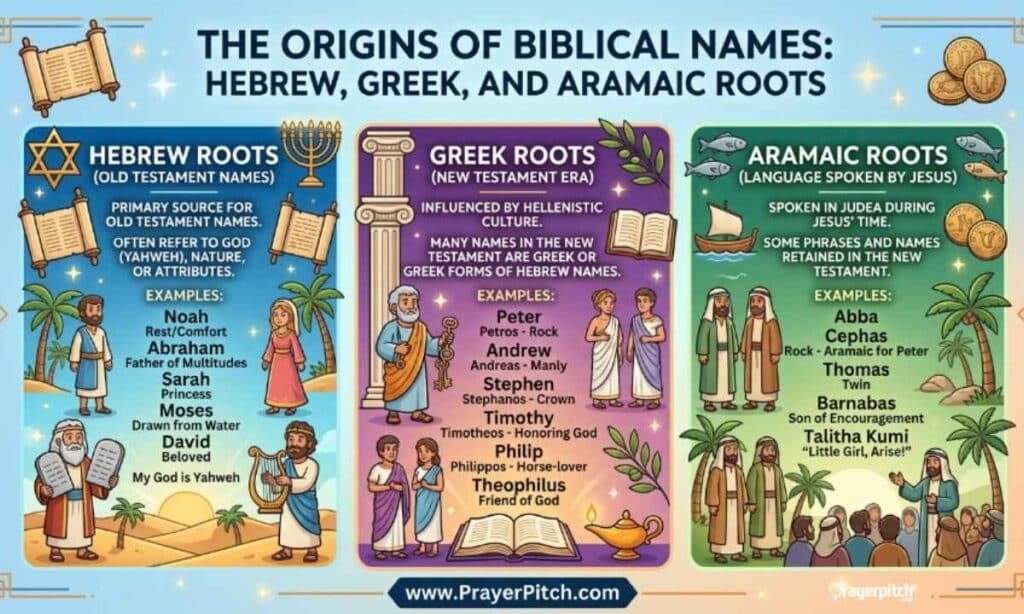
To truly understand biblical name meanings, you have to understand where the Bible comes from linguistically.
Wondering what the name Nolan means from a biblical perspective? Explore its origin, spiritual significance, and faith-based interpretation.
👉 https://prayerpitch.com/nolan-meaning-in-the-bible/
Hebrew Names (Old Testament)
The majority of names in the Hebrew Bible (Old Testament) come from — you guessed it — ancient Hebrew. These names are often descriptive and theophoric, meaning they contain a divine element.
Common Hebrew roots you’ll see in names include:
- El (אֵל) — meaning God, found in names like Elijah, Elisha, Samuel, Daniel, and Nathaniel
- Yah/Jah — a shortened form of Yahweh (God’s name), found in Isaiah, Jeremiah, Obadiah, and Josiah
- Ben — meaning son of, as in Benjamin (“son of the right hand”)
Here’s a quick reference table of common Hebrew roots:
| Root | Meaning | Example Names |
| El (אֵל) | God | Elijah, Elisha, Daniel, Samuel |
| Yah/Jah | Yahweh/Lord | Isaiah, Jeremiah, Zechariah |
| Ben | Son | Benjamin, Benaiah |
| Bar | Son of (Aramaic) | Barnabas, Bartholomew |
| Am | People/Nation | Ammon, Amos |
| Shalom | Peace | Solomon, Jerusalem (indirectly) |
Greek Names (New Testament)
The New Testament was written primarily in Koine Greek, which is why many New Testament names have Greek roots or are Greek versions of Hebrew names.
- Jesus is the Greek form of the Hebrew Yeshua (“God saves” or “salvation”)
- Philip comes from the Greek Philippos, meaning “lover of horses”
- Andrew derives from Andreas, meaning “manly” or “strong”
Explore the meaning of Stephanie in the Bible and learn how this beautiful name represents honor, victory, and God’s blessings.
👉 https://prayerpitch.com/stephanie-meaning-in-the-bible/
Aramaic Names
A smaller but fascinating category, Aramaic names appear especially in the Gospels:
- Thomas — from the Aramaic Ta’oma, meaning “twin”
- Martha — from Marta, meaning “lady” or “mistress of the house”
- Tabitha — meaning “gazelle” (also rendered as Dorcas in Greek)
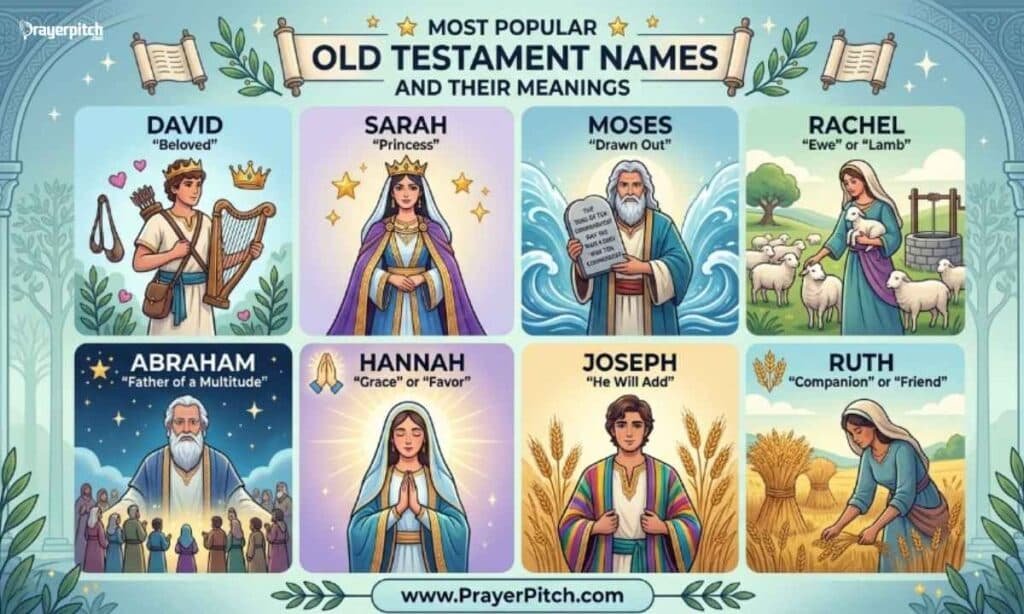
Most Popular Old Testament Names and Their Meanings
1. Adam — “Man” or “Earth”
The very first name in scripture is also one of the most enduring. Adam comes from the Hebrew adamah, meaning “earth” or “ground.” It’s a grounding (pun intended) reminder of human origin and humility.
Adam remains a top 50 baby name in many countries and carries with it the weight of origin — the start of the human story.
2. Noah — “Rest” or “Comfort”
Long before it became the #1 boy’s name in the United States, Noah was a Hebrew name meaning rest or comfort. From the root nuach, it evokes peace and steadiness. The story of Noah in Genesis connects the name to resilience, faith, and new beginnings after a storm — literally.
3. Abraham — “Father of Many Nations”
Possibly one of the most profound name transformations in scripture: Abram (“exalted father”) was renamed Abraham by God, meaning “father of a multitude.” It’s a name that carries covenant, promise, and legacy.
4. Sarah — “Princess” or “Noblewoman”
Also renamed in scripture (from Sarai), Sarah means “princess” or “lady of high rank.” It’s consistently one of the most popular Hebrew girl names globally — elegant, classic, and saturated with meaning.
5. David — “Beloved”
One of the most beloved names in history (we’re not sorry for that pun), David comes from the Hebrew root dod, meaning “beloved” or “uncle.” As the name of Israel’s greatest king and the author of many Psalms, it carries artistic and regal connotations.
6. Ruth — “Friend” or “Companion”
The Book of Ruth is one of the Bible’s most beautiful stories of loyalty and love. The name itself means “friend,” “companion,” or “vision of beauty.” Simple, timeless, and meaningful.
7. Elijah — “My God is Yahweh”
A fiery prophet with an equally fiery name — Elijah (Hebrew: Eliyahu) means “my God is Yahweh.” It’s a declaration of faith in one syllable-packed punch. No wonder it’s been in the US top 10 for years.
8. Miriam — “Beloved” or “Wished-for Child”
The sister of Moses, Miriam is often considered the origin of the name Mary and Maria. It likely derives from the Egyptian mry (beloved) combined with Hebrew influence. It’s one of the oldest female names still in active use today.
9. Solomon — “Peace”
From the Hebrew shalom (peace), Solomon means “man of peace.” As the wisest king in scripture, the name has always carried an air of wisdom, wealth, and gravitas.
10. Deborah — “Bee”
Yes, really — Deborah means “bee” in Hebrew. But don’t let that sting (we said what we said). In scripture, Deborah was one of the only female judges of Israel, making this a name that buzzes with strength, leadership, and purpose.
Learn the inspiring biblical perspective on the name Vanessa, including its meaning, symbolism, and faith-centered insights.
👉 https://prayerpitch.com/vanessa-meaning-in-bible/
Most Popular New Testament Names and Their Meanings
1. Jesus — “God Saves” or “The Lord is Salvation”
The most significant name in Christian scripture, Jesus is the Greek rendering of the Hebrew Yeshua or Yehoshua (Joshua). It means “God saves” or “Yahweh is salvation.” This name, above all others, carries theological and cultural weight across two millennia.
2. Mary — “Beloved” or “Bitterness”
Interestingly, the name Mary (from Miriam) has debated meanings. Some scholars trace it to the Hebrew mar (bitter) combined with yam (sea), yielding “drop of the sea” or “bitterness.” Others link it to “beloved” or “wished-for child.” Either way, it remains the most common female name in history.
3. John — “God is Gracious”
From the Hebrew Yochanan via Greek Ioannes, John means “God is gracious” or “Yahweh has shown favor.” It’s one of the most common names on Earth and has been for centuries — carried by apostles, kings, popes, and poets.
4. Peter — “Rock” or “Stone”
Jesus himself gave Simon the name Peter (Greek: Petros), meaning “rock” or “stone.” It was a prophetic name — one that defined the foundation of the early church. It’s also one of history’s most durable names.
5. Paul — “Small” or “Humble”
The apostle Paul’s name comes from the Latin Paulus, meaning “small” or “humble.” It’s a beautiful irony — one of the most prolific writers in Christian history bore a name meaning smallness.
6. Luke — “Light” or “Luminous”
From the Greek Loukas (possibly a shortened form of Lucanus), Luke is associated with light and luminosity. As the author of both the Gospel of Luke and Acts of the Apostles, the name carries a literary and spiritual brightness.
7. James — “Supplanter” or “He Who Follows”
James is the English form of the Hebrew Yaakov (Jacob), meaning “supplanter” or “one who grabs the heel.” Despite its slightly competitive etymology, it became one of the most royal and widely used names in history.
8. Thomas — “Twin”
As noted earlier, Thomas means “twin” in Aramaic. The apostle Thomas is famous for his doubt — but also for his profound confession of faith. The name is straightforward, grounded, and enduringly popular.
9. Matthew — “Gift of God”
From the Hebrew Mattityahu via Greek Matthaios, Matthew means “gift of God” or “gift of Yahweh.” It’s a beautiful name for any child, packed with divine gratitude in its very syllables.
10. Elizabeth — “My God is an Oath” or “Consecrated to God”
From the Hebrew Elisheba, Elizabeth means “my God is an oath” or “my God is abundance.” As the mother of John the Baptist and cousin of Mary, the name holds one of scripture’s most joyful cameos.
Discover the spiritual meaning of Kenneth and explore its origin, biblical associations, and timeless Christian significance.
👉 https://prayerpitch.com/kenneth-meaning-in-bible/
Rare and Underused Biblical Names Worth Reviving
Not every great biblical name makes it to the popular list. Here are some hidden gems:
| Name | Gender | Origin | Meaning |
| Zipporah | F | Hebrew | “Bird” or “Sparrow” |
| Malachi | M | Hebrew | “My messenger” or “My angel” |
| Kezia | F | Hebrew | “Cassia” (a fragrant spice) |
| Obadiah | M | Hebrew | “Servant of God” |
| Selah | F | Hebrew | “Pause” or “Reflect” (a musical term in Psalms) |
| Jethro | M | Hebrew | “Excellence” or “Abundance” |
| Tirzah | F | Hebrew | “She is my delight” |
| Amos | M | Hebrew | “Carried by God” |
| Naomi | F | Hebrew | “Pleasantness” or “Sweetness” |
| Thaddaeus | M | Aramaic/Hebrew | “Gift of God” or “Heart” |
These names are rare enough to feel distinctive but rooted enough to feel meaningful. If you’re looking for a biblical baby name that won’t be shared by five other kids in the class, this list is your treasure chest.
Want to know the biblical meaning of Luke? Explore its origin, scriptural significance, and the inspiring story behind the name.
👉 https://prayerpitch.com/luke-meaning-in-the-bible/
Biblical Names That Mean “Gift” or “Blessing”
Gift-related names are among the most popular categories of biblical names — and for good reason. Parents have always wanted to name children in ways that reflect joy and gratitude.
Here are biblical names that carry meanings of gift, blessing, or divine favor:
- Matthew — “Gift of God”
- Nathaniel / Nathan — “God has given”
- Jonathan — “God has given” (Hebrew: Yehonatan)
- Elnathan — “God has given”
- Zebedee — “My gift” (father of James and John)
- Isidore (Greek/Hebrew blend) — “Gift of Isis” but used in Christian tradition
- Dositheus — “Gift of God” (early church name)
- Tobias / Tobit — “God is good”
Biblical Names and Their Spiritual Significance
Beyond etymology, many biblical names carry prophetic or theological weight based on their story in scripture. The meaning of the name wasn’t just a label — in Hebrew culture, a name was a destiny.
Consider these remarkable name-story connections:
- Jabez — His name meant “pain” because his mother bore him in sorrow. Yet he prayed boldly and God expanded his territory (1 Chronicles 4:9–10). The name became synonymous with unlikely blessing.
- Ichabod — Meaning “the glory has departed,” this name was given in a moment of national tragedy (1 Samuel 4:21). It’s one of scripture’s most haunting names.
- Jesus / Yeshua — Named before birth by angelic announcement, explicitly tied to his mission: “He will save his people from their sins” (Matthew 1:21).
- Isaac — Meaning “laughter,” named because his elderly mother Sarah laughed when told she’d conceive. Every time she called his name, it was a reminder of a miracle.
These names aren’t just words. They’re compressed theology.
Learn the spiritual meaning of Samantha and explore its biblical significance, origin, and timeless message of faith.
👉 https://prayerpitch.com/samantha-meaning-in-bible/
How to Research Your Own Biblical Name Meaning?
If you want to dig into the meaning of your own name — or find a biblical name for a child — here are some practical steps:
- Start with the root language. Is the name from the Old or New Testament? Hebrew, Greek, or Aramaic?
- Look up the original-language spelling. Many English names are transliterations or translations of much older forms.
- Cross-reference multiple sources. Name etymology is sometimes debated — Hebrew scholars don’t always agree, so compare a few references.
- Consider the biblical character. The meaning of the name is enriched by the life and story of the person who bore it.
- Look for thematic patterns. Many biblical names cluster around themes: creation, war, peace, divine encounter, or family.
Biblical Name Meanings by Theme
Here’s a thematic breakdown to make choosing (or understanding) a name easier:
Names Meaning “Peace”
- Solomon — Peace
- Shiloh — Peaceful, tranquil
- Absalom — “Father of peace”
- Irene (Greek, New Testament context) — Peace
Names Meaning “Strength” or “Power”
- Samson — “Son of the sun” / strength
- Gideon — “Mighty warrior”
- Caleb — “Faithful” / whole-hearted
- Ethan — “Strong” or “enduring”
Names Meaning “Light” or “Brightness”
- Phoebe — “Bright” or “shining” (Romans 16:1)
- Zohar — “Brilliance” (Old Testament)
- Luke — “Light”
- Lucifer — Originally “light-bearer” (fallen angel, Isaiah 14:12)
Names Meaning “God is with us” or Divine Presence
- Emmanuel / Immanuel — “God with us”
- Elijah — “My God is Yahweh”
- Elisha — “My God is salvation”
- Gabriel — “God is my strength”
The Cultural Legacy of Biblical Names
Biblical names have shaped cultures far beyond the church. They’ve given us:
- Royal dynasties: James, Elizabeth, Mary, David — names carried by monarchs for centuries
- Literary giants: Ruth, Esther, Job — names evoking resilience and beauty in literature
- Global cross-cultural unity: In countries as different as Ethiopia, Norway, Brazil, and South Korea, you’ll find Sarahs, Noahs, and Davids
The Bible is, among many things, the world’s greatest naming book. It’s given humanity a shared vocabulary of identity.
5 FAQs About Biblical Name Meanings
FAQ 1. What is the most common biblical name still used today?
John (from Hebrew Yochanan, “God is gracious”) is widely considered the most common biblical name in use globally, found across virtually every culture and language.
FAQ 2. Do biblical names have to be religious to use?
Not at all — many people use biblical names for their beauty, cultural weight, or family tradition, completely independent of personal faith.
FAQ 3. What does the name “Jesus” actually mean?
Jesus comes from the Hebrew Yeshua, meaning “God saves” or “Yahweh is salvation” — a name given prophetically before his birth.
FAQ 4. Are there biblical names that mean “love”?
Yes — David (“beloved”), Jedidiah (“beloved of the Lord”), and Agabus (Greek root linked to love) are among the closest biblical names to the meaning of love.
FAQ 5. What is the oldest biblical name still used today?
Adam, from the Hebrew adamah (earth), is likely the oldest biblical name still commonly used — appearing in the very first chapters of Genesis and in baby name charts today.
Closing Statement
Biblical names are more than ancient relics — they are living words, carried by billions of people across the globe. Whether you’re drawn to the thunderous legacy of Elijah, the quiet grace of Hannah, or the hopeful simplicity of Noah, there’s a biblical name that speaks to something deeper than fashion.
Names from scripture have endured because they mean something. They anchor us, inspire us, and remind us that we are part of a story much bigger than ourselves. Choose one wisely — or simply appreciate the one you already carry.