

The Lord’s Prayer is the prayer Jesus gave his followers when they asked him how to pray. It appears twice in the New Testament: in Matthew 6:9–13, inside the Sermon on the Mount, and in a shorter form in Luke 11:2–4, where a disciple watches Jesus praying and asks to be taught. Many English speakers know it as the Our Father, or by its Latin name, the Pater Noster.
Most people meet this prayer long before they study it. It is said in churches on Sunday mornings, at weddings and funerals, and at the bedsides of children still learning the words. That familiarity is a gift, but it can also make the prayer slide past us. Phrases like “hallowed be thy name” and “lead us not into temptation” are recited far more often than they are understood.
This guide sets out what the prayer says and means: the biblical text alongside the traditional worship version, the setting in which Jesus taught it, a line-by-line walk through every petition, an honest comparison of Matthew and Luke, and practical ways to pray it. Where sincere Christians read a line differently, that difference is named rather than smoothed over.
What Is the Lord’s Prayer?
It is a short model prayer — roughly sixty words in the Greek of Matthew — that Jesus taught his disciples as a pattern for speaking to God. It carries his name not because he prayed it himself (it asks for forgiveness, which Christian teaching has never applied to him) but because he is the one who gave it.
The shape is deliberate. It opens with an address: God is Father, and he is in heaven. Then come petitions concerned with God himself — his name, his kingdom, his will. Only then does the prayer turn to human need: bread, forgiveness, testing, evil. Matthew’s form is traditionally counted as seven petitions, Luke’s as five.
Jesus offered it as a pattern and as a prayer. Matthew introduces it with an instruction to pray in this manner; Luke reports Jesus telling the disciples that when they pray, they should say these words. Christians have done both ever since.
The Lord’s Prayer: Full Text
There is no single official English wording, which surprises people who assume the version they grew up reciting is simply “the” prayer. What congregations say aloud is a traditional worship text with centuries of history behind it; what appears in a Bible is a translation of the Greek.
Matthew 6:9–13 (King James Version)
Our Father which art in heaven, Hallowed be thy name. Thy kingdom come. Thy will be done in earth, as it is in heaven. Give us this day our daily bread. And forgive us our debts, as we forgive our debtors. And lead us not into temptation, but deliver us from evil: For thine is the kingdom, and the power, and the glory, for ever. Amen.
The Traditional Worship Version
This is the wording carried into English-speaking worship through the Book of Common Prayer, and it is what most people recite from memory:
Our Father, who art in heaven, hallowed be thy Name; thy kingdom come; thy will be done, on earth as it is in heaven. Give us this day our daily bread. And forgive us our trespasses, as we forgive those who trespass against us. And lead us not into temptation, but deliver us from evil. For thine is the kingdom, and the power, and the glory, for ever and ever. Amen.
Two differences stand out. “Who” has replaced “which,” a change in ordinary English rather than in meaning. More noticeably, “debts” has become “trespasses,” a choice explained further down this page. Many churches now use a modern ecumenical wording agreed in the 1980s, which keeps the same structure in current English.
Luke 11:2–4 (King James Version)
Our Father which art in heaven, Hallowed be thy name. Thy kingdom come. Thy will be done, as in heaven, so in earth. Give us day by day our daily bread. And forgive us our sins; for we also forgive every one that is indebted to us. And lead us not into temptation; but deliver us from evil.
Open a recent translation, and Luke will look shorter than this. That is not an omission by modern editors; it reflects manuscript evidence discussed below. In the earliest copies, Luke opens simply with “Father,” asks for bread day by day, speaks of sins rather than debts, and ends at the petition about temptation.
Where Is the Lord’s Prayer Found in the Bible?
Both settings matter, because in each Gospel the prayer answers a question the surrounding passage has raised.
Matthew 6: Inside the Sermon on the Mount
The setting is the long block of teaching that runs from Matthew 5 through 7. Chapter 6 addresses three practices any devout Jewish listener would have recognised: giving to the needy (6:1–4), praying (6:5–15), and Jesus’ teaching on fasting (6:16–18). Each carries the same warning against doing it to be admired, and the same promise that the Father who sees in secret will reward.
Just before the prayer, Jesus warns against vain repetitions — piling up words in the belief that volume will be heard. Then comes the line that makes the model prayer make sense: your Father knows what you need before you ask him. If he already knows, why ask? Because prayer forms the person praying, and because a child asking a father is a relationship, not a transaction.
Luke 11: A Disciple Asks
Luke gives a different setting. Jesus is praying in a certain place, and when he finishes, a disciple asks him to teach them to pray, as John the Baptist had taught his own followers. These men had watched Jesus pray for years, and something about it made them want the same thing.
What follows in Luke is just as instructive. Jesus tells the story of a man banging on a friend’s door at midnight for bread, then gives the encouragement to ask, seek, and knock. Luke’s frame is persistence; Matthew’s is sincerity over performance. The prayer sits comfortably inside both.
Teachers in the ancient world taught the same material repeatedly, to different audiences. Two related accounts of a prayer Jesus almost certainly gave more than once is what we should expect — and it places this prayer among the other great prayers recorded in Scripture, most of which reach us through one writer’s account of one occasion.
The Meaning of the Lord’s Prayer, Line by Line
Read slowly, the prayer divides into two halves. The first is about God: his name, his kingdom, his will. The second is about us: our bread, our sins, our vulnerability. Nothing in the second half is trivial, but it arrives second.
“Our Father in Heaven”
The address does more work than any other line. God is named as Father before a single request is made: a child speaking to a parent, not a subject petitioning a distant authority.
Scripture has spoken of God as a father before — Israel is called God’s son, and the Psalms compare his compassion to a father’s. What the Gospels present as characteristic of Jesus is the ease with which he uses that address, and the fact that he hands it to ordinary people to use themselves. Mark preserves the Aramaic word Abba on his lips in Gethsemane (Romans 8:15 and Galatians 4:6 show believers using it too).
Then there is that first word: our. Not my Father. A person praying alone in the dark still says it in the plural, which quietly rules out the idea that faith is a private arrangement. It is also why this prayer sits naturally alongside praying on behalf of other people.
“In heaven” keeps the balance. Father speaks of nearness; heaven speaks of authority. Remove the first and prayer turns cold; remove the second, and it shrinks into something merely comforting.
“Hallowed Be Your Name”
“Hallowed” is an old word we now keep almost exclusively for this prayer. It means treated as holy, set apart, honoured as sacred. The petition asks that God’s name be held in the reverence it deserves.
In Hebrew, thought a name is not a label; it stands for the whole person — character, reputation, everything known about who someone is. So asking that God’s name be hallowed is asking that God himself be rightly known and honoured, first in the world and then, uncomfortably, in the one praying.
Notice where this petition falls: first. Before bread, before forgiveness, before protection. Worship leads, and requests follow, which is the exact reverse of how most of us pray when we are worried.
“Your Kingdom Come”
The kingdom of God in the Gospels is less a place than a reign — God’s rule being exercised and recognised. Jesus began his ministry announcing that this kingdom had come near, and much of his teaching describes what it looks like when that rule takes hold in ordinary lives.
So the petition looks two directions at once. It asks for the final completion of God’s rule, when everything broken is set right, and for that rule to advance now — in this street, this workplace, this household, this heart.
Praying it honestly has consequences: asking for God’s kingdom to come is also asking for our own small kingdoms of control and preference to give way. Christians differ on how much of that kingdom to expect in the present age, but nearly all agree the line commits the person praying to living as though it will be answered.
“Your Will Be Done”
Matthew adds the clause that gives the line its force: on earth as it is in heaven. Heaven is where God’s will is done without resistance. The prayer asks for the same conditions here.
This is often mistaken for fatalism, a shrug in religious clothing. That is not how Jesus prays it. In Gethsemane, he asks first for the cup to pass from him — a real request, honestly made — and only then submits. The wanting is spoken aloud before it is surrendered, which is permission for the rest of us to bring what we actually want to God before we say these words.
It also works as a compass. Anyone who has spent a season praying about God’s direction for their life knows the request rarely produces a detailed map. What it produces, prayed steadily, is a willingness to go wherever the answer points — usually the harder half of the problem.
“Give Us This Day Our Daily Bread”
The Greek word behind “daily” is genuinely unusual. It appears in the New Testament only here and in Luke’s parallel, and almost nowhere else in surviving Greek, leaving translators to work from the shape of the word rather than from established usage. The main possibilities are “necessary for existence,” “for today,” and “for the coming day.” Jerome found the problem awkward enough that he rendered it one way in Matthew and another in Luke.
What survives every reading is the modesty of the request. Not a storehouse, not next year’s security — bread, for today. There is an echo of the manna in Exodus 16, gathered one day at a time, with anything hoarded spoiling overnight.
“Bread” stands for ordinary physical need: food, shelter, the means to live. Some traditions also read a spiritual dimension here, connecting the petition to Christ as the bread of life or to the Eucharist, and treating the physical sense as primary does not require dismissing that. Notice the plural again — our bread, not mine.
“Forgive Us Our Debts”
Matthew uses the language of debt. Sin, in that image, is an obligation owed and unpaid — real, quantifiable, outstanding. Luke uses the more direct word for sins.
The English “trespasses” entered common use through William Tyndale’s sixteenth-century translation and was carried into worship by the Book of Common Prayer, which is why many congregations say “trespasses” while their Bibles say “debts.”
That this petition sits inside a daily prayer tells us something. Jesus assumed his followers would need forgiveness regularly — not once, at a decisive moment, but as part of the ordinary rhythm of speaking with God. You name what needs naming, you ask, and you go on.
“As We Forgive Our Debtors”
This is the line people trip on, and they are right to. The small word “as” ties the forgiveness we ask for to the forgiveness we extend. Matthew is the only Gospel writer to comment after the prayer, and this is the line he comments on: if you forgive others, your heavenly Father will forgive you; if you do not, he will not forgive yours (6:14–15).
Christians differ on precisely how this works. Some read it as a plain condition. Others read it as diagnosis — a heart that has received mercy will produce mercy. Both readings take the words seriously, and neither treats the line as optional.
It helps to be clear about what forgiveness is not. It is not pretending the harm was small, not automatic reconciliation, and not an obligation to restore trust to someone who has given no reason for it. It is releasing your claim to repayment — which takes time, and praying this line while still working through a serious betrayal is often less a declaration of success than a statement of intent.
“Lead Us Not Into Temptation”
One Greek word does double duty here, covering both temptation and testing, and that is the source of nearly every question this line raises. The most common one is fair: would God lead anyone into temptation at all? The letter of James states plainly that God tempts no one.
Two readings carry most weight. The first takes the word as trial: a request not to be brought into a testing that would break us — the concern Jesus voices when he tells the disciples to watch and pray so that they do not enter into temptation. The second reads it as a request for protection from yielding. Many Christians pray it meaning something of both.
The debate is not merely academic. In 2017, the French Catholic bishops adopted wording along the lines of “do not let us enter into temptation,” and the revised Italian missal approved in 2019 uses a phrase closer to “do not abandon us to temptation.” The German bishops decided against a similar change, and English-speaking churches have kept the traditional wording. Those were decisions about liturgical translation, not edits to the biblical text.
“Deliver Us From Evil”
The Greek phrase can be read as “from evil” in general or as “from the evil one.” Both are grammatically available, and translators have gone both ways — many modern versions choose the personal reading, while the traditional English wording keeps the broader one. The parallel in John 17, where Jesus asks the Father to keep his followers from the evil one, supports the personal reading without settling it. And the verb matters as much as the noun: this is rescue language, being pulled out of something rather than kept at a distance from it.
For most people, this line is not theoretical. It gets prayed during illness, in unsafe homes, in situations no one chose — the same seasons in which many believers reach for more specific prayers for God’s protection.
“For Thine Is the Kingdom, and the Power, and the Glory”
This closing line, the doxology, is where the traditional worship version and many modern Bibles part company — and readers who notice often assume something has been removed from Scripture.
Here is what happened. The earliest surviving manuscripts of Matthew do not include the doxology; it appears in a large body of later ones, so most modern translations print the prayer without it and add a footnote. But the line is ancient. A short form appears in the Didache, an early Christian handbook usually dated to the late first or early second century.
The wording echoes David’s prayer in 1 Chronicles 29, which ascribes greatness, power, and glory to the Lord. Catholic practice separates the doxology from the prayer during Mass; most Protestant congregations say it straight through. Saying it is not adding to Scripture, and omitting it is not subtracting from it.
Why Is the Lord’s Prayer So Important to Christians?
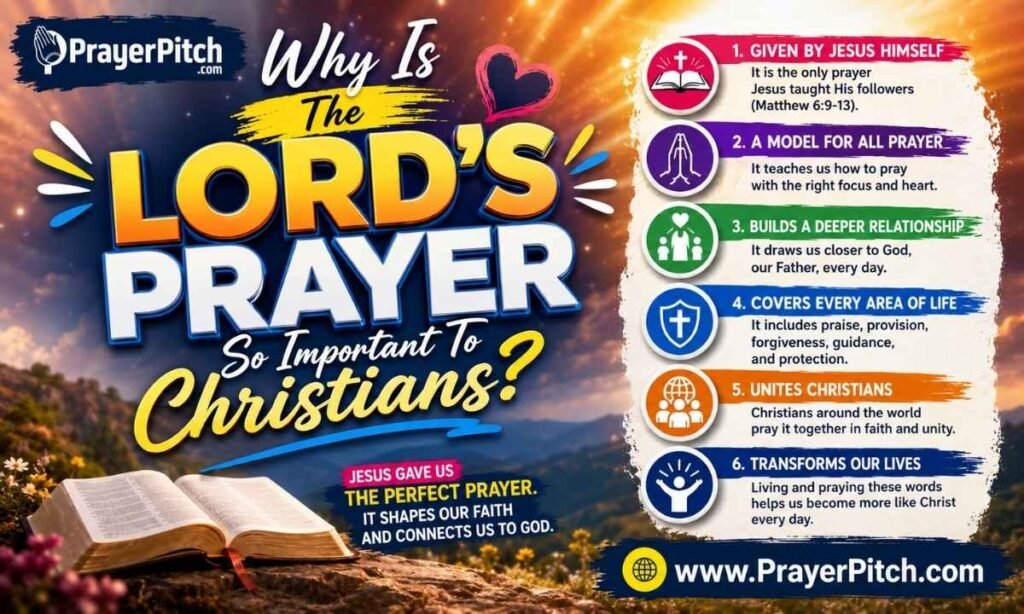
The obvious reason is its source. Of everything Christians pray, this is the one text Jesus explicitly handed over as a model.
Its reach matters too. This is one of the very few things nearly all Christians say in common — Catholic, Orthodox, Anglican, Baptist, Pentecostal, Methodist, Presbyterian. A visitor who knows no one in the room can usually join in.
There is also how much it carries. In a few lines it names God as Father, holds his holiness and his kingdom together, teaches dependence for daily needs, ties divine forgiveness to human forgiveness, and admits that people who pray still face testing and evil. The early church taught it to new believers preparing for baptism.
Then there is the practical value that only becomes obvious under pressure. Grief, panic, and exhaustion strip away the ability to compose words, and a memorised prayer keeps working when improvisation fails.
What Does the Lord’s Prayer Teach Us About Prayer?
Taken as a pattern rather than a script, this prayer quietly corrects several instincts most of us bring to prayer.
- Start with God, not with the crisis. Three petitions pass before a single human need is mentioned — a reordering of attention that changes how the requests are made.
- Keep it short. Jesus rules out the idea that God is persuaded by volume of words. The model prayer is around sixty words. Brevity is not a lack of seriousness.
- Pray in the plural. Every petition is corporate. Even alone, you are praying as part of a people and asking for things other people need too.
- Ask for enough, today. The bread petition sets the scale of ordinary asking — genuine need, on a short horizon, brought regularly.
- Tell the truth about sin. Confession is built into the daily pattern, not reserved for special occasions or moments of collapse.
- Let your prayer touch your relationships. What you do with the person who wronged you is prayer business, not a separate department of life.
- Expect to need protection. The closing petitions assume ongoing exposure to testing and evil, and treat asking for help as normal rather than as a sign of weak faith.
One principle sits underneath all of these. Because the Father already knows what we need, prayer is not an information exchange. It is time spent with someone, and the person most changed by it is usually the one praying.
How to Pray the Lord’s Prayer
There are two good ways to use it, and neither cancels the other.
The first is to pray it as it stands. Slowly. Out loud if you can, because hearing your own voice stops the words from running together into a blur. Sixty words take about twenty seconds at a rushed pace and closer to a minute if you let each line land.
The second is to use it as a framework — praying each line, then filling it in with your own words before moving on. That turns a one-minute recitation into ten or fifteen minutes of substantial prayer. A worked example:
- Our Father in heaven — pause. Say who you are speaking to, and what it means today that he is a Father and not a stranger.
- Hallowed be your name — pause. Name something about God you are actually grateful for this morning. Specific beats general.
- Your kingdom come — pause. Pray for one situation that badly needs God’s rule: a country, a church, a family, a decision in front of you.
- Your will be done — pause. Bring the thing you want most right now. Ask for it plainly, then hand it over.
- Give us this day our daily bread — pause. Ask for what today actually requires — including money, work, health, and the people who depend on you.
- Forgive us our debts — pause. Name what you did and left undone. Say it in the singular here; this part is yours.
- As we forgive our debtors — pause. Name the person. If you cannot yet release it, say that honestly and ask for help with it.
- Lead us not into temptation — pause. Name the pressure you know is coming this week, before it arrives.
- Deliver us from evil — pause. Ask for protection for yourself and for people you love who are somewhere you cannot reach.
A few practical notes. If your mind wanders, go back to the last line you remember rather than starting over. If one petition takes the whole time, let it. And if you are teaching a child, one line a night works better than the whole thing at once.
Praying it in company is worth doing too. It is one of the few prayers a group can say together without a leader, which makes it useful at a graveside or in a hospital room where nobody feels able to pray aloud alone — the same reason another widely memorised prayer gets reached for in hard moments.
The Lord’s Prayer for Daily Prayer and Reflection
The Didache’s instruction to pray it three times a day suggests the earliest Christians treated it as a rhythm rather than an occasional set piece. Some concrete ways it fits into ordinary life:
In the morning, it works as a frame before the day fills up. Pray it once at normal speed to settle, then again slowly, stopping at the bread petition to think through what the day actually requires — or pair it with a short prayer to open the morning.
In the evening, the emphasis shifts. The forgiveness petitions do the work of an examination of conscience: what happened today, what needs confessing, who needs forgiving. The closing petitions carry into the night, alongside an evening prayer before sleep.
With family, its brevity is the point. Children can learn it a line at a time, and the plural pronouns give everyone something to do — one person adds a name at “give us this day,” another at “deliver us from evil.” Households already keeping a list of things they pray for as a family can slot those requests into the relevant petitions.
Over a week, one petition a day for seven days is an old and useful practice. It slows the prayer down enough that lines you have said ten thousand times start saying something back.
A word of caution about repetition. Jesus warned against empty phrases, and any prayer said daily can slide into background noise. The remedy is small deliberate changes: say it aloud, pray a different translation for a month, or add a sentence of your own after each line. The prayer works by being meant, not by being said.
Matthew 6 vs. Luke 11: What Is the Difference?
Readers usually meet this question by accident — they know the prayer from church, read Luke, and find it shorter than expected.
- The setting. Matthew presents the prayer as part of a sermon to a crowd, in a teaching on giving, prayer, and fasting. In Luke it is a private answer to a disciple’s direct request.
- The address. Matthew has the full “Our Father in heaven.” The earliest manuscripts of Luke have simply “Father.”
- The will petition. Matthew includes “your will be done, on earth as it is in heaven.” It is absent from the earliest text of Luke.
- The bread petition. Matthew asks for bread “this day”; Luke asks “day by day,” a slightly more continuous phrasing.
- Sin language. Matthew says debts and debtors throughout. Luke asks forgiveness for sins, then speaks of everyone indebted to us — keeping the debt image in the second half.
- The ending. Matthew includes “deliver us from evil,” followed in the traditional text by the doxology. In the earliest manuscripts, Luke ends at the temptation petition.
Why does the King James Version of Luke look so much fuller? Because it rests on later Greek manuscripts. Copyists who knew Matthew’s wording by heart sometimes brought Luke into line with it. Modern translations work from earlier manuscripts and print the shorter Luke with footnotes recording the longer readings — following the older evidence, and saying so.
Do the differences amount to a contradiction? Not on any ordinary reading. Jesus travelled and taught for years, and no teacher delivers core material once. Matthew and Luke also write for different readerships and shape their accounts accordingly. Every petition in Luke appears in Matthew, and the two agree on structure, order, and substance.
Traditional and Modern Versions of the Lord’s Prayer
If the wording you know does not match the wording in your Bible, the explanation is usually one of five things.
- Which Greek text lies underneath. Translations based on later manuscripts include the doxology in Matthew and a fuller Luke; those based on earlier manuscripts do not.
- The age of the English. Thee, thou,u and art were ordinary English when the earliest widely used versions were made. Modern translations use current English; worship often keeps the older forms because congregations know them by heart.
- Liturgical inheritance. The version most people recite comes from the Book of Common Prayer tradition rather than directly from any one Bible translation. That is why it can differ slightly from every Bible on the shelf.
- Translation choices within a tradition. Debts, trespasses and sins all render the same idea. Reformed and Presbyterian churches have generally kept debts; Anglican, Catholic and Methodist worship has favoured trespasses; several modern ecumenical texts use sins.
- Language and denomination. Every language has made its own choices, some of them recently, as the French and Italian revisions of the temptation petition show.
One clarification is worth stating plainly, because it causes a good deal of confusion. The version recited in most churches is a traditional worship text, not a direct quotation of any single modern translation. Compare it word for word against your own Bible, and small differences are expected rather than alarming.
Common Questions About the Lord’s Prayer
What is the Lord’s Prayer?
It is the model prayer Jesus taught his disciples, recorded in Matthew 6:9–13 and Luke 11:2–4. It moves from worship of God to requests for daily needs, forgiveness, and protection.
Who taught the Lord’s Prayer?
Jesus taught it — in Matthew as part of the Sermon on the Mount, and in Luke in answer to a disciple asking to be taught to pray. It carries his name because he gave it, not because he prayed it for himself.
Why does the prayer say “Our Father” rather than “My Father”?
Because the prayer was given to a community, not an individual. Praying it always involves other people, which is part of what the words are teaching.
What does “hallowed be your name” mean?
To hallow something is to treat it as holy. The petition asks that God be honoured for who he is — in the world, and by the person praying.
What does “daily bread” mean?
It refers to the ordinary provision a person needs to live, asked for daily rather than stockpiled. The unusual Greek word behind “daily” suggests what is necessary for existence, or for the coming day.
What does “lead us not into temptation” mean?
It is usually read one of two ways: as a plea to be spared trials heavy enough to break us, or as a plea not to give way when temptation arrives. Scripture is clear elsewhere that God himself tempts nobody.
Why do some Bibles leave out “for thine is the kingdom”?
It is missing from the oldest copies of Matthew we have and present in many later ones, so translators usually move it to a footnote. Its use in worship goes back to the earliest Christian centuries.
Is it “debts,” “trespasses,s” or “sins”?
All three are in use, and all carry the same meaning. Which one you say depends on the translation your church follows and on the wording it inherited from English worship.
Can the Lord’s Prayer be used as a daily prayer?
Yes — early Christians prayed it several times a day. It works both as a prayer recited in full and as a framework you pause within to pray in your own words.
A Prayer That Keeps Teaching
What makes this prayer remarkable is how much it holds without ever becoming heavy. It is short enough for a child to learn and deep enough that people who have prayed it for fifty years still find new things in it. It asks for God’s kingdom and God’s will before anything else, requests bread for one day, forgiveness for real sins and rescue from real dangers — and ties our forgiveness to our willingness to forgive, the one line most of us would probably have left out.
You do not need to master it before using it. Say it word for word when you have nothing else; use it as a framework when you have more time; let it correct the order of your praying when worry pushes your own needs to the front. The differences between Matthew and Luke, between debts and trespasses, between one tradition and another, are worth understanding — but none of them stands between you and praying it tonight.
Whatever else is uncertain, this much is not: Jesus was asked how to pray, and this is what he said. That is a good enough reason to keep saying it, slowly, until the words start meaning what they say.

3 thoughts on “The Lord’s Prayer: Meaning, Text, History & How to Pray It”