

These Bible verses about God’s love, grace, and human worth aren’t just encouraging words for difficult days. They reveal the heart of God and the incredible truth of how He sees you. As you read them, may you be reminded that your identity is not found in what you do, but in whose you are.
You matter—not because of what you’ve achieved, how you look, or what others think of you, but because you were created by God. In a world that often ties value to success, popularity, or performance, Scripture offers a much deeper and more lasting truth: your worth is rooted in God’s love for you.
Why God’s Love Defines Our Worth?
Many of us spend a large part of our lives trying to prove that we’re worthy. We work harder, seek approval, and look for validation from other people, hoping that achievement or acceptance will finally make us feel enough. But the Bible presents a completely different perspective. According to Scripture, your worth is not something you have to earn—it is something God gave you from the very beginning.
Biblical self-worth isn’t built on self-confidence, success, or personal accomplishments. It’s built on the unchanging truth of who God says you are. Throughout Scripture, God calls His people chosen, loved, and wonderfully made. These aren’t empty words meant to make us feel better for a moment; they are powerful truths about our identity in Him.
When we begin to see ourselves through God’s eyes, our perspective changes. The pressure to constantly compare ourselves to others starts to fade. Feelings of inadequacy lose their power. The exhausting pursuit of trying to prove our value becomes less important because we realize our value has already been established by our Creator.
At the heart of this truth is God’s incredible love. His love is not based on our performance, our past mistakes, or our ability to get everything right. It is a faithful, pursuing love that reaches for us even when we fall short. And when we truly understand that kind of love, it changes the way we see ourselves, the way we treat others, and the way we live each day.
What the Bible Says About God’s Unconditional Love?
The phrase “God’s unconditional love” is one we hear often, but it’s far more than a comforting idea. Throughout the Bible, God’s love is shown through His actions. It’s the love of a father who eagerly welcomes home a child who has wandered far away. It’s the love of a shepherd who goes searching for one lost sheep, refusing to give up until it is found. And it’s the love that led God to send His Son into the world—not because the world was perfect, but because it desperately needed saving.
In the New Testament, this kind of love is often described by the Greek word agape. Unlike love that depends on feelings or circumstances, agape is steadfast, sacrificial, and deeply committed. It is a love that chooses to remain faithful even when things are difficult. It isn’t limited to our best moments; it reaches us in our weakest ones as well.
This truth is especially important because many people unknowingly live with the pressure of trying to earn God’s approval. We may feel that if we prayed more, served more faithfully, or made fewer mistakes, then God would love us more. But Scripture tells a different story. God’s love does not begin when we finally get everything right. It begins with Him.
Romans 5:8 reminds us that God demonstrated His love for us while we were still sinners. In other words, His love came first. Before we could prove ourselves, before we could clean up our lives, and before we could earn anything, God chose to love us. That truth frees us from striving and invites us to rest in the grace and acceptance that He offers.
Bible Verses About God’s Love for Every Person
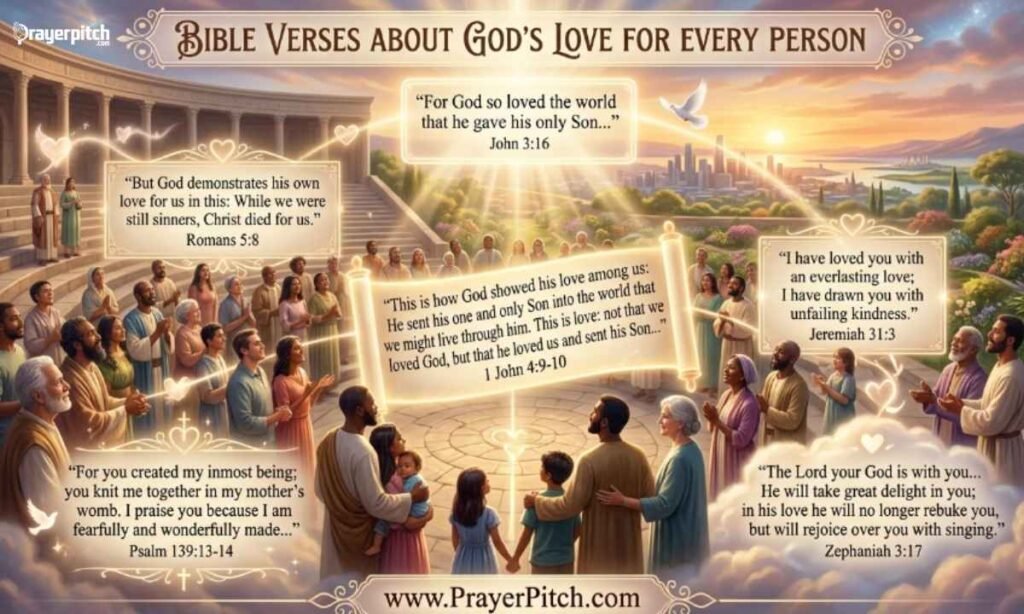
The Bible doesn’t speak about God’s love as a distant concept or a vague feeling. Instead, it reveals a love that is personal, intentional, and deeply committed. These verses remind us that God’s love is not reserved for a select few—it reaches every person and invites each of us into a relationship with Him.
John 3:16 tells us that God’s love was so great that He gave His only Son so that everyone who believes in Him can have eternal life. Romans 5:8 takes that truth even further by showing that Christ died for us while we were still sinners. God didn’t wait for us to become perfect before loving us. He loved us first.
Jeremiah 31:3 paints a beautiful picture of God’s enduring affection: “I have loved you with an everlasting love; I have drawn you with unfailing kindness.” Unlike human love, which can be inconsistent or conditional, God’s love remains steady through every season of life.
In 1 John 4:9–10, we see the clearest definition of love found in Scripture. Love is not merely our attempt to reach God—it is God’s decision to reach us. He demonstrated that love by sending His Son so that we could have life through Him.
Then there is Zephaniah 3:17, a verse that often stops readers in their tracks. It describes God as a mighty Savior who delights in His people and rejoices over them with singing. Think about that for a moment. The Creator of the universe doesn’t simply put up with you or reluctantly accept you. He delights in you.
For anyone who has ever felt overlooked, unwanted, or unworthy, this truth is powerful. God’s love is not cold or distant. It is warm, personal, and full of joy. He sees you, knows you completely, and still chooses to love you. That is the kind of love these verses invite us to embrace—a love that never fails and never lets go.
Bible Verses About Grace and God’s Unmerited Favor
Grace is one of the most beautiful truths in the Bible, yet it’s often misunderstood. Many people think of grace as simply getting another chance after making a mistake. While that’s certainly part of it, biblical grace goes much deeper. Grace is God’s undeserved favor—His kindness, mercy, and love freely given to people who could never earn it on their own.
At the heart of the Christian faith is the reality that salvation is not something we achieve through good behavior, religious performance, or personal effort. It is a gift from God. Ephesians 2:8–9 makes this clear, reminding us that we are saved by grace through faith, not by our own works. In other words, God’s love for us is not based on what we can do for Him but on what He has already done for us.
Romans 3:23–24 highlights another important truth: every person has fallen short of God’s perfect standard, yet God freely offers justification through His grace. None of us are excluded from the need for grace, and none of us are beyond its reach.
Grace also sustains us in everyday life. In 2 Corinthians 12:9, God tells Paul, “My grace is sufficient for you, for my power is made perfect in weakness.” This verse reminds us that grace is not only for salvation; it is also the strength God provides when we feel overwhelmed, discouraged, or inadequate. When our own strength runs out, His grace remains.
Hebrews 4:16 invites believers to approach God’s throne with confidence, knowing that mercy and grace are available whenever they are needed. We do not have to hide our struggles or pretend to have everything together. God welcomes us into His presence and offers help in our moments of weakness.
Titus 2:11 adds another encouraging reminder: God’s grace has appeared and offers salvation to all people. Grace is not reserved for those who seem spiritually strong or have lived perfect lives. It is available to everyone.
That’s what makes grace so powerful. It reaches people in their failures, doubts, and brokenness. It welcomes the person who has drifted away from faith. It comforts the one carrying guilt from the past. It reminds those who feel unworthy that God’s love is greater than their mistakes. Grace does not wait for us to become perfect before it meets us. It finds us where we are and gently leads us toward where God wants us to be.
Bible Verses About Your Identity and Worth in God’s Eyes
One of the most liberating things you can do is replace the world’s definition of your worth with God’s. The world bases worth on productivity, appearance, and social capital. God bases it on creation and covenant.
| What the World Says | What God Says |
| You’re only as good as your last achievement | You are made in the image of God (Genesis 1:27) |
| Your value depends on who approves of you | You are chosen and dearly loved (Colossians 3:12) |
| Your past defines your future | You are a new creation in Christ (2 Corinthians 5:17) |
| You need to earn belonging | You’ve been adopted as God’s child (Romans 8:15) |
One of the most powerful questions we can ask is, “Who does God say I am?” The answer matters because the way we see ourselves shapes the way we live. While the world often defines identity by achievements, appearance, relationships, or social status, the Bible points us to something far more secure—our identity in God.
These verses reveal how God sees His people and remind us of the incredible value He has placed on every human life.
Genesis 1:27 tells us that we were created in the image of God. This means that every person carries inherent dignity, worth, and value simply because they were created by Him. Our worth is not something we earn; it is something woven into us by our Creator.
In 1 Peter 2:9, believers are described as a chosen people, a royal priesthood, and God’s special possession. These words remind us that we are not forgotten or overlooked. God has called us, set us apart, and invited us to reflect His light in the world.
Romans 8:15–16 offers another beautiful truth: through Christ, we are adopted into God’s family. We are not distant strangers trying to earn His approval. We are His children, welcomed into a loving relationship with our Heavenly Father. Because of this, we can approach Him with confidence, knowing we belong to Him.
Colossians 3:12 describes believers as God’s chosen people who are holy and dearly loved. Notice that before Paul talks about how Christians should live, he reminds them who they are. Their identity comes first. They are already loved by God, and their actions flow from that secure foundation.
Then, in 2 Corinthians 5:17, we are given the promise of transformation. Anyone who is in Christ is a new creation. The mistakes of the past, the labels placed on us by others, and the burdens we once carried no longer define us. Through Christ, a new life begins.
These verses are more than encouraging statements to read once and forget. They are truths meant to shape the way we think about ourselves every day. When doubt creeps in, they remind us that we are created in God’s image. When we feel insignificant, they remind us that we are chosen and loved. When shame tries to define us, they remind us that we are made new in Christ.
The more we embrace these truths, the more our identity becomes rooted in what God says about us rather than what the world says about us.
Bible Verses That Remind Us We Are Wonderfully Made

Few passages in the Bible speak as personally about human worth as Psalm 139. In this beautiful chapter, David reflects on a God who knows every detail of our lives—our thoughts, our struggles, our strengths, and even our beginnings before anyone else knew we existed. It’s a powerful reminder that we are fully seen, fully known, and deeply loved by our Creator.
Psalm 139:13–14 paints a picture of God’s intimate involvement in our creation: “For you created my inmost being; you knit me together in my mother’s womb.” These words remind us that our lives are not random or accidental. God was at work long before we took our first breath, carefully forming us with purpose and intention. David’s response is one of worship: “I praise you because I am fearfully and wonderfully made.”
This same message echoes throughout Scripture. In Isaiah 43:4, God speaks tenderly to His people, calling them precious, honored, and loved. Imagine hearing those words from the Creator of the universe. They reveal a God who does not view people as insignificant but as deeply valuable in His sight.
Psalm 8:4–5 expresses a sense of wonder that God, despite His greatness, chooses to care for humanity. David marvels that God is mindful of us and has crowned us with glory and honor. It’s a reminder that our worth comes not from our accomplishments but from the attention and affection God gives us.
Isaiah 64:8 uses another powerful image: God as the potter and His people as the clay. This picture reveals a Creator who works with care, skill, and purpose. A potter doesn’t randomly throw clay together. Every curve, detail, and design is shaped intentionally. In the same way, God has formed each life with meaning and purpose.
For anyone who has ever struggled with feelings of inadequacy, rejection, or insignificance, these verses offer hope. They remind us that we are not here by chance. We are known by God, loved by God, and crafted by His hands. Our value does not come from what we achieve or how others see us. It comes from the simple but profound truth that we belong to the One who created us.
When you read these passages, remember that they are more than beautiful words on a page. They are God’s declaration that your life matters, that you are intentionally made, and that you are treasured by Him.
Bible Verses About Loving Others as God Loves Us
One of the clearest messages throughout the Bible is that God’s love is never meant to stop with us. When we truly understand how deeply God loves us, it naturally changes the way we treat the people around us. Receiving God’s grace and compassion should inspire us to extend that same grace and compassion to others.
This connection between loving God and loving people is woven throughout Scripture. In the Old Testament, God’s people were instructed to love their neighbors as themselves. Jesus later reinforced this truth, making love the defining mark of His followers. The apostle Paul also devoted significant attention to what genuine, Christ-centered love looks like in everyday life.
In John 13:34–35, Jesus gave His disciples a powerful command: “Love one another. As I have loved you, so you must love one another.” Notice that Jesus didn’t simply tell His followers to love others according to their own standards. He pointed to His own example. The love He demonstrated was patient, sacrificial, forgiving, and unwavering—even toward those who misunderstood, abandoned, and rejected Him.
First John 4:19 reminds us where this love begins: “We love because he first loved us.” Our ability to love others flows from experiencing God’s love ourselves. We are not asked to manufacture love from our own limited strength. Instead, we respond to the love we have already received from Him.
Jesus summarized God’s priorities in Matthew 22:37–39 when He said that the greatest commandments are to love God wholeheartedly and to love our neighbors as ourselves. These two commands are inseparable. A growing relationship with God should produce a growing love for people.
Perhaps the most detailed description of biblical love is found in 1 Corinthians 13:4–7. Here, love is described as patient, kind, humble, forgiving, and enduring. It doesn’t seek its own advantage or keep a record of wrongs. This kind of love goes far beyond emotion. It is a daily choice to treat others with grace, respect, and compassion.
Romans 12:10 adds another practical challenge by encouraging believers to be devoted to one another and to honor others above themselves. In a culture that often promotes self-interest and competition, this kind of love stands out.
Following Jesus means learning to love as He loved. That doesn’t mean we’ll do it perfectly. There will be moments when patience runs thin, forgiveness feels difficult, and compassion doesn’t come naturally. But God’s love continually calls us higher. The more we understand how much we have been loved by Him, the more willing we become to show that love to others.
In the end, love is more than a feeling—it is evidence of a transformed heart. And according to Jesus, it is one of the clearest ways the world recognizes His followers.
Bible Verses About Unity, Compassion, and Human Dignity
The Bible’s message about worth and value extends far beyond the individual. While Scripture teaches that each person is uniquely loved and created by God, it also emphasizes the dignity and value of every human being. From beginning to end, the Bible reminds us that all people are made in God’s image and therefore deserve to be treated with respect, compassion, and honor.
This truth challenges us to look beyond the labels and divisions that often separate people. Differences in background, ethnicity, social status, culture, or life experiences may shape who we are, but they do not determine our value in God’s eyes.
One of the clearest examples of this is found in Galatians 3:28. In a society deeply divided by class, ethnicity, and gender, Paul declared that those who belong to Christ are united in Him. His words pointed to a new identity that transcends the barriers people often build between one another. While human differences still exist, they no longer define a person’s worth before God.
Acts 17:26 reinforces this idea by reminding us that all nations and peoples ultimately share a common origin. Every person is part of God’s creation and exists within His sovereign plan. This truth leaves little room for prejudice, superiority, or discrimination.
The book of James takes the conversation even further. James 2:8–9 warns against showing favoritism and calls believers to love their neighbors as themselves. Genuine faith, according to Scripture, cannot be separated from the way we treat others. When we value people based on status, appearance, or personal advantage, we move away from God’s heart for humanity.
Micah 6:8 offers a simple but powerful summary of what God desires from His people: to act justly, love mercy, and walk humbly with Him. Justice and mercy are not optional virtues reserved for a select few; they are part of the lifestyle God calls His followers to embrace.
Similarly, Philippians 2:3–4 encourages believers to reject selfish ambition and instead consider the needs of others. In a culture that often prioritizes self-promotion, this passage invites us to practice humility, kindness, and genuine concern for those around us.
Together, these verses paint a beautiful picture of how God intends people to live. They remind us that human dignity is not earned through success, wealth, influence, or social standing. It comes from being created and loved by God. Because every person bears His image, every person has value.
When we truly embrace this biblical perspective, it transforms the way we see and treat others. Compassion becomes more than a feeling. Kindness becomes more than a good habit. Caring for people, seeking justice, extending mercy, and showing respect become natural responses to the truth that every life matters to God.
In a world often divided by differences, these passages call believers to reflect God’s heart by recognizing the worth, dignity, and humanity of every person they encounter.
How to Apply These Bible Verses to Daily Life?
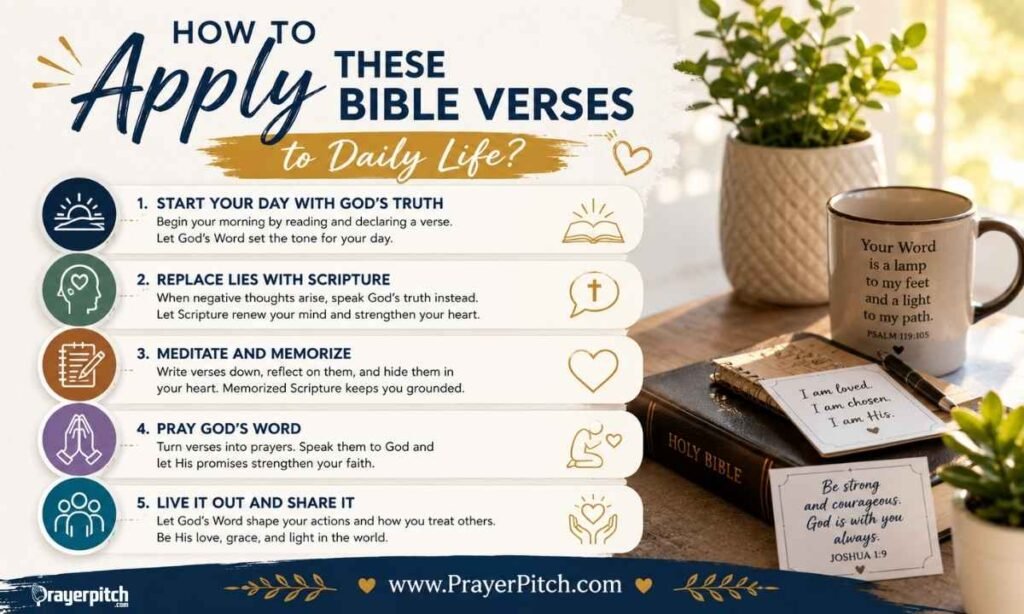
Reading Bible verses about God’s love, grace, and human worth can be deeply encouraging, but their real impact comes when we allow those truths to shape the way we live. It’s one thing to know what Scripture says; it’s another thing to believe it, embrace it, and apply it to everyday life.
Here are a few practical ways to make these biblical truths part of your daily walk with God:
1. Begin Each Day with God’s Truth
The way you start your morning often influences the rest of your day. Before checking notifications, emails, or social media, spend a few moments reflecting on a verse that reminds you of who you are in Christ. Verses like Psalm 139:14 or Zephaniah 3:17 can help set your mind on God’s love and purpose for your life before the distractions of the day begin.
2. Replace Negative Thoughts with Scripture
Everyone experiences moments of self-doubt, insecurity, or discouragement. When those thoughts arise, don’t let them have the final word. Turn to God’s Word and remind yourself of what He says about you. If you find yourself dwelling on past mistakes or feelings of inadequacy, meditate on verses such as 2 Corinthians 5:17, which reminds believers that they are a new creation in Christ. The goal isn’t to ignore your feelings but to ground them in truth.
3. Focus on God’s Perspective Instead of the World’s
The world often measures worth through success, appearance, popularity, or achievement. Scripture tells a different story. Take time to identify the messages you frequently hear—or tell yourself—and compare them with what God’s Word says. As you regularly meditate on biblical truth, your mindset begins to shift from seeking approval from others to finding security in God’s love.
4. Turn Bible Verses into Personal Prayers
One of the simplest ways to deepen your connection with Scripture is to pray it back to God. Instead of merely reading a verse, personalize it in prayer. Thank God for His love, His grace, and His promises. This practice helps move biblical truth from something you know intellectually to something you genuinely experience in your relationship with Him.
5. Share God’s Love with Others
The truths found in these verses are not meant to stay with us—they are meant to flow through us. As you grow in your understanding of God’s love and grace, look for opportunities to extend that same love to the people around you. A kind word, an act of compassion, forgiveness, encouragement, or simply treating others with dignity can reflect God’s heart in powerful ways.
Ultimately, the goal is not just to read these verses but to allow them to transform the way you think, speak, and live. The more you remind yourself of God’s love, grace, and the value He has placed on your life, the more those truths become a steady foundation for every season you face.
A Prayer of Gratitude for God’s Love and Grace
Heavenly Father,
Thank You for loving me with a love that never changes. Thank You that my worth is not determined by my successes, failures, or the opinions of others, but by the simple truth that I belong to You. Long before I took my first breath, You knew me, formed me, and loved me completely.
Lord, when I struggle with doubt or feel unworthy, remind me of what Your Word says about me. Replace every lie with Your truth. Help me to see myself through Your eyes—as someone who is deeply loved, chosen, and created with purpose. When shame, fear, or insecurity try to take hold, let Your grace speak louder than my doubts.
Teach me to rest in Your love instead of striving for approval. Help me trust that Your grace is enough, even when I feel weak or imperfect. May the truth of Your promises sink deep into my heart so that I not only understand them but truly believe them.
Father, help me extend the same love and kindness to others that You have shown to me. Give me a compassionate heart, a patient spirit, and a willingness to see the value and dignity in every person I meet. Let my words and actions reflect Your love in a world that desperately needs it.
Today, I choose to rest in the confidence that I am fearfully and wonderfully made, dearly loved, and securely held in Your hands. Thank You for never leaving me, never giving up on me, and never stopping Your work in my life.
In Jesus’ name,
Amen.
Frequently Asked Questions About God’s Love and Human Worth
1. What does the Bible say about human worth?
The Bible teaches that human worth is rooted in being made in the image of God (Genesis 1:27) and is not earned through achievement or behavior. Every person carries inherent dignity simply by virtue of being God’s creation.
2. Which Bible verse best describes God’s unconditional love?
Romans 5:8 is widely considered the clearest expression: “While we were still sinners, Christ died for us.” It captures that God’s love acts toward us even at our worst — not after we’ve cleaned up.
3. How does God’s grace affect our identity?
Grace redefines identity by removing the burden of self-justification. Ephesians 2:8–9 makes clear that salvation — and by extension, our standing before God — is a gift, not a trophy, which frees us to receive our identity rather than construct it.
4. Why is Psalm 139 important for understanding our worth?
Psalm 139 is deeply personal, describing God’s intimate knowledge of each individual before birth. The declaration that we are “fearfully and wonderfully made” directly challenges any belief that our existence is accidental or insignificant.
5. What does Galatians 3:28 teach about unity in Christ?
Galatians 3:28 teaches that human divisions — ethnic, social, and gender-based — don’t define ultimate worth or belonging in God’s family. In Christ, every believer shares equal standing, which makes the Church a powerful witness to human dignity and unity.
Conclusion: Resting in God’s Love, Grace, and Purpose
As you reflect on these Bible verses, one message shines through again and again: God’s love for you is real, constant, and unchanging. From Genesis to Revelation, Scripture tells the story of a God who creates, pursues, forgives, restores, and values His people beyond measure.
Life will still bring challenges. There will be seasons of uncertainty, moments of doubt, and days when you struggle to see your own worth. But the truth of God’s Word remains steady through it all. Your value is not determined by your circumstances, your achievements, or the opinions of others. It is rooted in the One who created you and calls you His own.
The beautiful message of grace is that you don’t have to earn God’s love or prove that you deserve it. Through Christ, you are invited into a relationship with Him, welcomed with open arms and loved with an everlasting love. His acceptance is not based on perfection but on His faithfulness.