

Seven short prayers, seven moments of Christ’s suffering, and one quiet question at the heart of it all: how much did He give, and how will I answer that love? The 7 Prayers of St Bridget of Sweden, often called the “12-year prayers,” invite Christians to walk slowly through the seven times Jesus shed His blood, from His circumcision as an infant to the soldier’s lance on Calvary. Many people first encounter the devotion in a small prayer booklet or a shared post, and they arrive with honest questions about what it is, where it came from, and whether you can trust its famous promises.
This guide answers those questions plainly. Below you will find the structure of the seven prayers, the Scripture behind each one, a short history of St Bridget herself, a careful look at the promises and what the Catholic Church has actually said about them, and practical help for praying with a sincere heart. The aim is not to sell a formula. It is to help you pray well.
What Are the 7 Prayers of St Bridget of Sweden?
The 7 Prayers of St Bridget are a traditional Catholic devotion built around the seven sheddings of Christ’s Precious Blood. Each “prayer” is usually one Our Father and one Hail Mary, offered in honor of a specific moment in the life and Passion of Jesus:
- The Circumcision
- The Agony in the Garden of Gethsemane
- The Scourging at the Pillar
- The Crowning with Thorns
- The Carrying of the Cross
- The Crucifixion
- The Piercing of His Side
Most booklets open the set with a short introductory prayer, expressing the wish to pray the Our Father seven times in union with Jesus’ love. Each Our Father is then followed by a brief offering that names the wound being honored, and the set often closes with a prayer to the Precious Blood.
The purpose is meditation. Rather than racing through words, the devotion slows a person down so they can stand, in faith and imagination, beside Christ at each moment. It belongs to the same tradition of Passion devotion that produced the Stations of the Cross and the Sorrowful Mysteries of the Holy Rosary. Christians pray it to grow in gratitude, to make reparation for sin, or to give daily prayer a steady shape, and its recurring themes are suffering, mercy, repentance, love, and hope.
Versions differ: the offering lines vary between booklets, and some add the Glory Be. It is also easily confused with the Fifteen Prayers of St Bridget, a separate one-year devotion with a similar history of controversy over its promises.
One point matters for honesty. Popular literature says Christ revealed this devotion to St Bridget. That claim belongs to devotional tradition, not documented history, and no clear source for the seven prayers or their promises has been identified in her recorded Revelations. It is fairest to call them prayers attributed to St Bridget.
Who Was St Bridget of Sweden?
St Bridget (Birgitta) was born in 1303 at Finsta, near Uppsala, into a devout noble family closely connected to the Swedish royal house. As a young teenager, she married Ulf Gudmarsson, a nobleman who later governed an important district. Their marriage lasted about twenty-eight years and produced eight children, one of whom became St Catherine of Sweden.
After Ulf died in 1344, Bridget gave herself to prayer and penance and founded the Order of the Most Holy Saviour, known today as the Bridgettines. In 1349 she left Sweden for Rome, never to live in her homeland again. From Rome she wrote to popes and rulers and cared for the poor. She died in Rome on July 23, 1373, and was canonized in 1391 by Pope Boniface IX. Her feast is kept on July 23.
Bridget is remembered above all as a mystic. Her visions, later gathered as the Revelations, return again and again to the Passion of Christ and the sorrows of the Virgin Mary, and her vivid accounts shaped Christian art and devotion for centuries. That focus on the suffering Christ is the main reason later Passion devotions came to carry her name.
In 1999, Pope John Paul II named her a co-patroness of Europe in his apostolic letter Spes Aedificandi. In it, he made a careful point worth remembering: the Church recognized her holiness “without ever pronouncing on her individual revelations.” Honoring the saint is not the same as endorsing every prayer or promise later linked to her name.
The 7 Prayers of St Bridget of Sweden
The heart of each prayer is the Our Father and the Hail Mary, two of the oldest and most universally approved prayers in the Church. Their texts are given below, followed by the seven meditations. For a line-by-line look at the first, see our guide to the Lord‘s Prayer.
A note on the offering lines: the short dedication after each Our Father is worded differently across booklets, and no single version can be shown to be original or authoritative. So rather than presenting one booklet’s text as historical, each section names the traditional focus and gives a suggested offering in plain words, written for this guide. Use it, use your parish booklet’s wording, or speak in your own words. For each of the seven, pray one Our Father and one Hail Mary, then the offering.
The Our Father
Our Father, who art in heaven, hallowed be thy name; thy kingdom come, thy will be done on earth as it is in heaven. Give us this day our daily bread, and forgive us our trespasses, as we forgive those who trespass against us; and lead us not into temptation, but deliver us from evil. Amen.
The Hail Mary
Hail Mary, full of grace, the Lord is with thee. Blessed art thou among women, and blessed is the fruit of thy womb, Jesus. Holy Mary, Mother of God, pray for us sinners, now and at the hour of our death. Amen.
The Glory Be (optional, used in some versions)
Glory be to the Father, and to the Son, and to the Holy Spirit, as it was in the beginning, is now, and ever shall be, world without end. Amen.
Prayer 1: The Circumcision
Suggested offering: Heavenly Father, I offer You the first drops of blood Your Son shed as a newborn child. Teach me to give You my life from its very beginning, holding nothing back.
Scripture: Luke 2:21, where Jesus is circumcised on the eighth day and named.
Theme: obedience and humility. Meditate on how early His self-giving began, long before Calvary, and offer God the small, hidden parts of ordinary life.
Prayer 2: The Agony in the Garden
Suggested offering: Lord Jesus, I honor Your agony in Gethsemane, when Your sweat fell like drops of blood. Give me the courage to say “Your will be done” when I am afraid.
Scripture: Luke 22:44, where His sweat becomes like great drops of blood as He prays in anguish.
Theme: surrender. The suffering here is interior: fear, sorrow, and loneliness while His friends slept. It honors the struggle of choosing God’s will when every instinct pulls the other way.
Prayer 3: The Scourging at the Pillar
Suggested offering: Merciful Father, look on the wounds Your Son received under the scourge, and by them heal what sin has broken in me and in the world.
Scripture: John 19:1 and Matthew 27:26, where Pilate has Jesus scourged.
Theme: reparation and healing. Christian tradition has long linked the scourging with Isaiah’s words that we are healed by His stripes. It is a natural place to bring personal weaknesses honestly before God.
Prayer 4: The Crowning with Thorns
Suggested offering: Eternal Father, I offer You the crown of thorns pressed onto the head of Your Son. Humble my pride and purify my thoughts.
Scripture: Matthew 27:29 and John 19:2, where soldiers crown Him with thorns and mock Him as king.
Theme: humility. The King of heaven accepted a crown of mockery. This meditation turns to the mind: pride, resentment, the need to be right, and the quiet ways we crown ourselves.
Prayer 5: The Carrying of the Cross
Suggested offering: Lord Jesus, I walk with You on every step beneath the cross. Help me carry my own burdens patiently and help others carry theirs.
Scripture: John 19:17, where He goes out bearing His cross, and Luke 23:26, where Simon of Cyrene is made to help.
Theme: perseverance and compassion. Simon’s role makes this a good moment to remember people who are struggling, and to ask how you might be a Simon for someone today.
Prayer 6: The Crucifixion
Suggested offering: Father, I offer You the wounds in the hands and feet of Jesus, nailed to the cross for love of us. Let me never forget the price of my redemption.
Scripture: Luke 23:33–34, the crucifixion at Calvary and His prayer of forgiveness for those who crucified Him.
Theme: sacrifice and forgiveness. This is the center of the devotion. His words from the cross make it a fitting time to forgive others and to receive forgiveness yourself.
Prayer 7: The Piercing of His Side
Suggested offering: Most Precious Blood of Jesus, flowing with water from His pierced Heart, wash me in mercy and draw me close to that Heart.
Scripture: John 19:34, the soldier’s spear and the flow of blood and water.
Theme: mercy. The Church Fathers often saw in the blood and water a sign of the sacraments, especially Baptism and the Eucharist. The devotion ends not with death but with an open heart, a quiet sign that mercy is always available.
What Are the Promises of the 7 Prayers of St Bridget?
Devotional booklets commonly print five promises, presented as words of Christ to St Bridget, for anyone who prays the seven prayers daily for twelve years. In general terms, the list says such a person would be spared Purgatory, be counted among the martyrs, see certain relatives kept in or brought to grace, and know of their death in advance.
A few things are important to understand:
- They are devotional claims, not Church teaching. No Church document teaches that reciting a set of prayers for a fixed period secures any of these outcomes.
- Their origin is uncertain. They are attributed to a private revelation, but they have not been traced to a reliable source in St Bridget’s recorded Revelations.
- The Church has warned about promises of this kind. In 1954, the Holy Office (today the Dicastery for the Doctrine of the Faith) warned that the supernatural origin of promises printed in a pamphlet of St Bridget’s Fifteen Prayers was uncertain, and told bishops not to permit their publication. That warning named the Fifteen Prayers, not the seven, but the same caution reasonably applies to the very similar promises attached to the 12-year prayers.
- They can mislead about salvation. Catholic teaching holds that salvation is a gift of grace, received in faith and lived out through conversion, love, and the sacraments. No one can lock in an outcome for themselves or their loved ones by a method.
None of this makes the prayers themselves suspect. The most faithful approach is to pray for love of Christ and leave the outcome to God. If the promises first drew you in, there is no shame in that; simply let your motive grow into something deeper than a contract.
Those hoping to pray for the eternal rest of loved ones can do so freely and with confidence, without leaning on a guaranteed formula. Our collection of prayers for the soul to rest in peace offers words for exactly that intention.
How to Pray the 7 Prayers of St Bridget
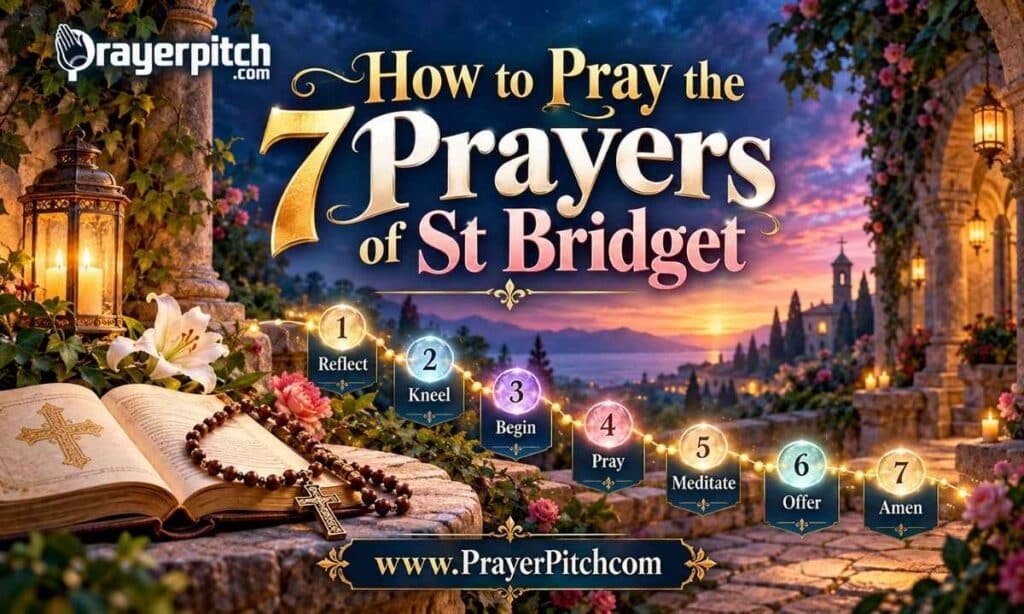
The devotion takes about ten minutes, but how you pray matters far more than how long.
Prepare your heart. Pause for a moment of silence, make the Sign of the Cross, and ask the Holy Spirit to help you pray with attention. Briefly calling your sins to mind fits the devotion’s themes of mercy and repentance.
Find a quiet place. A corner of your room or a church after Mass both serve well, and a crucifix in front of you helps focus attention.
Choose a consistent time. Many people fold the prayers into an existing routine, alongside short morning prayers or at the end of the day. Linking the devotion to a time you already pray makes it far easier to keep.
Read slowly. Before each Our Father, name the moment you are honoring and picture it, then read its Scripture passage.
Pray with meaning, not mechanics. Jesus warned against empty, repetitive praying (Matthew 6:7). If your mind wanders, gently return. If one wound moves you, stay with it. The words are a doorway, not a checklist.
End with gratitude. Close with a word of thanks, a prayer to the Precious Blood, or a Glory Be. In the evening, the devotion makes a peaceful close to the day.
Stay humble. If you miss a day, do not panic or assume you must start over. God is not keeping a ledger against you. Simply resume in peace.
How Long Should You Pray the 7 Prayers of St Bridget?
Traditionally, the devotion is tied to daily recitation for twelve years, which is why it is called the “12-year prayer.” That number comes from the same devotional tradition as the promises. It is not a requirement of the Church.
People approach the time frame in different ways:
- Long-term daily prayer. Some commit to the full twelve years as a personal discipline, much as someone might commit to a daily Rosary.
- Seasonal practice. Others pray it during Lent, Holy Week, or July, the month traditionally dedicated to the Precious Blood. It pairs naturally with a season of fasting and prayer.
- Occasional meditation. Some return to it on Fridays or whenever they want to sit with the Passion.
Each is legitimate. Consistency matters because it shapes the heart over time, but the value lies in the relationship it builds, not in reaching a number. Treating prayer as a transaction, words in exchange for a guaranteed result, misses the point; the tradition at its best invites steady, loving attention to Christ that slowly changes how we live.
Spiritual Meaning of the Seven Prayers
At its core, the devotion is about love: the love of Christ made visible in His suffering, and the answering love of the one who prays.
The circumcision and the agony teach humility and surrender. Before the cross, Jesus accepted human weakness and wrestled honestly with fear, which gives us permission to bring our own fears to God rather than hide them.
The scourging and the crowning with thorns speak of repentance. They invite an honest look at sin, not to wallow in guilt but to see what mercy has covered. For anyone carrying regret, these prayers for forgiveness of sins can help put that repentance into words.
The carrying of the cross brings perseverance and compassion. Faith does not remove burdens; it teaches us how to carry them and how to help carry others’.
The crucifixion and the pierced side reveal sacrifice and mercy. They answer the question every person eventually asks, “Does God really love me?” with a cross and an open heart.
Running through all seven is gratitude, and beneath the sorrow there is always hope, because the Passion does not end on Good Friday. The wounds this devotion honors are the same wounds the risen Christ showed to Thomas. Holding all of it together is faith: trust that this suffering was for us, even on days when prayer feels dry.
Bible Verses That Relate to St Bridget’s Prayers
Beyond the Gospel passages tied to each wound above, these verses (King James Version) capture the devotion’s central themes:
- Isaiah 53:5: “With his stripes we are healed.” Christians have long read this prophecy of the suffering Servant in light of the Passion, especially the scourging.
- Romans 5:8: Christ died for us while we were still sinners. The prayers do not earn love; they respond to love already given.
- Hebrews 9:22: Without the shedding of blood there is no remission of sins, which is why tradition gives such attention to the Precious Blood.
- 1 Peter 2:24: Christ bore our sins in His own body on the tree, so that we might live to righteousness, linking His wounds to our healing and new life.
- Psalm 51:17: “A broken and a contrite heart, O God, thou wilt not despise.” David’s prayer of repentance captures the humble heart the devotion asks for.
- Philippians 2:8: He humbled Himself and became obedient unto death, the humility that runs from the first prayer to the last.
- 1 John 1:7: “The blood of Jesus Christ his Son cleanseth us from all sin.” A fitting verse to close the devotion.
Scripture is full of honest prayer, and our guide to powerful prayers in the Bible explores many examples.
Are the 7 Prayers of St Bridget Approved by the Catholic Church?
The saint is approved. St Bridget is canonized, and the Church holds her up as a model of holiness as a wife, mother, foundress, and mystic.
The core prayers are approved. The Our Father comes from Jesus Himself, and the Hail Mary is among the Church’s most used prayers. Praying them in honor of the Passion fits squarely within Catholic tradition.
Her revelations are private revelations. The Catechism of the Catholic Church (paragraph 67) teaches that private revelations, even recognized ones, do not belong to the deposit of faith or complete what God revealed in Christ. Catholics may find them helpful but are not bound to believe them.
The promises are a separate matter. They have not been approved, and the 1954 warning shows the Church’s caution toward guarantees of this kind. This guide could verify no papal endorsement or indulgence specific to the seven prayers, so be wary of booklets or websites claiming otherwise without a clear citation.
For questions about a particular booklet, ask your parish priest, and read primary sources such as the Catechism and Vatican documents for yourself.
Who Can Pray This Devotion?
Anyone drawn to Christ’s Passion can pray this devotion. It is rooted in Catholic tradition, but its two main prayers are loved by Christians of many traditions, and its meditations come straight from the Gospels. No enrollment or special permission is needed.
It suits busy parents, commuters, the sick who cannot manage longer prayers, and anyone getting ready for Confession, where it pairs well with a prayer before confession. It can be prayed alone or in a group, for your own intentions or for someone else.
No single devotion is a test of faithfulness, though. If these prayers help you love Christ more, keep them. If another form of prayer serves you better, that is no failure.
Frequently Asked Questions About the 7 Prayers of St Bridget
What are the 7 Prayers of St Bridget of Sweden?
A traditional Catholic devotion of seven Our Fathers and seven Hail Marys, each honoring one of the seven times Jesus shed His blood. Tradition attributes it to St Bridget.
What are the promises of the 7 Prayers of St Bridget?
Booklets list five promises for twelve years of daily prayer, such as freedom from Purgatory and grace for relatives. They are not Church teaching, and the Church has urged caution toward such claims.
How long should you pray the 7 Prayers of St Bridget?
Tradition links them to twelve years of daily prayer, but the Church sets no required period. Pray them for as long as they draw you closer to Christ.
Can I pray the 7 Prayers of St Bridget every day?
Yes, in about ten minutes a day. Missing a day is no failure; simply pick up again.
What is the purpose of the 7 Prayers of St Bridget?
To meditate on Christ’s Passion and respond with love, gratitude, and repentance. It is a path to deeper prayer, not a formula for guaranteed results.
Are the 7 Prayers of St Bridget officially approved?
The Our Father and Hail Mary are, and meditating on the Passion is encouraged. The attached promises are not, so ask your priest about any specific booklet.
Can I pray these prayers for someone else?
Yes. Offering prayer for others is an ancient Christian practice; simply name the person as you begin and leave the outcome to God.
What Bible verses relate to the prayers of St Bridget?
Each wound has a Gospel source, such as Luke 22:44 for the agony and John 19:34 for the pierced side. Isaiah 53:5 and 1 John 1:7 echo the themes of healing and cleansing.
Conclusion
At their best, the 7 Prayers of St Bridget of Sweden are not about counting years or collecting promises. They are about learning to look at Jesus, really look, at each moment He gave His blood for love of us. Seven Our Fathers and seven Hail Marys become seven small acts of attention: to His humility as a child, His anguish in the garden, His wounds, His mockery, His burden, His death, and His opened heart. Whether you pray them for twelve years, through a single Lent, or only on Fridays, the invitation is the same. Come slowly. Come honestly. Bring your sins, your fears, and the people you love. Trust that God’s mercy is larger than any formula, and let gratitude grow where it will. The devotion bears its best fruit not in what it promises, but in the person you slowly become by praying it.